For New York mayors visiting the State Capitol to make their annual budget pleas to lawmakers, the experience can be trying, if not humbling.
For Zohran Mamdani, the former state assemblyman who was elected mayor of New York City last year, his inaugural trip to Albany on Wednesday for what is known as “Tin Cup Day” was no different.
Mr. Mamdani, like his predecessors, urged his former legislative colleagues to account for the city’s abundant needs, as well as the growing gap between how much the city received from the state versus how much it contributed in taxes. He asked for more consideration, more funds and more cooperation to enable him to fulfill his mandate to make the city more affordable.
For the most part, the mayor’s entreaties were greeted politely, but skeptically.
He soon found himself in the same position as many mayors before him: defending details of the city budget, the pace of trash pickup and whether or not school lunches were adequately appetizing.
In other words, the honeymoon that attends any new mayor, particularly one as charismatic and popular as Mr. Mamdani, appeared to be coming to its natural end.
“It’s mid-February,” said State Senator John Liu, a relatively early supporter of Mr. Mamdani’s mayoral campaign, after the mayor used part of his opening statement to blame his predecessor, Eric Adams, for the city’s budget shortfall. “So I will respectfully say that the time for blaming past mayors and governors is past.”
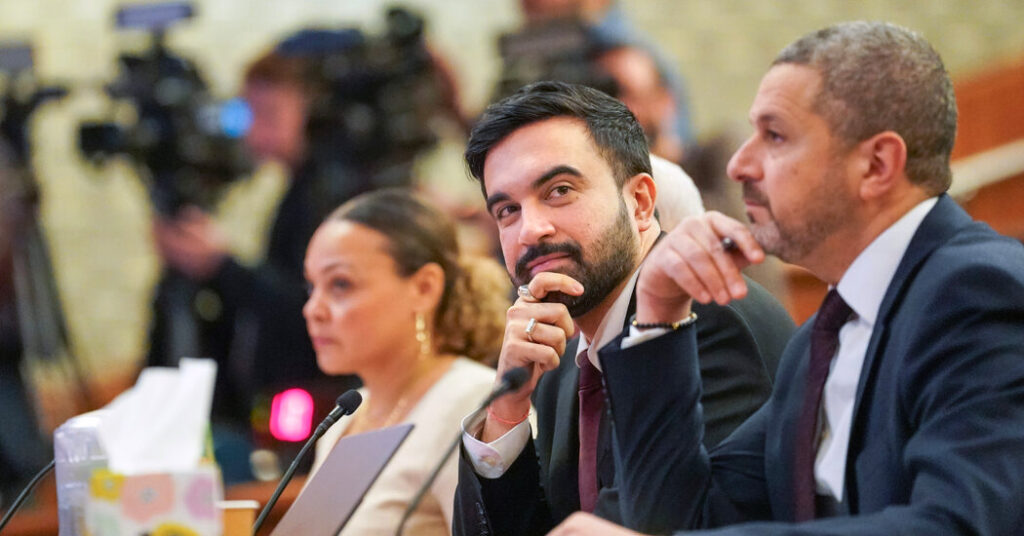
Mr. Mamdani began the morning by shaking hands with each lawmaker on the dais, Democrat and Republican, and exchanging pleasantries and jokes. The tone remained cordial throughout his testimony, which went on for nearly five hours (give or take a few stolen bathroom breaks).
There were many shared laughs and flashes of Mr. Mamdani’s charm. There were also moments of tension, including over some of his budget assertions, with lawmakers from both parties expressing skepticism about his desire to raise taxes on wealthy New Yorkers.
Mr. Mamdani argued that New York City had given the state too much for too little in return — a situation that he argued had shortchanged the five boroughs.
“For years, New York City has been treated not as an engine of shared prosperity, but as a resource to be drained,” Mr. Mamdani, 34, said. He identified several potential fixes, including tapping into a large statewide pot of money that the city has historically been excluded from, and raising taxes on the wealthy.
But others noted the tension between Mr. Mamdani’s demand to tax the rich and his opposition to the state’s reliance on its wealthiest city for tax revenue.
“We make more, we have more, so we should get more,” summarized Assemblyman Pat Burke of Buffalo, who chairs the Committee on Cities. “I think that’s a bad argument.”
Mr. Mamdani insisted that there was no need to view state fund allocations as a zero-sum game, arguing again for raising taxes on the rich. To that end, Mr. Mamdani asked for a 2 percent raise on New Yorkers earning more than $1 million a year — an amount he said would be easily covered by the savings wealthy people would see on their federal taxes, following President Trump’s tax cut. Such a tax, the mayor said, would raise $4 billion per year to help the city close looming budget gaps.
Gov. Kathy Hochul, who would have to sign off on any tax increase, has vowed not to raise rates as she campaigns for re-election.
Others noted that New York State had an unusually high tax burden and warned that New York City was already losing finance jobs to other states.
In her testimony, Jodi Giglio, a Republican assemblywoman, pressed Mr. Mamdani on how he would address the issue, asking, “What are you going to do to stop the exodus?”
Mamdani officials insisted that there had been no loss in the share of high earners.
Ms. Giglio was unmoved. “They’re leaving,” she said, before leaving the hearing room herself immediately after her testimony.
Roughly a dozen Republicans skipped their party’s state convention in Garden City on Long Island, where Bruce Blakeman received the nomination for governor, choosing instead to stay in Albany for the opportunity to grill Mr. Mamdani under oath.
Of those, the most scathing attacks came from Assemblyman Ari Brown, who unleashed a drumbeat of criticism, beginning with the deaths of New Yorkers during the recent cold snap. When he began to interrogate Mr. Mamdani over well-worn accusations of antisemitism, refusing to let Mr. Mamdani answer, Democratic lawmakers stepped in.
The exchange grew so heated that Assemblyman J. Gary Pretlow of Westchester reprimanded Mr. Brown, telling him to stick to budgetary issues.
One budget controversy centered on Mr. Mamdani’s revising the city’s budget shortfall to $7 billion over two years, down from $12 billion. As recently as two weeks ago, the mayor had cited the $12 billion figure — which matched an estimate from the city comptroller — as ammunition for his push to get the state to raise taxes on corporations and the wealthy.
Mr. Mamdani said the revised figure assumed “an aggressive posture on savings,” reserves and updated forecasts that included gains from Wall Street bonuses at the end of last year.
Andrew Rein, president of the Citizens Budget Committee, said Mr. Mamdani’s revised budget narrative was hewing “closer to reality.” But Mark Levine, the city comptroller, expressed doubt about the mayor’s new estimate, even as he acknowledged that new revenues would diminish the gap.
Even before Mr. Mamdani’s appearance on Wednesday, the mayor has already cleared some of the hurdles he was projected to face in Albany.
In her executive budget, Ms. Hochul proposed extending mayoral control of New York City schools with no strings attached, enabling Mr. Mamdani to avoid a fight that had proven difficult for previous mayors (and a fight in which Mr. Mamdani, a former critic of mayoral control, did not seem particularly invested).
The mayor has also already won Ms. Hochul’s partial support of his campaign vow of universal child care. The governor has proposed spending $4.5 billion, more than a third of it in new funding that will expand access across the state. A large portion of that money could allow New York City to enroll children as young as 2 years old within four years.
Mr. Mamdani testified for more than four hours, thanks to the constant flood of lawmakers from across the state eager to question him. He seemed awe-struck that he was no longer one of the many asking questions for precisely three minutes, and was now the focus of the questioning.
“It is an honor to sit on the other side of the dais today,” he said at the outset of his testimony. “It’s quite strange, and it’s hard to believe that I have a whole 10 minutes for this testimony.”
Grace Ashford covers New York government and politics for The Times.
The post Mamdani Finds Allies, and Skeptics, in Albany as He Asks for Funding appeared first on New York Times.