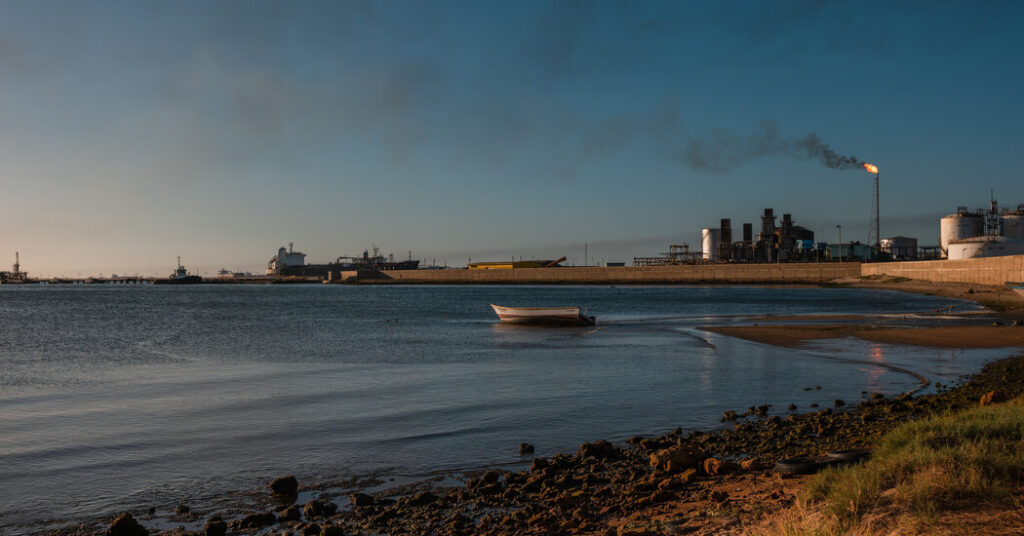
Congressional Democrats are escalating their efforts to ensure more oversight of hundreds of millions of dollars in Venezuelan oil proceeds being controlled by the Trump administration in what they say is an unregulated and opaque arrangement susceptible to corruption.
Top Senate Democrats introduced legislation on Wednesday calling on the White House to submit to independent accounting of the funds and their uses after lawmakers unsuccessfully pressed Cabinet officials for justification for the administration’s approach. Democrats said their goal was to force the administration to close offshore accounts holding the money and instead use domestic financial institutions that would be subject to congressional oversight.
They said President Trump’s plan for the money, which he asserted in a social media post last month would be “controlled by me,” was his latest attempt to make an end run around Congress and the law.
“The American people deserve to know what’s happening with the money received from these Venezuelan oil payments and where — and to whom — they are going,” said Senator Chuck Schumer, Democrat of New York and the minority leader, who proposed the measure along with Senator Adam B. Schiff, Democrat of California.
He added, “There is no reason that Trump should be circumventing the U.S. banking system and lining the pockets of his big oil buddies rather than driving down costs for hard-working Americans.”
The legislation comes after Democratic members of the House and Senate were not satisfied with explanations from administration officials about how they were handling the supervision and disbursement of as much as $500 million in proceeds from the sale of Venezuelan oil under U.S. authority. Officials said the money is being held in a Qatari account.
During recent testimony before the Senate Foreign Relations Committee, Secretary of State Marco Rubio framed the approach as an emergency arrangement to avert chaos and ensure stability through a transition period after the United States removed Venezuela’s leader, Nicolás Maduro. Mr. Rubio repeatedly promised that audits would be conducted, but he acknowledged that major elements of the arrangement were still being established.
Mr. Rubio’s assurances were thrown into doubt just days later during a House hearing with Treasury Secretary Scott Bessent. Mr. Bessent said he was not aware of a finalized agreement governing the Venezuelan oil funds and confirmed that no audit agreement was in place. When asked repeatedly under what statutory authority the Treasury Department was exercising custody and control over the money, Mr. Bessent cited the International Emergency Economic Powers Act but struggled to explain how it applied. He promised to “get back” to lawmakers with a written explanation.
Democrats who participated in the hearings said it appeared there was no legal underpinning for how the administration was collecting, banking or disbursing the money.
“Neither I nor any of my colleagues have any idea under what legal authority the United States is claiming title to the sovereign assets of another country,” said Representative Sean Casten, Democrat of Illinois, who questioned Mr. Bessent on the issue. He noted that comparable cases of the United States seeking to control foreign oil, such as in Iraq, were backed by congressional authorization and U.N. Security Council approval.
Senator Brian Schatz, Democrat of Hawaii, also raised questions about the legality of the system after he questioned Mr. Rubio.
“It is not obvious to me that they have permission to just establish an overseas account,” Mr. Schatz said.
He and other lawmakers said the administration was operating outside the appropriations process and federal law that requires that it spend only money appropriated by Congress or deposit excess dollars it collects into the Treasury under the control of Congress.
“If it were to be expended, then I think it is subject to something called ‘miscellaneous receipts,’ and the money would have to be appropriated,” Mr. Schatz said in an interview, referring to the law that requires federal officials to hand over any money to the Treasury unless they are explicitly authorized by another statute not to. “I don’t think they know what their plan is.”
Administration spending to advance foreign policy objectives outside congressional scrutiny has led to trouble in the past, The Iran-contra scandal of the mid-1980s occurred when the Reagan administration diverted proceeds from secret arms sales to Iran to support anti-communist rebels in Nicaragua despite a congressional prohibition on doing so.
The administration says its handling of the oil money is intended to prevent creditors who are owed huge sums by Venezuela from trying to seize the funds. That framework is backed by an executive order from January declaring the oil revenue to be the “sovereign property of the government of Venezuela held in custody by the United States, and not as the property of the United States,” while authorizing the U.S. Treasury to release it as directed by the secretary of state.
Mr. Casten warned that without clear legal authority and formal controls, the arrangement could amount to a “fraudulent conveyance” or illegal transfer of property to avoid creditors, especially given both Qatar and Venezuela’s history of corruption and the involvement of oil traders previously accused of bribery. The administration has countered that the money never technically enters U.S. hands, a distinction Mr. Rubio repeatedly emphasized at his hearing.
Senator Jeanne Shaheen of New Hampshire, the top Democrat on the Foreign Relations Committee, warned that “America’s dollars are still going to drug runners and to significant organizations who we don’t want to have benefit from the funding.”
Mr. Rubio conceded that U.S. officials were “dealing with individuals that have been involved in things that in our system would not be acceptable,” but insisted the arrangement was temporary.
“We are in the transition and stabilization phase,” he said. “By no means is our policy to leave in place something permanent that’s as corrupt as you’ve described.”
Whether the new legislation can attract any G.O.P. backing is in question, but some Republicans have privately questioned the legality of the Trump administration’s handling of the oil money. The proposed legislation calls for the nonpartisan Government Accountability Office to begin an audit within 30 days of its approval and to issue its findings to Congress within 90 days of completing its work. It is also to report to Congress if the administration obstructs its efforts.
“The American people deserve to know more about this scheme and where the money is going,” Mr. Schiff said. “This independent audit would help deliver answers.”
Carl Hulse is the chief Washington correspondent for The Times, primarily writing about Congress and national political races and issues. He has nearly four decades of experience reporting in the nation’s capital.
The post Democrats Push for Transparency on Venezuelan Oil Money Controlled by U.S. appeared first on New York Times.