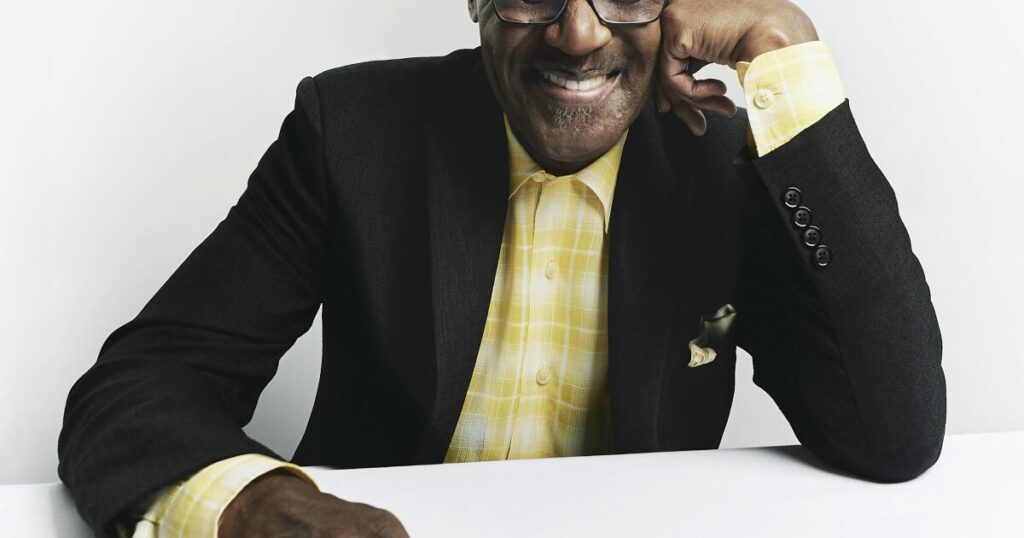
Six months and 16 Oscar nominations ago, Delroy Lindo hopped on a Zoom call with the awards consultants running the campaign for Ryan Coogler’s genre-defying American horror story, “Sinners.” Actors don’t often participate in these meetings. But Lindo had received so much love for his turn as bluesman Delta Slim since “Sinners” premiered in April, he figured, “Why not sit in?” Mostly, he just wanted to ask one simple question: How can we make the most of this moment?
“I don’t know what their answer was, but it seems to have worked,” I tell him over lunch recently.
Lindo starts rapping on the wood table separating us and doesn’t stop until I ask if he’s a man given to superstition.
“Can I tell you where I think it comes from?” he asks. “I’m acutely aware absolutely nothing is promised. There’s no such thing as a sure thing. Anything can happen. So in knocking wood, one is trying to increase one’s chances that the outcome will be what one wants.”
So you’ve been knocking on wood for the last six months?
“Hell, yes!” Lindo answers, laughing. “Hell, yes!”
Now I’m the one who’s laughing, which Lindo appreciates. But he has more to say on the subject.
“You have to understand something,” he continues. “When an actor does a piece of work and it really touches people and has an impact like it did with Delta Slim and ‘Sinners,’ you can’t help but think how it might be broadened. I try to maintain an emotional distance because I have no control over much of it. Awards season.” He shakes his head. “So …” Lindo pounds on the table again. “Knock … on … wood.”
You want an illustration of the unpredictable nature of the acting profession? Lindo and I wouldn’t be at this table talking and rapping and toasting the first Oscar nomination of his long career if one particular cut of “Sinners,” the version Coogler showed him at the Imax headquarters in Playa Vista more than a year ago, had gone out into the world.
If you’ve seen the film, you’ll no doubt remember Delta Slim delivering a monologue in the car riding to the juke joint with Stack (Michael B. Jordan) and Preacher Boy (Miles Caton) where he recalls the lynching of a fellow musician. The scene ends with Lindo breaking into a guttural humming and drumming, expressing pain that transcends words.
When Lindo saw the movie that first time, the monologue had been truncated, and the scene preceding it, where their car passes a chain gang and Delta Slim stands and exhorts the prisoners to “hold your heads,” was gone too.
After the credits finished rolling and the lights came up, Coogler asked Lindo what he thought of the film. Lindo looked at him. “Can we talk, man?” They went outside, and Lindo laid out in his steady, resonant baritone why he thought Coogler needed to reinstate the chain-gang scene, which reveals Delta Slim’s origin story — and surely, since the chain-gang scene is intertwined with the monologue in the car, that should go back into the movie too.
“What Ryan did so brilliantly is he took the time to introduce all of the main characters in their native environments so the audience gets invested in them and what they mean to the community,” Lindo says. “For Delta Slim, those scenes were the fundamental building blocks.”
It should be noted that there were many different cuts of “Sinners”: one as short as 90 minutes, one that opened with the vampire Remmick being chased by the Choctaw, one without the celebrated surreal musical sequence that became the centerpiece of the film.
“The Delta Slim monologue had a lot of ‘Is it in, is it out?’ debate,” “Sinners” film editor Michael P. Shawver says. “But I knew in my heart and soul I was never going let the movie out without that being in it.”
Coogler, it turns out, saw it that way too.
“I couldn’t imagine making a movie about the blues without giving some deeper context on what that music really signifies,” Coogler writes in an email. “It’s easy to get lost in the rhythm and the artistry of it all, but the blues was born from a lot of pain and adversity in a particular time and place. When I wrote the script, I felt like I needed a living, breathing embodiment of that, and Delroy nailed it.”
“We could have filmed that monologue a thousand different times and it would have taken on new life with each take,” Coogler continues. “The gut-punch way he ends it, going from telling the story of a lynching to drumming along and humming … it’s macabre, sorrowful and beautiful all at the same time. It shows you exactly why Delroy’s such a masterful actor. If you ever needed to give someone the world’s fastest lesson in what the blues is about, he gives it to you right there.”
“God bless him,” Lindo says.
“Working for the camera, we’re at the mercy of the editing process,” Lindo notes. He speaks slowly, deliberately, always choosing his words carefully because language is important to him. It’s his currency.
How does he feel about that loss of control?
“It’s scary,” Lindo says. “One had better make one’s peace with that very quickly. If you don’t, you will get your feelings hurt. It’ll be a problem.”
Asked to pinpoint when he came to terms with that, Lindo remembers “Clockers,” the 1995 Spike Lee crime drama in which he played the intimidating drug kingpin Rodney Little. It was his third collaboration with Lee, following “Malcolm X” and “Crooklyn,” and the two enjoyed a mutual respect and rapport. But Lee still cut three of Lindo’s scenes, which Lindo understood — “kind of, sort of.” Lee was looking at the larger story. Those scenes weren’t essential.
“Making one’s peace with it is not the same as accepting it and being happy with it,” Lindo says, raising an index finger, a gesture he often makes when telling you something he considers important. “It’s just the way it is. It’s a fact of life.”
When talking about his career, Lindo, 73, tells me more than once that “it’s not where you start, it’s where you finish.”
The first time he tells me this we are talking about one of his early lead acting turns, starring in the 1983 Yale Repertory Theatre production of “A Raisin in the Sun,” the story of a struggling Black family dealing with discrimination in 1950s South Chicago. Lindo played the frustrated patriarch, Walter Lee, and won some strong reviews. But he felt like he was the “weak link” in the production. In a GQ profile, it was written that Lindo, born in London, couldn’t convince himself that the African American experience was his to interpret.
“Nope,” Lindo says. “I did not say that.” Again, the index finger. “You’re giving me the opportunity to set the record straight.” He pauses and closes his eyes. “Doing that play, I had an inner monologue playing in my head that cast doubt on my ability to play the part successfully. And it continued and it grew. It became a tape and then an album and then a series of albums. It eroded my confidence.”
“You know what it was?” he continues. “It was a self-esteem issue. It was an issue of me saying to myself, ‘You’re not good enough. You want to do one of the great parts in the theater? No. You don’t have it.’ Now, what’s the root of all that?” Lindo laughs, clasps his hands together and raises them. “The roots of that are food for myself and a therapist.”
But there is a happy ending to the story. Lindo was cast once more as Walter Lee, for a production of “A Raisin in the Sun” mounted at the Kennedy Center in 1986. Lloyd Richards again was directing, indicating to Lindo that maybe he wasn’t as bad as he thought he had been. Richards did tell Lindo that he needed to jettison some of the neurotic choices he was making as an actor.
“Those are the words he used, ‘neurotic choices,’” Lindo says, shaking his head. He pauses. “Man, I’m giving you a lot here. But it’s OK. You know why it’s OK?”
Because you’re enjoying our conversation? I venture.
“No,” Lindo says. “I’m not particularly enjoying telling you about my failures. But this was an absolute period of growth for me as an actor all because I learned the most important thing: preparation, preparation, preparation.”
For his reprise of “A Raisin in the Sun,” Lindo called musical multihyphenate Oscar Brown Jr. and asked if he could fly to Chicago and pick his brain about life on the city’s South Side in the 1950s. Lindo walked the streets where “Raisin” playwright Lorraine Hansberry lived, steeping himself in what it meant to exist in that place and time. After that, the tape was no longer playing in his head, even when co-star Esther Rolle’s face fell after she realized that Lindo had been cast as Walter Lee. She thought she’d be headlining with Glynn Turman, but Turman had dropped out.
“Eight days, maybe nine into rehearsals, Esther turned to me — and this is when I knew it was going to be all right — and she said, ‘You’re a nice actor,’” Lindo remembers, smiling.
Preparation, preparation, preparation. For Delta Slim, Lindo read books on the blues, listened to Son House, Muddy Waters and Howlin’ Wolf and immersed himself in the culture of the Mississippi Delta. When it came time to shoot that monologue in the car, he was ready. On the next-to-last take, Lindo improvised, letting music take the place of words. Jordan went with it, turning to Caton in character, saying, “You got that guitar in your hand, don’t you, boy?” Caton begins playing.
“Man, we were all in the work,” Lindo says.
Where did that improvisation come from? I ask.
“It’s the musical manifestation of the pain I’m feeling,” Lindo says. “It’s the only thing I know how to do in that moment.”
It’s the blues.
“It’s the blues, man,” Lindo says. “I’ve heard it said numerous times: That’s where the blues comes from. And as an actor who participated in that moment, communicating that is extraordinary and profoundly gratifying.”
The post Delroy Lindo’s ‘Sinners’ monologue was almost cut. Then he pulled Ryan Coogler aside appeared first on Los Angeles Times.