Three films in the awards season conversation share a common theme: centering Palestinian stories.
Together, “The Voice of Hind Rajab,” “All That’s Left of You” and “Palestine 36” cover nearly a century’s worth of history. The plots and timelines differ, yet the movies all come from a shared desire to dig deeper than fleeting news coverage and social posts and show the complex lives of Palestinians.
Two years ago, the Tunisian director and writer Kaouther Ben Hania heard voice recordings of a 5-year-old girl in Gaza named Hind, who was trapped in a car with the bodies of six relatives. Rescuers from the Palestine Red Crescent tried to reach her, but she was found dead nearly two weeks after her haunting, high-pitched voice rippled across the world.
At the time, Ben Hania, whose 2023 documentary, “Four Daughters,” was nominated for an Oscar, was working on her next feature, a period piece set in Tunisia. But she felt a duty to share Hind’s story with the world, particularly as the war in Gaza raged on. “Palestinian voices are suppressed and invisible,” she said, but Hind’s was hard to forget. “Once you hear her voice, you can’t unhear it.” She contacted Hind’s mother, Wesam Hamada, and received permission to pursue the film.
The result, “The Voice of Hind Rajab,” is a docudrama that powerfully weaves in Hind’s voice recordings, while actors (Saja Kilani, Motaz Malhees, Amer Hlehel and Clara Khoury) dramatize the tense rescue effort in the Red Crescent’s West Bank call center. The film, shot in Tunisia, is up for the best international Oscar at the Academy Awards in March.
Ben Hania wanted the cast to approach the material with the same hope the rescue workers had the day they spoke to Hind. The script follows the recordings almost verbatim, and the actors didn’t hear the full conversations until the cameras started rolling. In the close-ups, it’s hard to tell which reactions are rehearsed; Ben Hania said one actor was so shaken by Hind’s pleas that he broke down on set once.
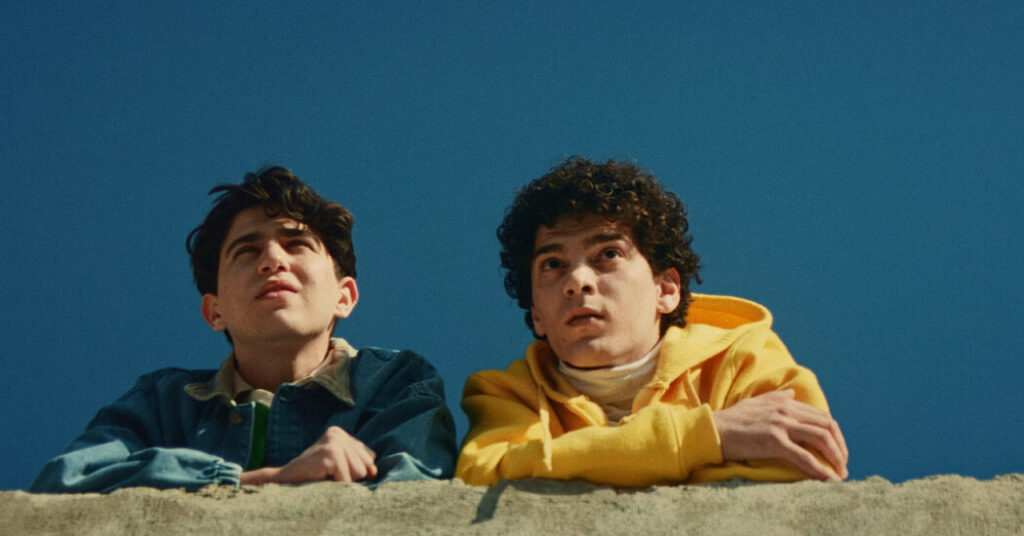
While that movie was a direct response to the war in Gaza, the Palestinian American director and actress Cherien Dabis had been mulling the premise of “All That’s Left of You” for years. The film unspools the trauma passed down over three generations in a Palestinian family. Inspired by her own relatives, Dabis said she wanted to explore “what it is to endure decades of political violence and how that changes you.” The film, which is up for best international film at the Indie Spirits on Sunday, stars the late Palestinian actor Mohammad Bakri and his sons Adam and Saleh, alongside Dabis as the matriarch.
The family’s story begins in Jaffa in 1948 during what is known as the Nakba, or “catastrophe,” the displacement and dispossession of hundreds of thousands of Palestinians during the creation of Israel. The tale then jumps to 1978, when the family is living in a refugee camp in the West Bank, and later to 1988, during the first intifada, or uprising, against Israeli occupation.
Preproduction began in May 2023 in the West Bank. After Hamas attacked Israel on Oct. 7, the territory went into lockdown and foreign crew members wanted to leave. Dabis had planned to shoot part of the film in Cyprus, so she prioritized those scenes while waiting to see if returning to the West Bank was possible. When it became clear that would hold up the film indefinitely, Dabis decided to shoot the remainder in Jordan and Greece, and had a team film some scenes in the West Bank with Dabis directing remotely via video calls.
“We shot more than half the film in the Palestinian refugee camps” in the north of Jordan, Dabis said, “which was great because we got to work with the Palestinian refugee community in the telling of, essentially, their own story.”
“Palestine 36,” written and directed by the Palestinian filmmaker Annemarie Jacir, looks back at a lesser-known episode of history, the farmer-led revolt against British colonialism in Mandatory Palestine. A period drama with an ensemble cast that includes Hiam Abbass and Jeremy Irons, the film starts in 1936, when millions of Jews were immigrating to the region under the Balfour Declaration.
The story oscillates between two Palestinian worlds: a village where farmers are losing their jobs and their land to Jews, and Jerusalem, where wealthy landowners host sophisticated parties and dismiss the farmers’ plight. After a mass strike is called, tensions between the locals and the British administration crescendo to a devastating boiling point.
Jacir, who lives in Bethlehem, said she focused on those events to show how the British Empire set the stage for the Israeli occupation. And the more she researched the story, she said, the more she was “struck by how contemporary and relevant it is to right now.”
Like Dabis, Jacir faced a number of hurdles. Her team spent nearly a year building props and restoring an entire village to emulate those of the 1930s. They also had to work around Israeli restrictions in the West Bank, like hourslong holdups at checkpoints. After Oct. 7, production came to a halt. Eventually the team relocated to Jordan, where they had to restore another village from scratch, but Jacir insisted on shooting the final scenes in the West Bank and Israel. “I didn’t want to finish the film anywhere else,” she said. The land itself was a character, she added, that could not be compromised.
The feature, which opens in New York on March 20 before a nationwide release in April, is Jacir’s fourth to be selected as the Oscar entry from the Palestinian territories. The film and “All That’s Left of You,” Jordan’s submission, made it as far as the Academy Award shortlist for best international feature, but didn’t make the cut for a nomination.
For all three filmmakers, working during the war in Gaza added another level of intensity. “We were literally creating scenes from 1948 that we were watching again happen on a more catastrophic, unprecedented scale in Gaza,” Dabis said. While she and Ben Hania said they were shocked that the war dragged on for so long, their movies helped alleviate a sense of helplessness. “It felt like we were channeling our grief rather than acting,” Dabis said.
Jacir removed some lighter moments from her script after the war began; they no longer felt appropriate. “Everything just became heavier,” she said, adding that “Palestine 36” was a product of love, pain and a lot of rage.
Getting the films off the ground wasn’t easy. Early on, “The Voice of Hind Rajab” had the support of executive producers like Brad Pitt, Joaquin Phoenix and Rooney Mara, and it won the top prize at the 2025 Venice Film Festival, yet was picked up by an independent distributor, WILLA, instead of a major studio. “All That’s Left of You” premiered at Sundance in 2025 and attracted Mark Ruffalo and Javier Bardem as executive producers. But Dabis said mainstream distributors were “afraid of the subject matter.” It’s an issue that also faced the makers of “No Other Land,” about Israel’s destruction of homes in the West Bank, a film that went on to win the best documentary Oscar last year.
All of the filmmakers worked in some capacity with Watermelon Pictures, a film production and distribution company founded by two Palestinian American brothers, Hamza and Badie Ali. “There’s not a lot of distributors willing to roll the dice on these films,” Hamza Ali said. “That’s why we exist.”
Watermelon Pictures was started in 2024 in part to uplift narratives the company believes challenge the status quo. Palestinians, Ali said, have long been dehumanized by the entertainment industry. “We want to move past that,” he added. “We want people to think of us beyond our suffering.”
Sara Aridi is a Times journalism education editor helping to explore partnerships with The School of The New York Times.
The post Decades of Palestinian History, Told by 3 Films With Awards Hopes appeared first on New York Times.