Toward the end of a new authorized documentary about King Charles III, the 77-year-old British monarch acknowledges that he has spent much of his very public life seeking “the restoration of harmony,” to little avail.
“Quite frankly, it has been a bit of an uphill struggle,” he quietly admits in the movie, released by Amazon Prime last Friday.
Given the decades of tumult inside the royal family — his marriage to and divorce from Princess Diana; his estrangement from his younger son, Prince Harry; the expulsion of his brother Andrew over the Jeffrey Epstein files — one might imagine he was lamenting the disputes inside palace walls.
But no. In fact, the two-hour film is an exploration of Charles’s environmental activism, which began in the 1960s, when being vocal about the health of the planet was still considered relatively fringe. The movie focuses on his longstanding assertion that Earth, and the people who live on it, need to find “harmony” to prevent the worst effects of climate change and ecological destruction.
“As our planet’s life support system begins to fail, and our very survival as a species is brought into question,” he is shown saying during a 2009 speech, “remember that our children and grandchildren will ask not what our generation said, but what it did.”
The environmental focus does not mean that the film, produced in cooperation with the king’s foundation and narrated by Kate Winslet, avoids any criticism of the monarch. At several points, Ms. Winslet acknowledges that Charles’s views were ridiculed at the time as overblown or hysterical.
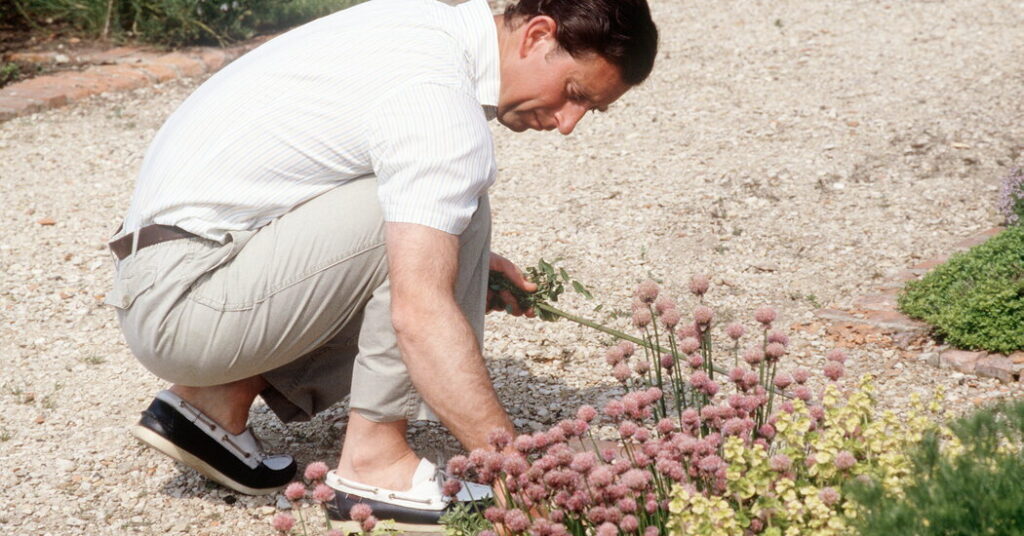
In 1986, he was mocked for saying in a television interview that he enjoyed talking to plants.
“I love coming here,” he said during the interview, describing his passion for his organic gardening at Highgrove, a longtime family home in southwestern England. “I just come and talk to the plants. Very important to talk to them. They respond.”
The documentary does not sugarcoat the response.
Old newspaper clippings flash up: “The Prince of Wales is going completely off his trolley,” the Irish Independent wrote. “Prince Charles as a bumbling eccentric?” The Sun asked.
Decades later, the Highgrove Estate gardens have become a tourist attraction welcoming up to 40,000 visitors a year.
The documentary also reminds viewers of Charles’s readiness to challenge modern architecture, often to the dismay of leading British architects. During a 1999 visit to Birmingham city center, he did not hold back what he thought about the cement-dominated construction that was in progress.
“It has no charm, no character. It’s a planned accident,” the prince said, with cameras rolling. “It’s the central library. But how could you tell? It looks like a place where books are incinerated, not kept.”
Such outspokenness, along with Charles’s support of some unconventional ideas, including homeopathy, has at times led to criticism in Britain that he has overstepped his constitutional role.
The film spends much of its time describing how he pursued his beliefs that people and nature needed to be harmonized. He founded a planned community called Poundbury, in southern England, where low-income housing and mansions for wealthier residents sit side-by-side, in a variety of pre-20th century styles, alongside green spaces, community buildings and local businesses.
The effort has been derided by some. A Guardian commentator called the town “fake, heartless, authoritarian and grimly cute.” But later, some critics came around, praising its energy efficiency and sense of community.
“I’ve tried to demonstrate how harmony in practice could be made to work, rather than just talk about all these things,” the king says in the documentary.
The film documents how Charles’s environmental advocacy eventually became mainstream as many nations begin reacting to climate change and its effects. But it also notes his frustration later in life, as he watched leaders — including President Trump — water down environmental regulations, retreat from clean air and water goals, and embrace the fossil fuel industry.
During his speech at Mr. Trump’s state banquet last September, Charles included a particular message about the environment. “Our legacy for the next 250 years and beyond,” he said, “is to ensure that our children, grandchildren, and those who come after them, can experience the awe and magnificence of the natural treasures found in the countryside, on the coasts, in the seas and in the National Parks established by your predecessors and mine.”
The film uses archival footage to chronicle the king’s life, and shows him watching the clips on a large screen. He sits largely still, sometimes with a slightly bemused look on his face.
“It would be nice to try and see if we can get through to people,” he says at the beginning. “But who knows?”
By the end, he seems more hopeful.
“Maybe,” he says, “by the time I shuffle off this mortal coil, there might be a little bit more awareness of the need to bring things back together again.”
Michael D. Shear is a senior Times correspondent covering British politics and culture, and diplomacy around the world.
The post ‘An Uphill Struggle’: King Charles Is Not Giving Up on the Planet Yet appeared first on New York Times.