Jonathan Dayton and Valerie Faris arrived at their first Sundance Film Festival feeling worn down. Making their debut feature, Little Miss Sunshine, had taken much longer than they’d anticipated; financing hiccups had forced the pair to spend years rescuing the film from development hell. But by the time Dayton and Faris left Park City, Utah, in January 2006, they were practically rock stars: Little Miss Sunshine, about a scrappy family trying to make it to a children’s beauty pageant, had become a festival darling, prompting an all-night bidding war among distribution companies. Fox Searchlight, the victor, bought the film for a then-record-setting $10.5 million and immediately sent the couple on a tour of more than 20 cities to drum up interest in the movie before its summer release.
In the months following the festival, Dayton and Faris went from theater to theater, watching audiences absorb their work. They participated in Q&A after Q&A. Eventually they wound up at the Oscars, where Little Miss Sunshine was nominated for Best Picture. “It changed our lives, coming here,” Dayton told me when we met at this year’s Sundance.
Faris, sitting next to him, noted that the two didn’t return to the festival in the 20 years since their film’s premiere for a reason. “That experience was so monumental,” she said, “that it was sort of hard to imagine coming back and not having that.”
Throughout its 40-plus years in Park City, Sundance has earned a reputation for offering new filmmakers an unbeatable time. The festival, which spotlights independent films, launched the careers of directors such as Steven Soderbergh, Todd Haynes, and Richard Linklater; more recent alumni include Chloé Zhao, Ryan Coogler, and Celine Song. In the 1990s and 2000s, Sundance was an offbeat destination for Hollywood’s creative talent, rejecting the glitz of European festivals and the solemnity of awards season in favor of strong movies that garnered word-of-mouth interest. (The Sundance Institute, the nonprofit organization behind the festival, also cultivates emerging artists through its series of labs and fellowships.) In 1999, the premiere of The Blair Witch Project ushered in the era of found-footage horror; five years later, Napoleon Dynamite won over festivalgoers, who later helped enter “Vote for Pedro” into the pop-culture lexicon. Sundance could anoint hits, dotting the industry’s creative landscape with unlikely blockbusters.
[Read: Ryan Coogler didn’t want to hide anymore]
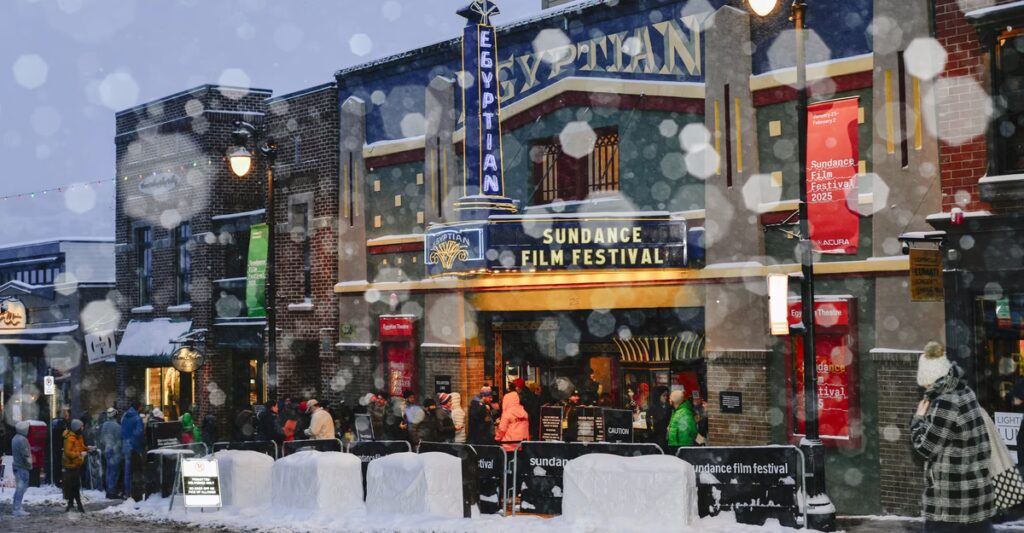
Yet I had a hard time picturing that version of Sundance while at this year’s festival, which concluded earlier this month. Main Street, without any screenings at the picturesque Egyptian Theater, wasn’t particularly crowded. Nights were tame and quiet for the most part, other than the evening of the afterparty for The Moment (a mockumentary starring Charli XCX), which took place at a hilltop club. Plenty of showings around town were sold out, but few generated feverish headlines about bidding wars during the festival’s run—a worrying development for the filmmakers who come to Sundance in hopes of finding a distributor for their work. Even the weather seemed off: Park City, usually blanketed in snow this time of year, was warm enough for some locals to walk around in just long-sleeved shirts.
Part of the muted atmosphere probably had to do with the fact that this year’s Sundance was the final one held in Park City before the festival’s move to Boulder, Colorado, in 2027—as well as the fact that this was the first edition since the passing of Sundance’s founder, the actor Robert Redford, in September. But the downbeat mood also seemed to reflect the lackluster indie-film business that’s been dogging the festival for years. The box-office success stories of the ’90s and 2000s—The Blair Witch Project, Saw, Four Weddings and a Funeral, (500) Days of Summer—inspired distributors to pour tens of millions into acquiring projects at the festival over the following decade, in the hope of discovering a critical and cultural phenomenon that could also turn a profit. Yet only a few films ever offered a substantial return on the financial investment; the last major box-office hit to break out of Sundance was 2017’s Get Out, which earned nearly $260 million. Last year, only two out of the 10 U.S. competition entries—Sorry, Baby and Twinless—grossed more than $1 million worldwide.
Of course, Sundance has always operated as a microcosm of Hollywood’s wider shifts. This year’s final rodeo in Park City seemed marked by the uncertainty generated by ongoing industry woes—massive studio mergers, job insecurity, and the growing use of AI during production, among others. While at the festival, I spoke with many filmmakers who were bringing their directorial debuts to Sundance. Having their work selected remains an achievement, but traveling to a popular, pricey ski destination such as Park City, many of them told me, feels riskier than ever. The cost of bringing a small movie there hoping to lock down distribution may not pay off, given buyers’ dwindling interest. “Sundance was like that island on the horizon that I could never get to, that I applied to every year, to the labs, and never got in,” Vera Miao, the writer-director of the contemplative ghost story Rock Springs, said. But, she added, “it’s extremely expensive. You know, you want people here, and everyone wants to be here. It’s just an incredible moment of celebration and community, and the tension of that has been a hard one.”
Some films that played in Park City this year arrived with name recognition and instant buzz: a drama starring Channing Tatum, a black comedy from Olivia Wilde. The director John Wilson could also be considered something of a known quantity. As the creator of the irreverent HBO docuseries How to With John Wilson, he has gained a cult audience for his rollicking work built on seemingly prosaic subjects—including, in one notable short film, his own failed efforts to get his work accepted into Sundance. Almost 10 years later, Wilson’s feature directorial debut was selected as one of Sundance’s opening-night films. The History of Concrete, a documentary that captures the director’s attempts to finance a project ostensibly about, yes, concrete, has been well received: The morning of our interview, we had planned to meet at the theater in which the film was being screened, but then had to find another spot—there were too many attendees crowding the cinema.
Several quality documentaries have emerged from Sundance in recent years; all five of this year’s Oscar nominees debuted there. Yet as of this writing, The History of Concrete still hasn’t found a distributor. Wilson, for his part, didn’t seem to spend all of his time in Park City thinking about the film’s chances of landing a buyer. Certainly he’d like to find a distributor, he told me, so he can pay back his collaborators. But as “existentially terrifying” as it is to think about how much steeper the slope has become for indie filmmakers, he said, “doing your best to not consider the market in a certain way is the strongest kind of start you can have.” The movie’s aim, he added, is to remind viewers that “people shouldn’t be afraid to create.”
Wilson isn’t alone in shutting out the noise of the industry’s upheaval. Stephanie Ahn, the director of the tender romance Bedford Park, told me that her film had taken almost 10 years to make—years she spent searching for financing and readjusting her goals depending on the resources available to her. “On the other side of it, the world that your film might encounter might be very different than what you expected,” Ahn said, “and you just have to be okay with that.”
Before being accepted into Sundance with Bedford Park, Ahn said, she had submitted her work what felt like hundreds of times. At the start of her career, she imagined the kind of reception she might get if she made it to Park City, her reveries riffing on the success stories she kept hearing about. (Little Miss Sunshine’s trajectory—the word-of-mouth momentum, the bidding wars, the rock stardom—was once the standard.) “When I was younger and striving to be a filmmaker and striving at Sundance, I fantasized about what it would be like,” she explained. “I think I let go of the fantasy some years ago.” She added, “I think a lot of us have let go of the old way of success.”
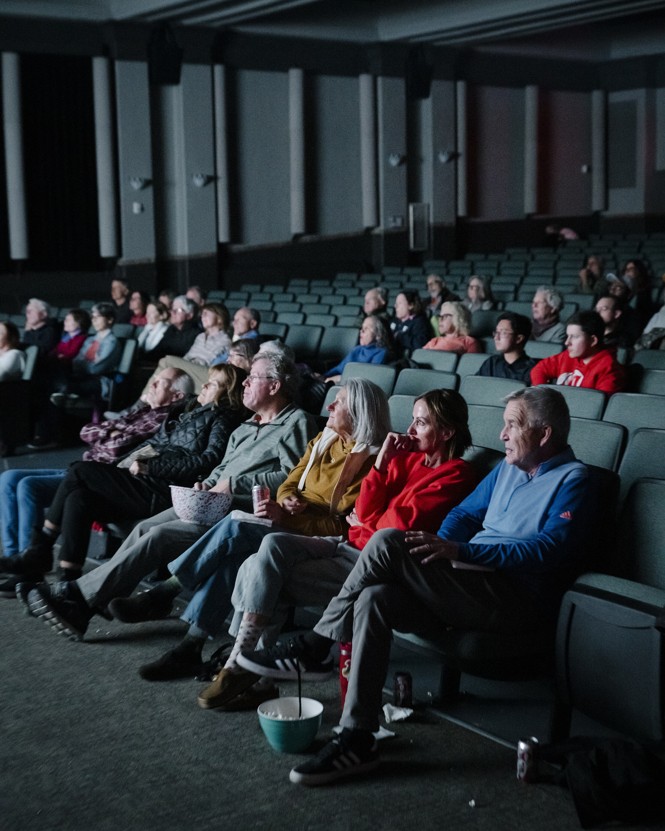
Bedford Park turned out to be a festival rarity: The film sold to Sony Pictures Classics, becoming one of just five narrative titles to land a buyer out of Park City so far. That statistic underlines just how hesitant companies have become to acquire indie projects. The internet offers various other distribution channels and ways to promote your film outside of a festival, some of the filmmakers I spoke with said. Sundance’s core value, then, is to offer a venue to showcase work to an invested, film-loving viewership.
Elaine Del Valle, a writer and producer of the visually inventive documentary TheyDream and a director herself, is a Sundance veteran who has begun to rely on grassroots tactics. For her most recent feature, last year’s coming-of-age drama Brownsville Bred, she skipped Sundance and reached out to theater chains before finding a distributor at a smaller film festival. By that point, Del Valle just wanted to share her work with an audience who cared. “It’s not about the money,” she told me. “It’s about the value.” These days, she does as much as she can on her own. “I say to myself, I run a studio,” she said. “What part of my studio needs my attention most today?”
Sundance has long championed that indie sensibility, elevating work produced outside of the studio system off a shoestring budget. But in order to remain a meaningful platform for creative renegades, the festival needs to also take risks. At least, that’s what the filmmaker (and Robert’s daughter) Amy Redford told me when I spoke with her the night before screenings began. “More and more, I think what we will see is people finding a way to get their stories out there on their own terms, because they can,” she said. In some ways, she pointed out, the festival’s forthcoming move to Boulder may offer a chance for a reset. “Sometimes,” Redford said, “you need to change your landscape to understand what you’re made of,” even if that change is as simple—or, as she put it, “exciting and messy and imperfect”—as relocating to a different town.
The post ‘A Lot of Us Have Let Go of the Old Way of Success’ appeared first on The Atlantic.