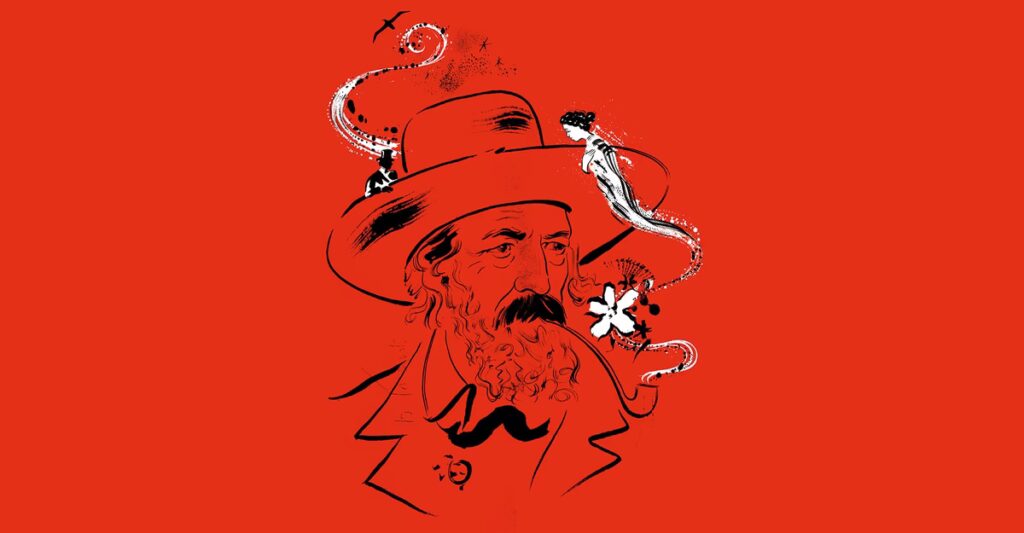
The appointment of a new medicine man is a dicey moment in the life of a tribe. Get it wrong, pick the wrong guy, and your deepest spiritual diseases will go not only untreated but undetected. Get it right, and there’s at least a chance of an accurate diagnosis. The Victorians, rather surprisingly, got it right. In fact, for all their pomposity and stolidity and leadenness of soul, and for all their windbag religiosity, they nailed it. They chose as their national poet a vagrant and depressed semi-atheist from a family of lunatics. They chose Alfred, Lord Tennyson.
Tennyson was already famous, largely on the strength of his blockbuster elegy, In Memoriam, when Queen Victoria made him her poet laureate in 1850. But it is with the haunted and chaotic pre-fame poet—the shaggy, craggy, germinal genius wandering in his cloud of tobacco smoke and melancholy, poring over his books about physics and chemistry—that Richard Holmes’s The Boundless Deep is chiefly concerned. Subtitled Young Tennyson, Science, and the Crisis of Belief, it tracks this character’s metabolic absorption of the most disturbing, displacing ideas that contemporary science had to offer; their effect on his personality; and their manifestation in his poetry.
Holmes, the master scholar-biographer of Coleridge and Shelley, is ideally qualified for such a gig. In prose so lucid that you barely notice when it has slipped into a stream of profound interiority, into the hidden life-current of his subject, Holmes gives us what feels like the whole man. His Tennyson is cosmically miserable, while also being—when among friends—very good company: that is, highly appealing to us moderns. He devours works of popular science, the information they contain as intoxicating to him as the poetry of his idols Keats and Shelley. Nervously puffing away on “infinite tobacco” (as his friend Thomas Carlyle described it), he rides the fault line between epochs. Astronomy is deepening space, geology is deepening time, and as the news comes in—one revelation after another—he can feel the answering tremor in human consciousness, and the fearful new understanding it foretells. An empty heaven. A disenchanted world. “I stretch lame hands of faith,” he writes in In Memoriam, “and grope, / And gather dust and chaff.” The new science of psychology, too, absorbs him. Not at all a degraded Romantic (for which he is sometimes mistaken), this Tennyson, in his gleamy-gloomy way, is a looming giant of modernity. Behind him is Keats and “The Eve of St. Agnes”; before him is The Waste Land.
Tennyson was prolific, prodigious. He rumbled with poetry; he recited it endlessly; it poured off him on long walks. Language teemed inside him, especially when he was a young man, producing verse so musical, it sometimes seems on the verge of becoming pure fluid sound, a kind of glittering higher gibberish:
A bow-shot from her bower-eaves, He rode between the barley-sheaves, The sun came dazzling thro’ the leaves, And flam’d upon the brazen greaves Of bold Sir Lancelot.
The darker strands of the young Tennyson’s existence—madness, spurned love, ruinous genes, insolvency—would become the themes of a later poem that Holmes regards as pivotal. It appeared in Tennyson’s first book as poet laureate, Maud, and Other Poems, published in 1855. The reviews were not good. In fact, they were violently hostile. Despite containing such patriotic bangers as “Ode on the Death of the Duke of Wellington” and “The Charge of the Light Brigade,” both previously published (and the latter instantly memorized by half the British empire), the new collection was discredited, in the eyes of its critics, by its long centerpiece, “Maud: A Monodrama,” a poem narrated by a madman.
“Ill considered, crude, tawdry and objectionable” was one reviewer’s judgment of Maud. To the reviewer in the Press, it might have been the output of “a love-sick youth in the measles.” One small constituency, however, rated Maud quite highly: Victorian shrink-types. Clinical accuracy is not something with which poets have traditionally tended to preoccupy themselves, but Tennyson’s account of mental extremity impressed the experts. Maud got a glowing write-up in the October 1855 edition of The Asylum Journal of Mental Science, and a doctor named Robert Mann published an entire pro-Maud pamphlet, Tennyson’s Maud Vindicated: An Explanatory Essay. “Where can this unprofessional psychologist have acquired his accurate insight into the phenomena of insanity?” he asked. (“I seem to have the doctors on my side if no one else,” the laureate growled in a grateful letter to Mann.)
“Maud” was personal. Tennyson called it “my little Hamlet” and then—after the critical kicking it sustained—“poor little Maud,” and it is indeed a strange, stormy, fragmented, wildly lyrical, futuristically subjective freak-out of a poem, part melodrama, part psychotic break. The narrator’s father, destroyed by the failure of “a vast speculation,” commits suicide; the narrator becomes obsessed with Maud, the daughter of the man who bankrupted his father, now living in grandeur on a neighboring estate and flashing her profile at him—“Faultily faultless, icily regular, splendidly null, / Dead perfection, no more”—as she rides past in her carriage. Obsessed, obsessed, truly obsessed: obsession like a dead flame licking the walls of life, or a wind singing through the deepest flaw in the universe. Maud and the narrator meet and fall in love—or do they? At one point, he seems to be lying outside her house in the dark—in a trance? stalking her?—hallucinating the sound of her footsteps in the movement of the leaves. Above him are the stars, bleep-bleeping away from the depths of untenanted space. He talks to them, lamenting
the boundless plan That makes you tyrants in your iron skies, Innumerable, pitiless, passionless eyes, Cold fires, yet with power to burn and brand His nothingness into man.
The cold fires, the nothingness—as Holmes shows us, all of this Tennyson had seen through the high-powered telescope in his garden, and read about in the books that were filling his library. To combine this kind of depth perception with the galactic ache of an unreal love, of an undead infatuation, that was new. That was scary. No wonder reviewers recoiled.
The vision was not just telescopic, but microscopic. In the second—and maddest—section of the poem, the narrator, having fled in panic to France, roams the Breton shoreline. He fixates upon a seashell:
The tiny cell is forlorn, Void of the little living will That made it stir on the shore. Did he stand at the diamond door Of his house in a rainbow frill?
Buffeted by hallucinations as he is, he zooms in on the long-gone shell-dweller like one of the underwater cameras in David Attenborough’s Blue Planet.
Part of Tennyson lived, was encamped, at the outer reaches of the psyche. Alcoholism, seizures, mood swings, incontinent rage—all ran in his family’s “black blood.” His father was regularly deranged; his brother Edward was a helpless depressive; and his brother Septimus introduced himself to Dante Gabriel Rossetti with the words “I am Septimus, the most morbid of the Tennysons.” Septimus was under the care of Matthew Allen, a psychiatric pioneer who called his establishment at High Beech, Essex, not an asylum but “a place of seclusion for exhausted minds.” Tennyson befriended Allen and began to spend a lot of time at High Beech: Holmes connects the poet’s observation of the patients there directly to “Maud,” noting, “The gardens at High Beech, the paths and the shrubberies, the wandering figures of the insane, muttering to themselves, recur like a remembered tune fifteen years later.”
A remembered tune, but also a staticky signal from the incoming 20th century, the noise of a voice splintered into different voices, fading in and out of clarity. Modern critics adore “Maud” for precisely the qualities that repelled its original audience—for its weirdness and its brokenness, and its pre-Freudian blast of erotic attachment. Tennyson would never be this exposed again: fame, the laureateship, and a steady marriage all solidified him. But for a long moment, he was beautifully out of sync with his public and ahead of his time, as any healer must be—because where can healing come from if not the future?
This article appears in the March 2026 print edition with the headline “The Madness of Lord Tennyson.”
The post Why Tennyson Feels So Modern appeared first on The Atlantic.