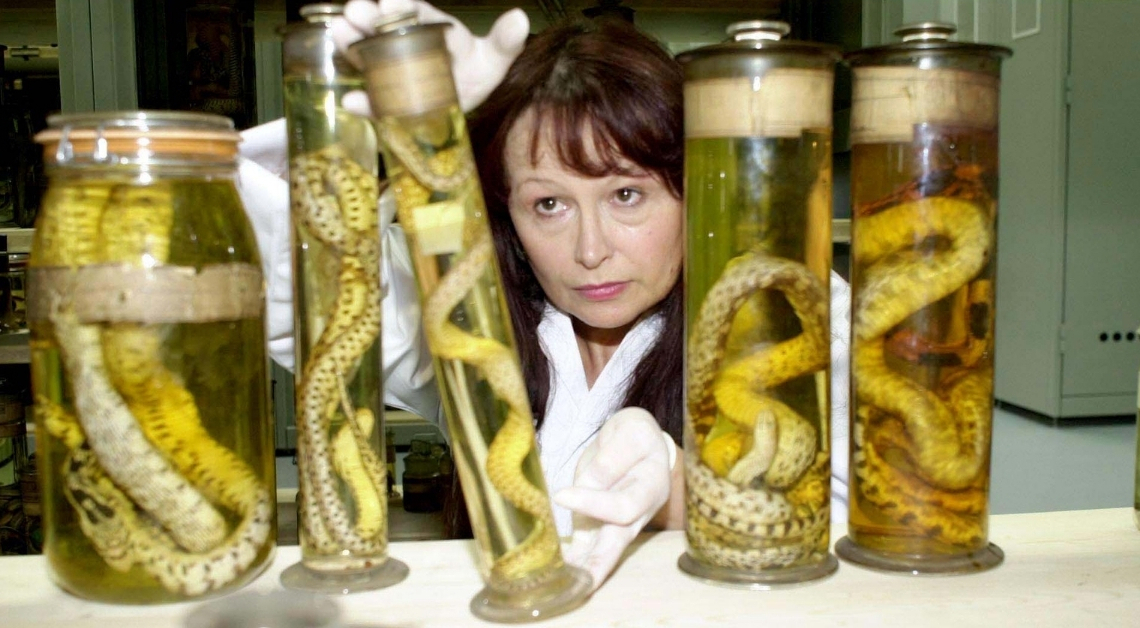
Hundreds of jars from Charles Darwin’s voyage aboard the HMS Beagle sit in the Natural History Museum in London. Inside them float the raw biological evidence that helped spark the theory of evolution. They’re packed with mammals, reptiles, fish, jellyfish, shrimp, all suspended in some murky mystery liquids that seem to have done a heck of a job preserving the specimens.
Scientists have long wondered what exactly is going on inside these jars, so they took a peek inside without opening up any of them. That would’ve been risky. Opening historical specimen jars can quickly lead to evaporation, contamination, and permanent damage to the specimens themselves.
And since preservation methods weren’t standardized in the 19th century, no one is exactly sure what chemicals are inside. For all they know, the proprietary chemical mixture could have degraded or become hazardous over 200 years.
Scientists Shot Lasers at Darwin’s Priceless Specimens. Here’s Why.
Still, some researchers needed to know what was in there. So they turned to a portable laser-based technique called spatially offset Raman spectroscopy, or SORS. Instead of sampling the jar directly, SORS fires lasers through the glass and compares scattered light at different offsets. By subtracting surface signals from deeper ones, scientists can read the liquid’s chemical composition without opening a single jar.
The team identified the preservation fluids in almost 80 percent of Darwin’s jars, with partial success in another 15. Only a handful of jars seemed resistant to laser identification.
As for what they contained, the results showed that mammals and reptiles were usually preserved in a formalin solution and stored in ethanol, while invertebrates were more often preserved in formaldehyde-based solutions that sometimes included a little glycerol or stabilizers to protect fragile tissues.
If you think all this sounds like an extremely nerdy and ultimately useless pursuit, you would be mistaken. Museums around the world hold more than 100 million fluid-preserved specimens, many of which are too fragile or dangerous to open. If we better understand how to detect what’s inside these jars without opening them, museum curators are better able to manage risks and slow degradation, thereby preserving these samples for future generations.
Darwin’s specimens helped us explain how life evolved, and now two centuries later, those same specimens are helping us figure out how they survived this long.
The post Why Scientists Just Shot Lasers at Charles Darwin’s Priceless Specimens appeared first on VICE.