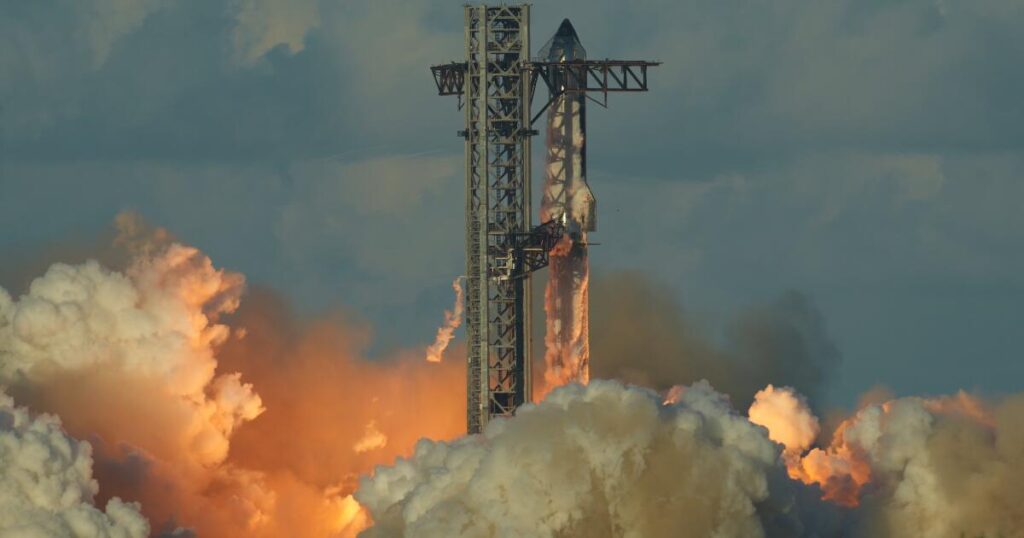
Elon Musk recently announced what seemed like an odd pairing of his companies: SpaceX was acquiring xAI, the artificial intelligence firm that also owns the social media platform X.
The merger combines a highly profitable rocket company with an AI startup that is burning through billions of dollars as it competes with OpenAI and other rivals for dominance in artificial intelligence.
The merger also comes as SpaceX — whose primary business of late has been launching Musk’s Starlink broadband satellites — readies for an initial public offering, possibly for this year.
The merged companies are valued at $1.25 trillion. That is higher than recent separate valuations of SpaceX at $800 billion and xAI‘s holding company at $230 billion. IPO shares are expected to price at roughly $525.
“I think it provides a narrative for the merging of SpaceX and xAI, sort of a cash generative business and a business that needs cash — at a pretty spectacularly high valuation,” said Steve Collar, chairman of Swissto12, a Swiss satellite maker.
Although the merger may make financial sense, there is far more to it than that. Here’s what to know about the plan.
This seems like an unlikely marriage. Why is Musk doing this?
Aside from the financial benefits, there are technical reasons. Musk has sketched out a futuristic plan that involves sending up to a million satellites — called data centers — into an orbit, where the sun could power them all day and night while they do artificial intelligence computations.
What exactly is a satellite data center?
The basic concept is simple. The satellite’s primary function would be to do computations on specialized chips, powered by solar panels in a “sun-synchronous orbit” that keeps them exposed 24/7 to the sun’s powerful rays.
Aren’t hundreds of billions of dollars already being spent building AI data centers on Earth?
Musk insists that within three years it will be cheaper to have AI data centers in space rather than the hyperscale data centers now being built on Earth because of the strain on the power grid — a timeline that some experts have questioned.
But isn’t launching 1 million satellites into orbit far-fetched?
Some think so. Indeed, the proposed number of launches is nearly 100 times more than the roughly 11,000 Starlink broadband satellites that SpaceX has sent into space since 2019 on its workhorse Falcon 9.
However, Musk is counting on using his massive Starship rocket, which is under development and can lift more than five times the payload.
“If you’re going to deploy a whole bunch of additional satellites, you’re creating this huge need for Starship,” Collar said.
Still, that seems like an inordinate number of launches.
There is no doubt about that. In a blog post, Musk talked about launching every hour to deliver millions of tons of satellites into orbit each year.
However, Collar said a functioning network of AI data centers in space could be much smaller, with 10,000, 50,000 or as many as 100,000 satellites. “I think with Elon, it’s kind of this all-or-nothing thing,” he said.
How far along is the development of space-based AI data centers?
Not very. It was only in November that Google announced Project Suncatcher, which it said is exploring an “interconnected network of solar-powered satellites” equipped with its own chips. And Starcloud, a year-old startup in Redmond, Wash., backed by Andreessen Horowitz and other major venture capital firms, launched a demonstrator satellite in November.
“I would say you are talking about the 2040 time frame before you’ve got any sort of usable system,” Collar said.
What are the technological challenges?
The first obstacle to overcome is to develop a computer chip that works in the extreme conditions of space, which includes exposure to much higher levels of radiation.
“If you want to take an Nvidia chip and make it work in space, you would probably need to invest a few years and many millions of dollars to make it what’s called space qualifying to make sure that it isn’t damaged by radiation,” said Ehud Behar, an astrophysicist at the Technion — Israel Institute of Technology.
Are there any drawbacks to a sun-synchronous orbit?
Yes. It exposes satellites to a lot of heat and the way to dissipate the heat generated by the sun and the computer chips would be to use large aluminum panels called radiators, but they are inefficient, Behar said.
“You’re going to need to build large surfaces to radiate the heat away. That’s part of the challenge. I don’t think these can be these small satellites. The mass has to be large enough to make it cost effective,” he said.
How does SpaceX propose to getting all that data back to Earth?
In a Federal Communications Commission application, SpaceX describes how the centers would transmit the data via optical, or laser, signals to the Starlink network for transmission to the ground while the entire system is in a low orbit roughly 300 miles to 1,200 miles above Earth.
Is there a technological challenge to that too?
Yes. Collar said that satellites in such an orbit circle the globe roughly every 90 minutes, making it tricky for them to communicate with one another. A potentially better idea would be to station the ground communications satellite in a higher orbit where it would circle the Earth at a much slower pace and its transmissions to the ground would cover a larger area.
“But launching into lower Earth orbit is so much cheaper, so all of this is a gigantic [trade-off] and that’s what makes it really interesting,” he said.
In a blog post, Musk also talked about how all these data will eventually be accessible on mobile phones from anywhere on Earth on a network he is building. How would that work?
SpaceX bought $17 billion worth of wireless spectrum in September from EchoStar, boosting a partnership it already had with T-Mobile that allowed customers to text when they are off the grid. It followed that up with an additional $2.6-billion purchase of EchoStar spectrum a month later.
However, Craig Moffett, a telecommunications analyst at MoffettNathanson, said that Musk’s satellite network, given the distances involved, would be far less efficient than ground-based cellular networks and would best benefit regions lacking access to existing networks.
Starlink doesn’t have “the right set of assets to serve as more than a niche player in the wireless market,” he said.
The post What to know about Elon Musk’s merger of SpaceX with his AI company appeared first on Los Angeles Times.