Vital organs of the same cinematic body, the artists who handcrafted Guillermo del Toro’s imposing “Frankenstein” helped ensure the experience of watching it feels immersive.
“When a movie is the best possible incarnation of itself, it’s a universe you fall into; as the youth says, it’s a vibe,” Del Toro says during an interview at the Sundance Film Festival in Park City, Utah, where he was in attendance to screen a restoration of his 1992 feature debut, “Cronos.”
Like Victor Frankenstein, who diligently selects body parts from corpses to stitch together his humanoid creation, the Mexican director carefully assembled his troupe of movie magicians. Of course, their talents mattered immensely to him, but so did their drive and their willingness to participate in the “team sport” of filmmaking.
“The cohesive personality of the film, the expressiveness of the film, depends on every aspect being orchestrated without an ego,” Del Toro says. “Each department sustains the department next to them.”
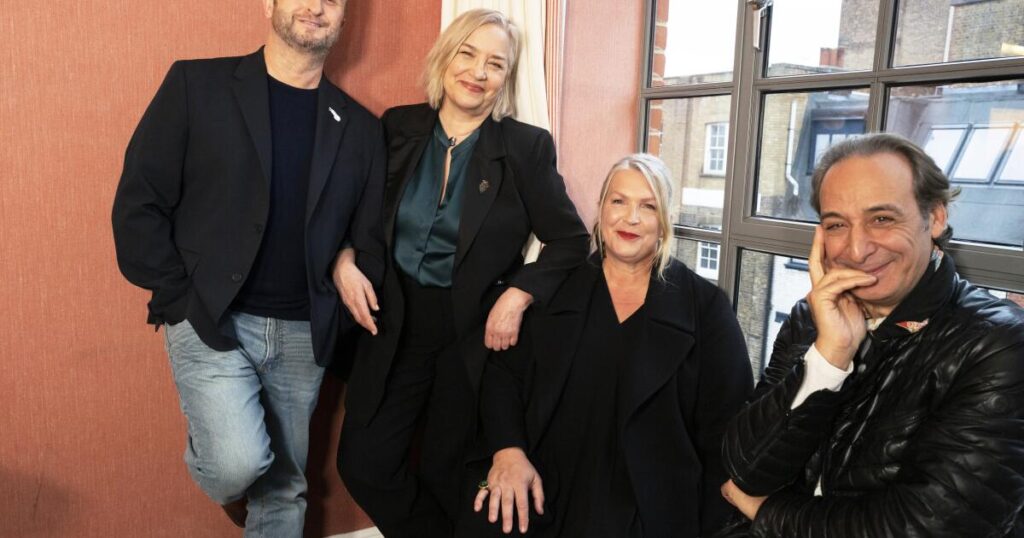
Del Toro clearly knows how to pick them. The Envelope recently caught up with makeup effects veteran Mike Hill, seasoned production designer Tamara Deverell, costume virtuosa Kate Hawley and acclaimed composer Alexandre Desplat, all Oscar-nominated for their work on “Frankenstein.”
And just like organs that constantly communicate with each other, their work is intimately intertwined. Nothing is conceived in isolation on a Del Toro film. “We all know what everyone’s doing within the different departments, so we all echo each other,” says Hawley.
In casting his acolytes, Del Toro seeks the alchemy that only human minds and hands can accomplish building tangible worlds. “The audience knows when something is digital, and when something has been crafted with real materials,” Del Toro explains. “I really believe people can tell the difference. Maybe they can’t articulate it, but they can feel it.”
Hill agrees. His mandate to create the prosthetics and makeup that transformed Jacob Elordi into the Creature aimed to make him look like an artwork that Victor Frankenstein handcrafted. Every part of him was by design, with the scars on his body reflecting incisions that those studying human anatomy in the 18th century would have made.
“If the monster felt fake, we would’ve lost the movie,” says Hill. “The Creature had to feel real. Not to put down VFX, but there’s a human quality they can’t catch.”
For Deverell, “Frankenstein” represented both the continuation of a creative partnership that dates back to the 1990s and an opportunity to showcase her multi-faceted skills. “Guillermo and I speak in a language of art history, and he is steeped in cinematic history,” she says.
With a team of technicians and craftspeople, Deverell constructed breathtaking sets, including Victor’s laboratory with giant batteries that required intricate steam and lighting mechanisms.
Undoubtedly, her pièce de resistance is the full-size Arctic ship where the opening sequence unfolds. Though the production considered existing vessels, none of them measured up. “There were specific action beats that Guillermo wanted, and a look that we all wanted,” she says. “To have complete creative control, there’s only one way to do it.”
To anyone who disagreed with the need for a ship, Del Toro would explain that it was not an extravagance. “It’s actually what tells the audience the scale of the movie,” he says.
The first half hour of the film, Del Toro believes, establishes its ambition and operatic quality. There are no digital doubles in that sequence, but real stunt performers aboard a ship that’s not a miniature but a massive structure that moves thanks to a giant gimbal.
It’s the way Del Toro pursues ideas by way of collaboration that brings Hawley back to his worlds (she even worked with him on his unmade version of “The Hobbit”). She’s learned to conceive her pieces considering that in his movies real water, mud, snow and fake blood might be in play.
“There’s something that happens with real materiality, real construction, there’s an alchemy to it,” Hawley says. “What a fabric does and performs is not always predictable, but the outcome and the potential you see in something then becomes the magic.”
As production timelines get shorter and A.I. utilization creeps into the filmmaking process, Hawley believes artists are trying to hold onto the craft as much as possible. “We came here to build worlds,” she says. “That’s what we did as kids. That’s what we do. This is our church.”
Del Toro admits he can be a “pain in the ass,” especially when dealing with his film’s production design and makeup effects. He atones by constantly reassuring his artisans. “They need to know that even if you are torturing them you admire them,” he says.
The only element of the film where Del Toro actively hopes to be surprised is the score. And Desplat is committed to delivering.
“Writing music is using your imagination. It’s not using references. It makes no sense to me,” says Desplat, who believes most scores today sound like work that has come before. “I hear many composers use references, but what for? That’s not what we do. We have the film to be inspired by. That’s enough.”
For “Frankenstein” — his third creature movie with Del Toro, after “The Shape of Water” and “Pinocchio” — Desplat thus avoided Gothic compositions to create a counterpoint to the images, highlighting the fragility of Elordi’s Creature, who he thinks of as the core of the film.
Also tying together the film’s craftsmanship is Del Toro’s awards campaign for “Frankenstein,” which he’s navigated to the tune of “F— AI.” The chant has resonated with those fighting to keep art made by humans for humans. “Frankenstein,” in turn, is the director’s latest monument to the beauty of imperfection.
“Art is the thing that we should never let go of, never surrender to mechanization or artificial intelligence,” Del Toro adds. “We need to grasp on it because this is the last point of contact between humans.”
The post To keep ‘Frankenstein’ human, Guillermo del Toro trusted his craftspeople appeared first on Los Angeles Times.