It is often said in Washington that Donald Trump’s advisers, cabinet members and allies are playing to an audience of one: the president.
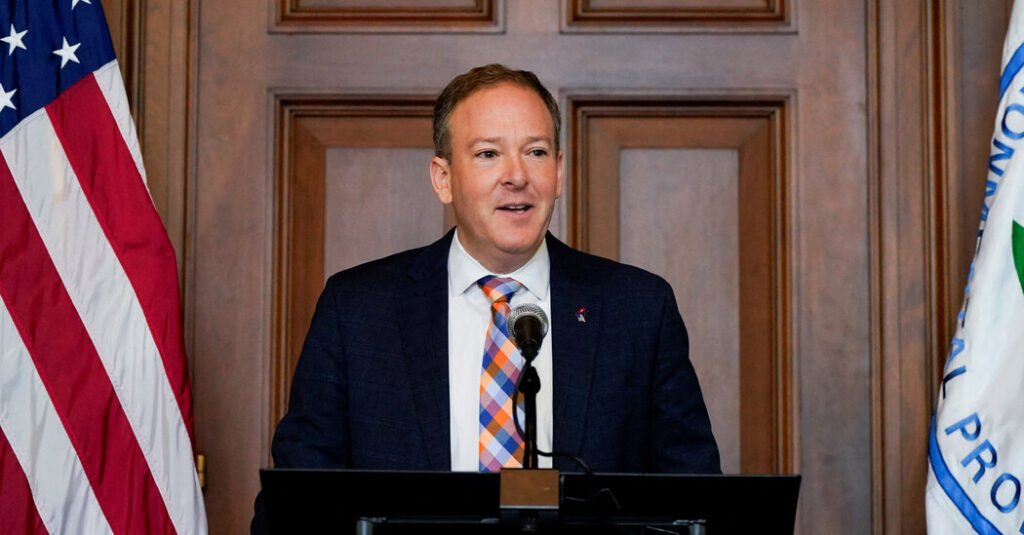
But Lee Zeldin, the administrator of the Environmental Protection Agency, appears to be playing to an audience of six: the conservative justices on the Supreme Court.
On Thursday, Mr. Zeldin will move to repeal a scientific determination that requires the federal government to combat climate change, according to Karoline Leavitt, the White House press secretary. The action will have taken just over a year to finalize, a remarkably rapid pace for an agency that typically spends at least three years on such efforts.
Legal experts said the speed would be no accident: It could allow the Supreme Court to consider related legal challenges while Mr. Trump is still in office. There, the conservative majority with an anti-regulatory bent could chip away at the federal government’s power to limit the greenhouse gas emissions that are dangerously warming the Earth.
And in an extreme scenario, the court could sharply curtail a future Democratic administration’s efforts to fight global warming.
“They’re swinging for the fences,” said Jody Freeman, the director of Harvard Law School’s Environmental and Energy Law Program. “They want to not just do what other Republican administrations have done, which is weaken regulations. They want to take the federal government out of the business of regulation, period.”
Jeffrey Holmstead, an energy attorney with the law firm Bracewell and a former E.P.A. official under President George W. Bush, said the second Trump administration was barreling toward the Supreme Court.
“They’ve moved very quickly, especially compared to the first Trump administration, where they didn’t do much of anything in their first year,” Mr. Holmstead said. “This time they’re much more organized and they have a pretty clear playbook.”
The scientific determination on climate change, known as the endangerment finding, concluded that carbon dioxide, methane and four other greenhouse gases are a threat to public health and welfare. It required the federal government to regulate these gases, which result from the burning of oil, gas and coal.
Carolyn Holran, a spokeswoman for Mr. Zeldin, did not respond to detailed questions for this article but said in an emailed statement: “Sixteen years ago, the Obama administration made one of the most damaging decisions in modern history — the 2009 endangerment finding. In the intervening years, hard-working families and small businesses have paid the price as a result.”
Ms. Holran added that the endangerment finding “is the legal prerequisite used by the Obama and Biden administrations to justify trillions of dollars of greenhouse gas regulations” affecting new gasoline-powered cars and trucks.
The endangerment finding has fueled fierce legal and political battles in Washington for more than two decades. And the issue has reached the Supreme Court once before.
In 2007, the justices ruled in a landmark case, Massachusetts v. E.P.A., that the agency had the authority to regulate greenhouse gases under the Clean Air Act of 1970. But they stipulated that the agency needed to prove that these gases posed a threat to public health and welfare.
Two years later, under President Barack Obama, the agency presented a mountain of scientific evidence to prove this point. In more than 200 pages, E.P.A. researchers detailed how rising concentrations of greenhouse gases in the atmosphere were supercharging storms, floods, wildfires and sea level rise, contributing to disease and death.
In its proposed repeal of the endangerment finding, the Trump administration is not expected to try to discredit this overwhelming scientific consensus. Instead, it will most likely argue that the Supreme Court got it wrong in Massachusetts v. E.P.A. and that Congress never explicitly gave the agency authority to regulate greenhouse gases under the Clean Air Act.
Once the repeal of the endangerment finding is finalized, environmental groups are certain to challenge it in federal court. And even if the Trump administration suffers an initial setback there, it is likely to appeal to the Supreme Court.
Ms. Freeman said she believed repealing the endangerment finding was a “secret effort” to overturn Massachusetts v. E.P.A. She noted that the Supreme Court’s conservative majority includes three justices who dissented in the 2007 case: Chief Justice John G. Roberts Jr., Justice Samuel A. Alito Jr. and Justice Clarence Thomas.
Jonathan Adler, a professor at William & Mary Law School, said the speed with which the E.P.A. is repealing the endangerment finding had both benefits and risks for the administration. On the one hand, he said, it could allow Trump administration lawyers to “defend their own work” in court and avoid the risk that a future administration might decide not to defend the case, essentially dropping it.
On the other, rushing could lead to mistakes.
“You want to move quickly, but for purposes of administrative review, agencies need to dot their i’s and cross their t’s, and that can take time,” Mr. Adler said, adding, “I’m not entirely convinced that the administration’s strategy is the most legally sound.”
A more definitive way to address the issue would be for Congress to weigh in. Democrats could pass legislation that defined greenhouse gases as air pollutants under the Clean Air Act, giving the E.P.A. the explicit authority to regulate them. Conversely, Republicans could enact legislation that said the opposite.
But in the half-century since Congress passed the Clean Air Act, it has never mustered the political will to decide this question. And it seems exceedingly unlikely to happen at a time when climate change has become such a polarizing topic.
In the absence of congressional action, some climate science denialists said they hoped that the high court would tie the hands of future Democratic administrations for decades to come.
“The goal is not just to rescind the endangerment finding, it’s to overturn Massachusetts v. E.P.A. and make sure this cannot come back, unless Congress decides to get involved,” said Steven J. Milloy, the founder of a website that has disputed the scientific consensus on climate change. “Anything else is not good enough.”
Maxine Joselow covers climate change and the environment for The Times from Washington.
The post The E.P.A. Is Barreling Toward a Supreme Court Climate Showdown appeared first on New York Times.