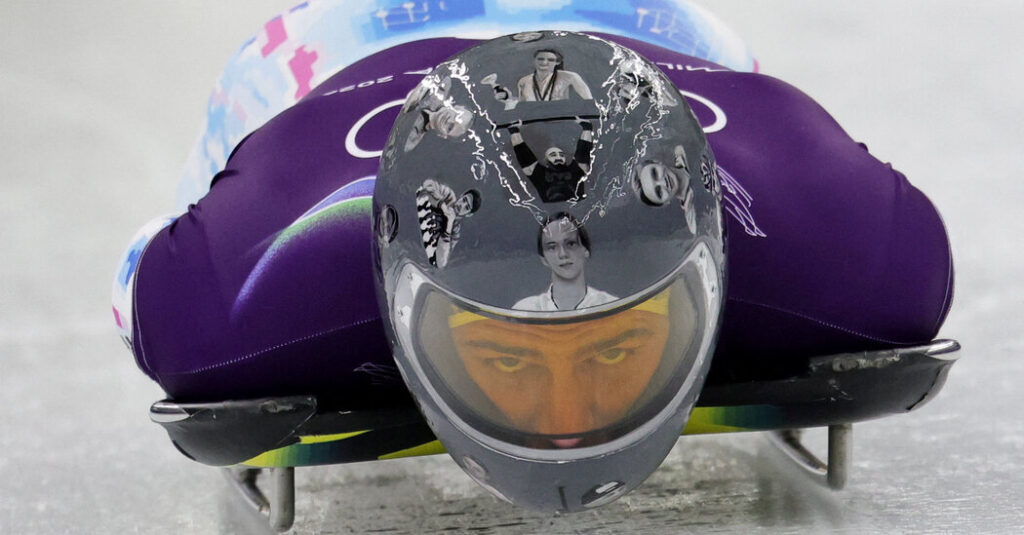
A Ukrainian athlete cannot wear a helmet featuring images of his countrymen who were killed in the war with Russia, Olympic officials said on Tuesday, ruling it a violation of the Games’ prohibition on political speech.
The athlete, Vladyslav Heraskevych, who is competing in the skeleton at the Winter Games in Italy, said his “remembrance helmet” was an important tribute to those who have died in the war. But the International Olympic Committee said it cannot be worn in competition and allowed Mr. Heraskevych to wear a black armband instead.
Mr. Heraskevych, 27, posted a video to Instagram on Monday night explaining that he had worn the helmet — featuring photographs of Ukrainian athletes who have died in the war — in a training session in Cortina d’Ampezzo.
After the session, an I.O.C. representative informed him that he could not wear the helmet in official training or in competition, Mr. Heraskevych said in the video.
“Despite this,” he said in the post, “we do not give up. We continue the fight.”
The athletes featured on the helmet, some of whom Mr. Heraskevych described as friends, were a mix of people killed as civilians and as combatants.
Mark Adams, an I.O.C. spokesman, told reporters in Milan on Tuesday that while athletes could speak freely on social media or in public appearances, Olympic rules ban political speech during official training and competitions.
“We need to keep that specific moment, that field of play, as pure as we can for the competition,” Mr. Adams said.
The Olympic Charter states, “No kind of demonstration or political, religious or racial propaganda is permitted in any Olympic sites, venues or other areas.”
Mr. Adams said that the Ukrainian Olympic committee had asked the I.O.C. to allow the helmet. After meeting with Mr. Heraskevych’s coach and others on Monday night, the I.O.C. decided that he could wear a plain black armband with no text as a gesture of remembrance, Mr. Adams said.
“As soon as we start getting into text, we start getting into issues of expression,” he said. “However much we may sympathize with that expression, once we open the door to that expression, it’s difficult to stop the expression of one that we may not agree with.”
Mr. Heraskevych, the first Ukrainian athlete to compete in skeleton, was his country’s flag-bearer during the opening ceremonies last week. In 2022, at the Winter Games in Beijing, he held up a sign that read “No War in Ukraine” days before Russian forces launched their full-scale invasion.
His helmet is more subtle. In an Instagram post on Tuesday, Mr. Heraskevych shared photographs and short biographies of the 21 people depicted on it, including Yevhen Malyshev, a 19-year-old biathlete; Dmytro Sharpar, a 25-year-old figure skater; and Pavlo Ishchenko, a Ukrainian bodybuilding champion.
Russian athletes have been barred from competing in the Olympics under their national flag for more than a decade, since a widespread doping scandal emerged after Russia hosted the 2014 Winter Games in the Black Sea ski resort of Sochi. But the I.O.C. has begun to loosen some rules, and some Russians are participating in the Games as neutral athletes, not officially representing their country.
President Volodymyr Zelensky of Ukraine praised Mr. Heraskevych in a social media post “for reminding the world of the price of our struggle.”
“This is precisely what reminds everyone of the global role of sport and the historic mission of the Olympic movement itself — it is all about peace and for the sake of life,” Mr. Zelensky said.
Despite Olympic rules, the Games have long been used as a platform for political statements. At the 1968 Summer Games in Mexico City, the American sprinters Tommie Smith and John Carlos raised their fists, clad in black gloves, during a medal ceremony to protest racism in the United States. They were expelled from the Games but kept their medals.
At the Paris Games in 2024, Manizha Talash, an Afghan break dancer, was disqualified after she wore a cape that read “Free Afghan Women” in competition.
Mr. Heraskevych’s helmet is not the only piece of apparel to come under scrutiny at this year’s Games. A month before they began, Olympic officials said Haiti could not include an image representing its revolutionary leader, Toussaint Louverture, on its uniforms, calling it political propaganda.
Heather Knight is a reporter in San Francisco, leading The Times’s coverage of the Bay Area and Northern California.
The post Olympic Officials Ban Ukrainian’s Helmet Honoring War Dead appeared first on New York Times.