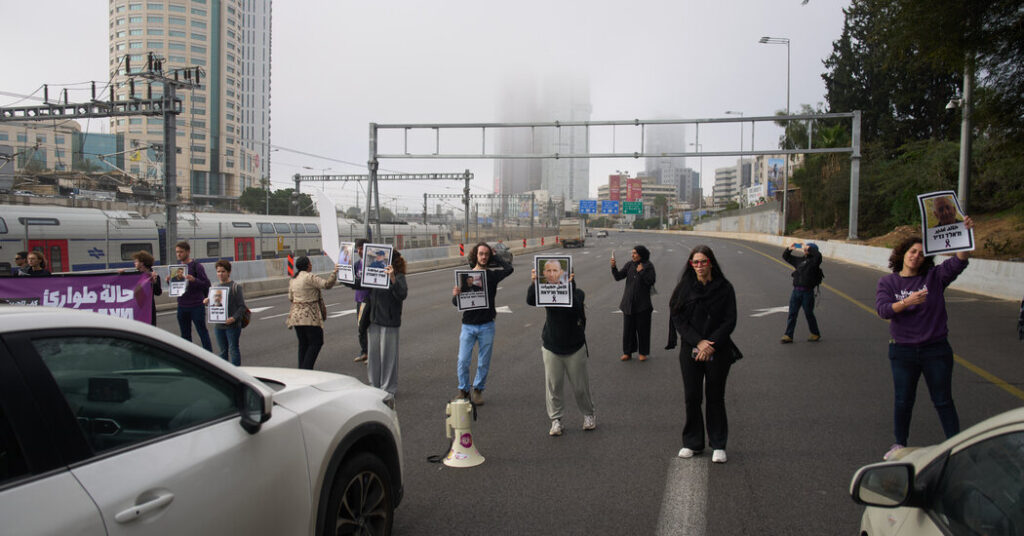
Bereaved families and their supporters blocked roads, staged work stoppages and dyed public fountains red across Israel on Tuesday to protest a surge in gun violence plaguing the country’s Palestinian-Arab minority community.
The “national day of disruption” was declared by families and activist groups led by Standing Together, a grass roots organization that advocates for equality between Jewish and Arab Israelis.
The country’s Arab population has witnessed a spike in violence in recent years, much of it driven by organized crime. At least 36 Arab citizens have died since the beginning of the year alone, according to local Arabic media reports.
Arabs make up about a fifth of Israel’s population of 10 million people. But criminal killings within the minority community have accounted for the vast majority of Israeli homicides in recent years.
“We, who have paid with the lives of our sons, brothers, parents, and loved ones, say no more,” a forum of the families of victims said in a statement. “Every day a person is murdered,” it added, blaming the government for neglect and the police for failing to curb violence.
Police representatives told a parliamentary committee on Tuesday that there were at least 241 homicides within the Arab community in 2025 compared with 47 among the Jewish population. It was the deadliest year on record for the minority group and an increase from 230 fatalities in 2024, according to the Abraham Initiatives, a Jewish-Palestinian Israeli advocacy group.
In addition, 21 foreign nationals were victims of deadly crime last year.
Video footage on Tuesday showed a small group of protesters blocking a main Tel Aviv artery during the morning rush hour.
Several protesters were detained in Tel Aviv and the northern port city of Haifa after pouring red dye into public pools and fountains, the police said. A fountain in the southern city of Beersheba was also turned red.
Organizers had called for a work stoppage from 11 a.m. to 1 p.m. Groups of Arab and Jewish medical workers, academics on university campuses, tech sector workers and others left their jobs and rallied around the country. Many of them carried portraits of homicide victims.
A protester in Jerusalem outside the official residence of Israel’s president, Isaac Herzog, held a banner that read, “The government is responsible for the safety of all its citizens.”
Dozens of medical workers in scrubs and white coats stood at midday outside Rambam Health Care Campus, the largest hospital in Haifa, a mixed city where Arab citizens make up about 14 percent of the population.
Elham Siwan, a nurse in the oncology department, said she had experienced the effects of gun violence about 18 months ago when her home in the Arab city of Sakhnin, about an hour’s drive away, was caught in crossfire. She said she believed that the assailants were targeting her neighbors.
“The damage is something we still haven’t recovered from, psychologically or financially,” said Ms. Siwan. She said three of her family’s cars were destroyed and the house sustained damage, though her family was not physically harmed.
Ms. Siwan said she temporarily left Sakhnin for a nearby village but felt that “no place is safe anymore.”
Dr. Nira Beck, head of the ultrasound unit at Rambam, who is Jewish, said her Arab colleagues and the wider Palestinian community were Israeli citizens who were being neglected by the state.
“We are obligated to stand with them,” she said.
Several factors have contributed to the soaring crime rate within Israel’s Arab community. Much of it is linked to loan-sharking and protection rackets run by Arab crime organizations that have proliferated over the years, according to Arab leaders and government officials. Gangs prey on communities that face discrimination and have limited access to bank loans.
High rates of unemployment and low levels of education have driven many young men into becoming foot soldiers for the gangs, while easy access to illegal weapons means that personal disputes often turn into deadly vendettas.
Only a fraction of shootings in the Arab community have resulted in an indictment. The police say that is a result of difficulty in gathering evidence and locating suspects and witnesses. Many Arab citizens say they are scared to testify for fear of being targeted by the gangs.
Ms. Siwan said police came to her home after the shooting, but told her there was little they could do.
“I blame the police, the state, and the government,” she said. “Things are out of control.”
Many Israelis say the situation has only deteriorated in the three years since Itamar Ben-Gvir, a far-right politician who promised to restore law and order, became the minister for national security, overseeing the police. Mr. Ben-Gvir’s office and the police did not respond to requests for comment.
Another Arab protester outside Rambam hospital, Dr. Muhammad Kaabeya, a hematologist, said he thinks “a hundred times” when he leaves his house.
“I don’t have enemies,” he said. “But I could be in the wrong place at the wrong time and that could cost me my life.”
Isabel Kershner, a senior correspondent for The Times in Jerusalem, has been reporting on Israeli and Palestinian affairs since 1990.
The post Israelis Protest Surge in Gun Crime Within Arab Community appeared first on New York Times.