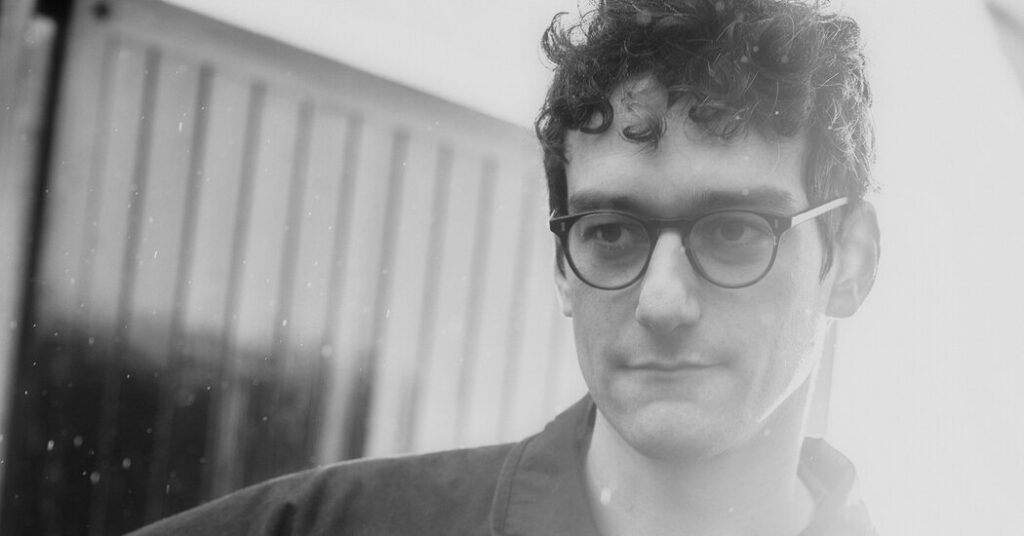
The producer Danny L Harle likes to describe his music with a near-paradox: “euphoric melancholy.” He also strives for, he says, “an alien beauty that’s outside of everything.” The songs he creates are often mournful and propulsive at the same time, merging room-shaking beats with solitary yearning.
Since the early 2010s, when he emerged with the paradigm-twisting English hyperpop collective PC Music, Harle has released more than 100 tracks. He has worked under his own name and with singers and songwriters including Dua Lipa, Charli XCX and Carly Rae Jepsen. On Friday, he will release “Cerulean,” which he considers his first full-fledged solo album.
“I had to make an album to make this statement,” Harle, 36, said by video from his studio in London. “A thing I could give to someone and say, ‘This is what I do.’ Not this mess of previous releases where you can hear fragments of me. This release was a kind of reconciliation of all my influences. That was the challenge I set myself.”
Harle’s influences are curated in his ever-expanding “huge playlist” for Spotify. It currently runs 67 hours with nearly 1,000 tracks, including pop hits, Italian electro-pop, classical pieces from the Renaissance to the 21st century, dance-club staples, nature sounds, a cappella British folk songs and more.
“I’m very interested in the relationship between the superficial enjoyment of something — as entertainment — but then if you look closer there’s intricacy and complexity to it,” he said.
Harle was the executive producer and the main collaborator on Caroline Polachek’s albums “Pang” (2019) and “Desire, I Want to Turn Into You” (2023), and she sings two songs on “Cerulean.”
“Danny and I both fundamentally love beauty in music,” she said in a video interview. “And we both are chameleons in a certain way, sonically. We don’t really have a set of aesthetics or sounds that we feel objectively committed to. So he and I are both up for shape-shifting, and trying different things, and blurring the edges between analog and digital sounds.”
Polachek first heard Harle’s work during the mid-2010s heyday of PC Music, which simultaneously parodied and exulted in pop’s artificiality and commercialism. (Its principals have gone on to become mainstream hitmakers.)
“In 2016, I think a lot of people had written off that whole collective as being completely ironic, which was of course a total misunderstanding of what they were doing,” Polachek said. “We’d entered into high sincerity and high authenticity in music at that time. And what I found was that Danny was both of those things, but of course he had a sense of irony as well.”
A listener can’t tell “if he’s joking or not when he gets really almost bombastic and maximalist in his music,” she added. “The cool thing is that there actually is no straight answer, because it is a joke and it also is 100 percent. He’s looking you dead in the eyes and he means it.”
Unlike many electronic-music producers, Harle works in a studio that isn’t stocked with vintage keyboards or gadgets. “It’s very rare that I find myself using any physical instruments,” he said as he panned to show his uncluttered work space. “I don’t really care about hardware at all. I’ve got my screens here, I’ve got my speakers here and my computer here, and that’s what I need.” Like many listeners in the 21st century, Harle experiences most of his music privately, via earphones: “The idea of sitting in front of somebody playing a guitar and singing at me is my nightmare.”
But he did reveal, on a couch behind him, an archaic instrument from the Baroque era: a tenor viol, from the family of the viola da gamba. He plays it on the album “Everybody Scream” by Florence + the Machine, which he helped produce.
“I never thought I’d play an instrument again,” he said, “mainly because my hands just kept on falling into the shapes of the repertoire of the instrument, rather than into a form where it would make the music that I like the sound of.”
Harle prizes abstract sound: not visuals, not physicality. And he’s drawn to digital sounds — particularly, he said, to “synthetic aerophones”: simulations of flutes, panpipes and other breath-driven instruments. “I find that to be for some reason incredibly emotional,” he said. “That kind of sound with a perfect-sounding synthetic reverb.”
“Cerulean” is actually Harle’s second album under his own name. His high-concept 2021 album, “Harlecore,” imagined multiple dance floors at a pounding 1990s-style rave, crediting the tracks to alter egos: DJ Danny, DJ Mayhem, DJ Ocean and MC Boing.
“Cerulean” is far more moody, varied and ambitious. It gathers and focuses the wildly disparate musical ideas that mingle in Harle’s music: purely synthetic textures and vulnerable human voices, classical intricacy and dance-floor impact, heartache and exhilaration.
When Harle started producing records, he envisioned a career as a dutiful craftsman. His father, John Harle, is a celebrated composer, saxophonist and music professor who has worked with classical, jazz and rock musicians. (He adds soprano saxophone lines to the digital fabric of the “Cerulean” track “Raft in the Sea.”) Danny Harle grew up playing cello, then switched to bass fiddle and bass guitar. He studied classical composition at college, but electronics poked in; his thesis project combined instruments with video game sounds. After leaning into the avant-garde as a student, he came to respect the clarity and directness of pop.
But he only expected to work as a facilitator. “I thought I was going to be one of those hired-gun producers who can take on any genre and work out what makes it tick, and then just smash it and write any kind of song for any kind of artist,” he said. “It’s not a self-indulgent thing — it’s like a service.”
Yet his early efforts at formula were “failures, failures, failures,” he said. Instead, his most idiosyncratic ideas found more traction. He had wanted to be a hack; instead, he found out he was an auteur.
Collaborations sharpened his sense of direction. “A true collaboration is like giving a part of yourself to someone else, and it actually makes you discover a lot about yourself,” he said. “When I’m collaborating with an artist, it feels like we’re both making an object and marveling at it, rather than it being a direct expression. There’s something objective, dare I say, to the creation of a beautiful thing.”
“Cerulean” is bookended by somber instrumentals that have a string orchestra from London, 12ensemble, at their center. “In a lot of the music that I love, like a lot of Renaissance polyphony, a lot of Elizabethan music, and more contemporary music like Thomas Adès, there’s a harmonic landscape which is constantly shifting,” he said.
Dance music, by contrast, “requires repetition to achieve what it sets out to do,” he explained. “I was aiming to try and actually escape the sonic identity of classical music, and just take what I love about it and put it into the sounds that I love.”
Between the instrumentals are crisp but ever-surprising songs, laced with hyperpop tweaks and dizzying arpeggios. Nearly all the vocals are by women, including Lipa, Polachek, PinkPantheress and Clairo. They sing about loneliness, lost love, memories and bare glimmers of hope. The lyrics are filled with aquatic imagery, like “Raft in the Sea” (sung by Julia Michaels) and “Island” (sung by Harle’s daughter Nico).
“In the music I listen to, if there is a voice, it’s nearly always a female voice, or a very high-pitched voice — it’s about pitch, not gender,” he said. “It’s particular types of voices as well — voices that make me almost burst into tears.”
Harle’s songs may be doleful, but the process behind them is not. The French singer, songwriter and producer Marylou Mayniel, who records as Oklou, has collaborated with Harle on her own music and sings “Crystallise My Tears” on “Cerulean.” In a video interview from France, she said, “When he works on his computer, he’s smiling all the time — not just when it’s really, really good. He genuinely has a lot of fun. He has such joy and amusement — that’s what I wish for myself and for all the artists I know. He’s like a child with toys.”
Jon Pareles, a culture correspondent for The Times, served as chief pop music critic for 37 years. He studied music, played in rock, jazz and classical groups and was a college-radio disc jockey. He was previously an editor at Rolling Stone and The Village Voice.
The post Inside Danny L Harle’s Synthetic Universe appeared first on New York Times.