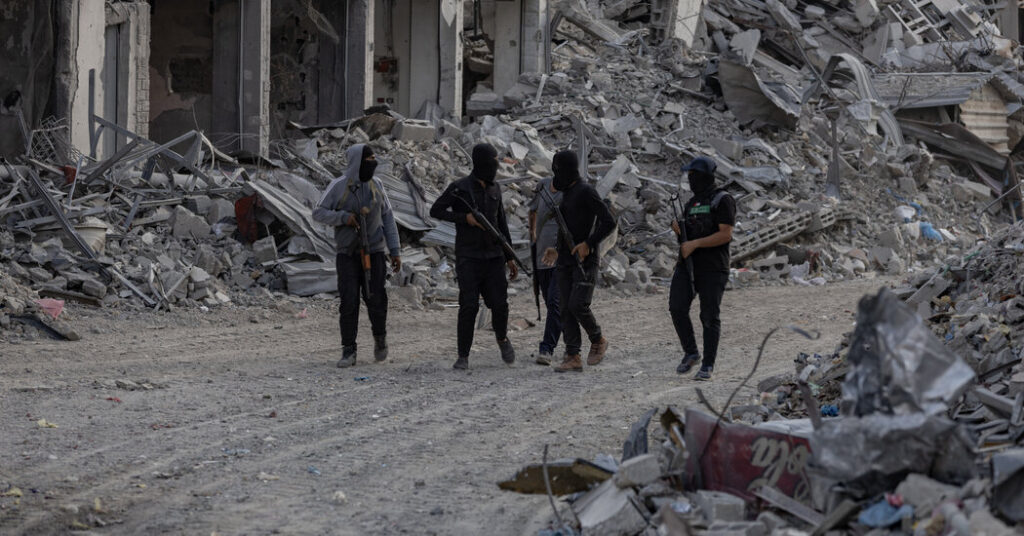
The United States is demanding that Hamas surrender all weapons that are capable of striking Israel, but will allow the group to keep some small arms, at least initially, according to a draft plan, officials and people familiar with the proposal said.
An American-led team, which includes Jared Kushner, President Trump’s son-in-law; Steve Witkoff, the U.S. special envoy for peace missions; and Nickolay Mladenov, a former senior United Nations official, intends to share the document with Hamas within weeks.
The officials, including a regional diplomat, and people familiar with the plan spoke on condition of anonymity because of the sensitivity of the details. They cautioned that the details could still change and different drafts could yet emerge.
Still, if the plan is presented to Hamas, it would represent a significant effort toward demilitarizing the armed group, a key element of Mr. Trump’s 20-point plan for Gaza that formed the basis of the cease-fire agreement between Israel and Hamas after two years of war.
If the militant group, still the most powerful Palestinian force in Gaza, does give up most of its weapons, it would be a breakthrough in diminishing Hamas’s monopoly on power.
A spokesman for Prime Minister Benjamin Netanyahu of Israel and a Hamas media official did not respond to requests for comment.
The Trump administration expects Hamas to disarm and carry out the 20-point plan, a White House spokesman, Dylan Johnson, said. “The United States is working closely with all parties and mediators to ensure full implementation of the plan and to advance a durable security framework that supports long-term stability in the region and prosperity for Gaza,” he added.
It was not immediately clear who would take ownership of the weapons that Hamas was meant to hand over or how that process would be carried out.
The draft plan appears to build on principles that have been publicly discussed before. Last month, Mr. Kushner gave a presentation in Davos, Switzerland, that included the next steps for the demilitarization of Gaza, saying that “heavy weapons” would be “decommissioned immediately.”
The presentation also said that “personal arms” would be “registered and decommissioned” as a new Palestinian administration took charge of security in the enclave, though it did not specify what weapons would be covered.
Trump Administration: Live Updates
Updated
- Homeland Security Shutdown Nears Amid Stalemate on Immigration Agent Curbs
- Ahead of the monthly jobs report, the administration is trying to downplay any slowdown.
- The U.S. hands over some NATO commands to its European allies.
Israel is unlikely to withdraw its troops from the enclave before Hamas and other militant groups lay down their arms. Israel also considers Hamas’ vast underground tunnel network in Gaza to be part of the group’s military infrastructure. And without demilitarization, it will be difficult for Mr. Trump’s new Board of Peace to bring about the next steps of the 20-point plan. Mr. Kushner, a key figure in the international group, has no official role within the Trump administration but has become a major architect in the postwar plans for Gaza.
The next steps include deploying an international stabilization force to Gaza, beginning large-scale reconstruction there and handing over administration of the territory to a Palestinian technocratic committee.
Demilitarization is “the linchpin of everything,” according to Shira Efron, chair of Israel policy at the RAND Corporation, a U.S.-based research institute. “If it doesn’t happen, we could end up with two Gazas, one run by Israel and the other by Hamas, or a return to a fully fledged war.”
Israel has refused to accept anything short of the full demilitarization of Gaza, vowing to strip Hamas of the ability to launch another attack against Israeli communities like the one it led on Oct. 7, 2023, that left 1,200 people dead and ignited the war in territory.
In November, Mr. Netanyahu said in a speech to Israel’s Parliament that Hamas would be disarmed “the easy way or the hard way, but it will happen.”
Hamas has not said publicly whether it would hand over its weapons, and the idea of even discussing disarmament has created fissures in the group. For many Hamas members, giving up their weapons would be tantamount to surrender, with armed struggle against Israel a crucial part of the group’s ideology. And Hamas may not give up its weapons in order to retain control in Gaza.
On Sunday, Khaled Meshal, a senior Hamas official, suggested that Hamas wanted to hold on to its weapons but was not planning to use them in the near future.
“As long as there’s an occupation, there’s resistance,” he said at an event in Doha, Qatar, hosted by Al Jazeera, the Qatari news network. Yet, later in his remarks, Mr. Meshal said it was doubtful that people in Gaza would consider taking up arms against Israel “in the next 10 to 15 years.”
The draft plan envisions a phased disarmament, which could take months or longer to complete, according to the officials.
In December, Mr. Netanyahu told Fox News that Hamas still had 60,000 “AK rifles,” referring to Kalashnikov-style rifles. Israeli officials have also said that more than half of the underground tunnels in Gaza, which Hamas has used to store weapons, hide out, and hold hostages, were still intact.
Aaron Boxerman contributed reporting.
Adam Rasgon is a reporter for The Times in Jerusalem, covering Israeli and Palestinian affairs.
The post Hamas Would Keep Some Arms Initially in Draft Gaza Plan, Officials Say appeared first on New York Times.