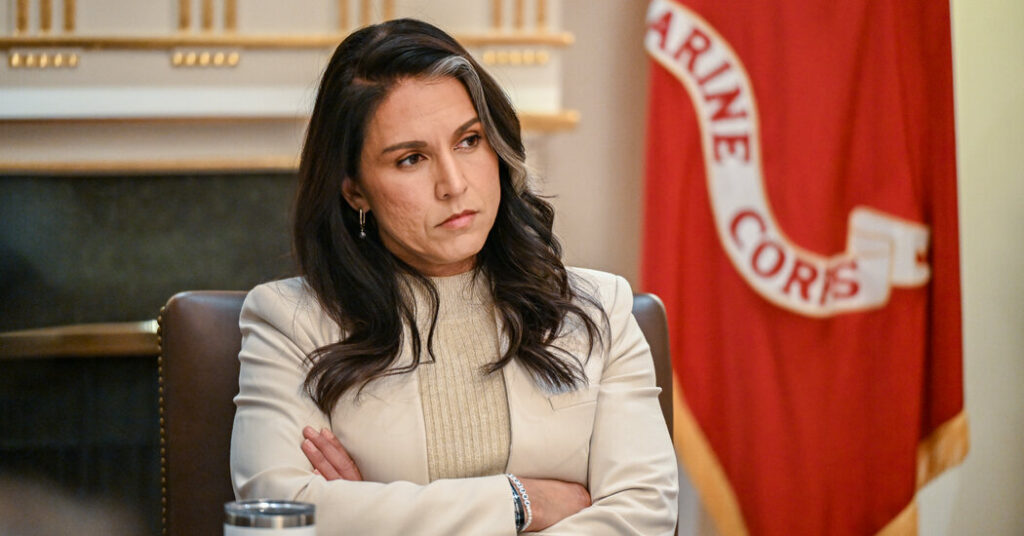
In late January, Tulsi Gabbard, the director of national intelligence, was leading a meeting on Syria in the Situation Room, when President Trump abruptly changed course by reminding her of an earlier chat on a subject he regarded as even more urgent.
Ms. Gabbard’s role in reopening and expanding the investigation of the 2020 election.
Now Mr. Trump was ordering Ms. Gabbard to help oversee an F.B.I. investigation of his baseless claims of irregularities in the vote, according to people with knowledge of the meeting.
“You go do that, you get it done,” Mr. Trump suddenly told her.
Days later Ms. Gabbard appeared at a warehouse in Fulton County, Ga., where ballots from the 2020 vote were stored. As the F.B.I. conducted a raid, she observed and oversaw their work. After the operation, Ms. Gabbard met with the F.B.I. agents and put Mr. Trump on speaker phone to address them.
It was an unusual move. Most presidents keep an arm’s distance from investigations. Mr. Trump’s conversation with the F.B.I. agents and his decision to order Ms. Gabbard to Georgia to oversee the raid could raise questions about vindictive prosecutions and complicate future court cases.
Ms. Gabbard has fallen in and out of favor at different times during the first year of the Trump administration — earning a rebuke from the president for a social media video, ill-timed comments about Iran’s nuclear program and frequent appearances on cable television that some viewed as self-promotion.
But with the renewed investigation into baseless claims about fraud during the 2020 election, she is back in the spotlight, and Mr. Trump’s good graces.
Administration officials say Ms. Gabbard has found her footing by being more judicious about her television appearances and focusing on the intelligence briefing. And perhaps more important, the White House sees Ms. Gabbard as a “true believer,” they said.
Ms. Gabbard’s super power — at least in the eyes of Mr. Trump — is her enthusiasm for what many consider conspiracy theories and her relentless focus on attacking, and rooting out, the so-called deep state.
This article is based on interviews with administration and other American officials as well as other people with knowledge of Ms. Gabbard’s work. They spoke on the condition their names or positions not be revealed given the sensitivity of Ms. Gabbard’s work.
After Ms. Gabbard accused former President Barack Obama of “treasonous conspiracy” for starting the investigation into Russian meddling in the 2016 election, Mr. Trump praised Ms. Gabbard, seeing her as an effective spokeswoman about issues he cares about.
As the director of national intelligence, Ms. Gabbard is charged with coordinating and overseeing the nation’s spy agencies — as well as intelligence briefings for the president. The office, in recent years, has collected and publicized evidence of foreign meddling in U.S. elections.
During the Biden administration, that meant tracking, and calling out, influence operations by Russia, Iran and other foreign powers. But Ms. Gabbard has shifted the focus of her office’s election defense work to the security of voting machines, and whether they could be compromised by adversarial foreign governments.
Citing a 2022 assessment about the potential for foreign powers to hack into electronic voting machines and manipulate the vote, Ms. Gabbard has pushed her office to look deeper into the voting systems. With the help of a U.S. attorney, her team seized voting machines from Puerto Rico last year to examine them for vulnerabilities.
The examination found various potential problems including modems that connected to cellular networks outside the United States — though no evidence of a foreign power tampering with votes has yet to be released. Amid Ms. Gabbard’s work on the voting machines, Mr. Trump tapped her to oversee the F.B.I. examination in Georgia.
Mr. Trump has expressed frustration with the Justice Department for not moving fast enough, or effectively enough, on prosecutions or investigations he wants to see. He has taken Attorney General Pam Bondi to task privately several times. And other officials said Mr. Trump has little confidence that Kash Patel, the F.B.I. director, can follow through and find evidence of wrongdoing on the issues the president cares about.
While the Trump administration’s explanation for Ms. Gabbard’s presence in Georgia has shifted, people briefed on the decision-making said the president’s doubts about the Justice Department prompted him to give Ms. Gabbard an outsize role in overseeing the investigation into voting irregularities.
Davis Ingle, a White House spokesman, dismissed any notion of “internal divisions” and said Mr. Patel and Ms. Gabbard were working together.
Trump Administration: Live Updates
Updated
- Judge strikes down California’s ban on masks for federal agents.
- Oz offers forceful call for vaccination as measles becomes more dire.
- A MAHA group is pledging $1 million to help defeat Senator Cassidy in a Louisiana primary.
Ms. Gabbard has defended her work on elections, and her office has said she has broad authority to coordinate and analyze intelligence related to election security, including both foreign influence and cybersecurity.
But she is not a prosecutor. She has no power to bring charges. Her authority is, ostensibly, limited to investigating international interference in U.S. elections.
Senator Mark Warner, Democrat of Virginia and the vice chairman of the Senate Intelligence Committee, said the “fiasco” of Ms. Gabbard’s visit to Georgia needed further investigation.
“If Donald Trump told Tulsi Gabbard to go to Atlanta, then he must have known about the warrant being served before it was served, which is against all protocols and rules,” Mr. Warner told reporters on Thursday. “She is foreign intelligence, not domestic criminal investigations.”
But Mr. Ingle said that Ms. Gabbard was working to carry out the president’s “election integrity priorities.” “President Trump pledged to secure America’s elections, and he has tasked the most talented team of patriots to do just that,” he said.
Mr. Trump, for his part, has little regard for bureaucratic boundaries. He encourages subordinates to venture outside their lanes to pursue his agenda, and to send the message that they work for him, not the rulebook.
The result is that Ms. Gabbard has pushed into areas that sit squarely in the jurisdiction of the Justice Department.
Todd Blanche, the deputy attorney general, who also talks to the president regularly, told reporters last week that Ms. Gabbard was not part of the Fulton County investigation, describing her as an “expert” in the election integrity “space,” without explaining what that meant. He later said he did not “know why” Ms. Gabbard was at the search — and was not even given a heads-up she would be on site.
Ms. Bondi, Mr. Blanche’s boss, is friendly with Ms. Gabbard, according to people in her orbit. She and Mr. Blanche — who would be responsible for any prosecutions or civil actions taken as a result of the investigation — have not always been on board with Ms. Gabbard’s actions, or even given advance notice of her forays on their turf.
In July, Ms. Gabbard highlighted what she saw as problems with intelligence agencies’ analysis of Russia’s role in the 2016 vote, and she made a referral to the Justice Department aimed at getting the government to investigate one of Mr. Trump’s top grievances. The claim, unsupported by evidence, was that the Obama administration tried to undermine Mr. Trump by overstating Russia’s meddling in the election.
She did not give Ms. Bondi warning before she made a demand to investigate Mr. Obama.
Ms. Bondi felt blindsided and annoyed, according to people familiar with her thinking.
The Justice Department declined to comment.
Ms. Gabbard has left other bruises within the Trump administration. Her critics say the decision to strip security clearances of current and former intelligence officials has caused consternation — tensions with Congress, and frustration within other intelligence agencies that Ms. Gabbard had targeted apolitical people who were doing important work.
Mr. Warner has said Ms. Gabbard is misreading the law. The U.S. intelligence community is in charge of hunting down foreign threats. Any sort of broad remit to investigate ballots in Fulton County or anywhere else in the United States would be at odds with laws that give Ms. Gabbard’s office authority to monitor and coordinate intelligence on foreign attempts to influence American elections.
But senior administration officials have said repeatedly that Ms. Gabbard is acting within her legal mandate and, importantly, doing the bidding of Mr. Trump.
Nick Corasaniti contributed reporting.
Julian E. Barnes covers the U.S. intelligence agencies and international security matters for The Times. He has written about security issues for more than two decades.
The post Gabbard’s 2020 Election Claims Put Her Back in Favor With Trump appeared first on New York Times.