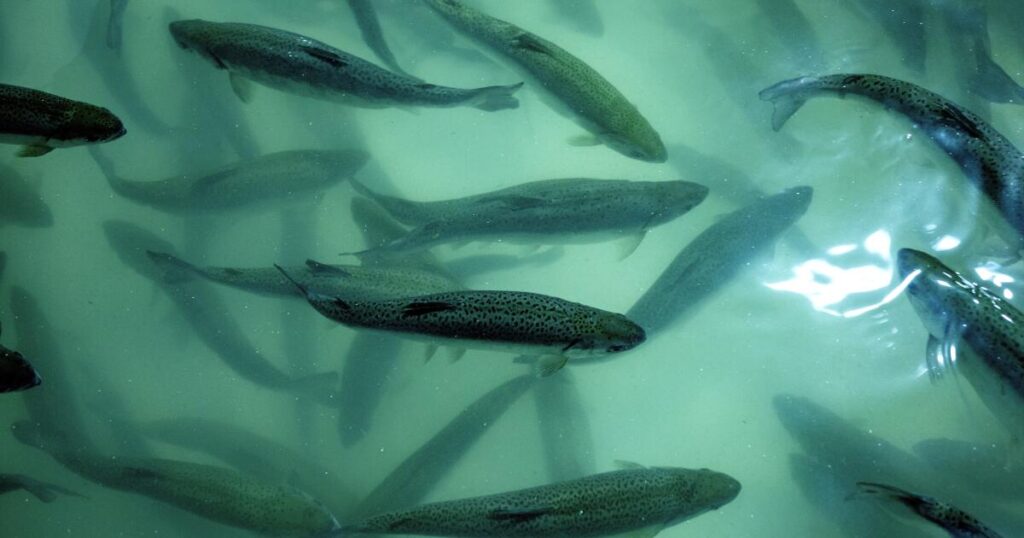
The federal government recently released new dietary guidelines aimed at “ending the war on protein” and steering Americans toward “real foods” — those with few ingredients and no additives. Seafood plays a starring role. But the fish that health advocates envision appearing on our plates probably won’t be caught in the crystal blue waters we’d like to imagine.
Over the past few decades, the seafood industry has completely revolutionized how it feeds the world. As many wild fish populations have plummeted, hunted to oblivion by commercial fleets, fish farming has become all the rage, and captive-breeding facilities have continually expanded to satiate humanity’s ravenous appetite. Today, the aquaculture sector is a $300-billion juggernaut, accounting for nearly 60% of aquatic animal products used for direct human consumption.
Proponents of aquaculture argue that it helps feed a growing human population, reduces pressure on wild fish populations, lowers costs for consumers and creates new jobs on land. Much of that may be correct. But there is a hidden crisis brewing beneath the surface: Many aquaculture facilities are breeding grounds for pathogens. They’re also a blind spot for public health authorities.
On dry land, factory farming of cows, pigs and chickens is widely reviled, and for good reason: The unsanitary and inhumane conditions inside these facilities contribute to outbreaks of disease, including some that can leap from animals to humans. In many countries, aquaculture facilities aren’t all that different. Most are situated in marine and coastal areas, where fish can be exposed to a sinister brew of human sewage, industrial waste and agricultural runoff. Fish are kept in close quarters — imagine hundreds of adult salmon stuffed into a backyard swimming pool — and inbreeding compromises immune strength. Thus, when one fish invariably falls ill, pathogens spread far and wide throughout the brood — and potentially to people.
Right now, there are only a handful of known pathogens — mostly bacteria, rather than viruses — that can jump from aquatic species to humans. Every year, these pathogens contribute to the 260,000 illnesses in the United States from contaminated fish; fortunately, these fish-borne illnesses aren’t particularly transmissible between people. It’s far more likely that the next pandemic will come from a bat or chicken than a rainbow trout. But that doesn’t put me at ease. The ocean is a vast, poorly understood and largely unmonitored reservoir of microbial species, most of which remain unknown to science. In the last 15 years, infectious diseases — including ones that we’ve known about for decades such as Ebola and Zika — have routinely caught humanity by surprise. We shouldn’t write off the risks of marine microbes too quickly.
My most immediate concern, the one that really makes me sweat, is the emergence of drug-resistant bacteria among farmed fish. Aquaculturists are well aware that their fish often live in a festering cesspool, and so many growers will mix antibiotics — including ones that the World Health Organization considers medically important for people — into fish feed, or dump them straight into water, to avoid the consequences of crowded conditions and prevent rampant illness. It would be more appropriate to use antibiotics in animals only when they are sick.
Because of this overuse for prevention purposes, more antibiotics are used in seafood raised by aquaculture than are used in humans or for other farmed animals per kilogram. Many of these molecules will end up settling in the water or nearby sediment, where they can linger for weeks. In turn, the 1 million individual bacteria found in every drop of seawater will be put to the evolutionary test, and the most antibiotic-resistant will endure.
Numerous researchers have found that drug-resistant strains of bacteria are alarmingly common in the water surrounding aquaculture facilities. In one study, evidence of antibiotic resistance was found in over 80% of species of bacteria isolated from shrimp sold in multiple countries by multiple brands.
Many drug-resistant strains in aquatic animals won’t be capable of infecting humans, but their genes still pose a threat through a process known as horizontal transfer. Bacteria are genetic hoarders. They collect DNA from their environment and store it away in their own genome. Sometimes, they’ll participate in swap meets, trading genes with other bacteria to expand their collections. Beginning in 1991, for example, a wave of cholera infected nearly a million people across Latin America, exacerbated by a strain that may have picked up drug-resistant adaptations while circulating through shrimp farms in Ecuador.
Today, drug-resistant bacteria kill over a million people every year, more than HIV/AIDS. I’ve seen this with my own eyes as a practicing tuberculosis doctor. I am deeply fearful of a future in which the global supply of fish — a major protein source for billions of people — also becomes a source of untreatable salmonella, campylobacter and vibrio. We need safer seafood, and the solutions are already at our fingertips.
Governments need to lead by cracking down on indiscriminate antibiotic use. It is estimated that 70% of all antibiotics used globally are given to farm animals, and usage could increase by nearly 30% over the next 15 years. Regulation to promote prudent use of antibiotics in animals, however, has proven effective in Europe, and sales of veterinary antibiotics decreased by more than 50% across 25 European countries from 2011 to 2022. In the United States, the use of medically important antibiotics in food animals — including aquatic ones — is already tightly regulated. Most seafood eaten in the U.S., however, is imported and therefore beyond the reach of these rules. Indeed, antibiotic-resistance genes have already been identified in seafood imported into the United States. Addressing this threat should be an area of shared interest between traditional public health voices and the “Make America Healthy Again” movement, which has expressed serious concerns about the health effects of toxins.
Public health institutions also need to build stronger surveillance infrastructure — for both disease and antibiotic use — in potential hotspots. Surveillance is the backbone of public health, because good decision-making is impossible without good data. Unfortunately, many countries — including resource-rich countries — don’t robustly track outbreaks of antibiotic-resistant pathogens in farmed animals, nor do they share data on antibiotic use in farmed animals. By developing early warning systems for detecting antibiotic resistance in aquatic environments, rapid response efforts involving ecologists, veterinarians and epidemiologists can be mobilized as threats arise to avert public health disasters.
Meanwhile, the aquaculture industry should continue to innovate. Genetic technologies and new vaccines can help prevent rampant infections, while also improving growth efficiency that could allow for more humane conditions.
For consumers, the best way to stay healthy is simple: Seek out antibiotic-free seafood at the supermarket, and cook your fish (sorry, sushi lovers).
There’s no doubt that aquaculture is critical for feeding a hungry planet. But it must be done responsibly.
Neil M. Vora is a practicing physician and the executive director of the Preventing Pandemics at the Source Coalition.
The post Factory farming of fish is brewing pathogens appeared first on Los Angeles Times.