The Kremlin has seized on the latest release of files related to Jeffrey Epstein, saying the lurid details of his ties with leading American and European figures in business, politics and culture underscore the moral depravity of the West.
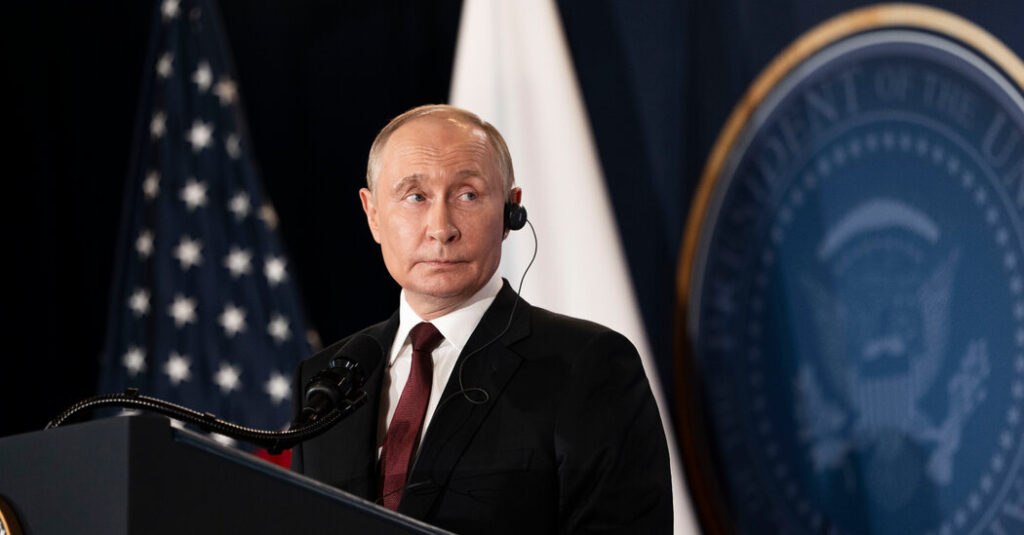
Yet the files also detail Mr. Epstein’s contacts inside similar circles in Russia, where he cultivated officials and traded favors, including with those he hoped might facilitate a meeting with President Vladimir V. Putin.
In 2014, Mr. Epstein befriended Sergei L. Belyakov, then a deputy minister of economic development who had attended the academy of the Federal Security Service, a successor of the Soviet K.G.B. At one point, Mr. Epstein turned to Mr. Belyakov for advice in what he described as a blackmail attempt by a Russian woman against a businessman. Other emails and court records make clear that the businessman was the billionaire financier Leon Black.
Through two senior Norwegian diplomats, the foreign minister of Slovakia and Ehud Barak, a former prime minister of Israel, Mr. Epstein sought to meet Mr. Putin or the Russian foreign minister, Sergey V. Lavrov. After Donald J. Trump’s election in 2016, Mr. Epstein offered his services to help the Russians understand the new American president.
“I think you might suggest to putin, that lavrov, can get insight on talking to me,” Mr. Epstein wrote in 2018 to Thorbjorn Jagland, a former prime minister of Norway who was then head of the Council of Europe.
Mr. Epstein does not appear to have ever landed a meeting with Mr. Lavrov, let alone Mr. Putin, but the files offer new details about the breadth of his contacts related to Russia, which he saw as an opening for political and business interests, as well as a source of the young women he lured into his network. It also shows how Russian officials sought out Mr. Epstein for advice, insights and possibly investments.
Some of Mr. Epstein’s ties with Russia have been known before, but the trove of more than 1.3 million files that the Justice Department released last month has raised new questions among Russia’s critics about whether the relationships opened the door to Russian intelligence activity.
Poland’s prime minister, Donald Tusk, said last week that his government would investigate the ties documented in the files.
Some of the people who appear in them have since resigned, including Brad Karp, chairman of the elite law firm Paul Weiss, who had exchanged emails with Mr. Epstein about Mr. Black. In Britain, the disclosures have rattled the government of Prime Minister Keir Starmer. It has prompted the resignation of Mr. Starmer’s chief of staff after the dismissal last fall of Peter Mandelson, the British ambassador to the United States.
Others linked to Mr. Epstein and Russia are also facing the fallout. They include Mr. Jagland and another Norwegian diplomat, Terje Rod-Larsen, whose wife, Mona Juul, stepped down on Sunday as the country’s ambassador to Jordan and Iraq.
Last week, Maria Zakharova, the spokeswoman for Russia’s foreign ministry, used the disclosures to disparage the United States and Europe. “Now we know how the Western elite treat children, including their own,” she said in a briefing, referring to Mr. Epstein’s exploitation of underage girls.
Ms. Zakharova did not respond to questions about Mr. Epstein’s ties to Russian officials, but critics of Mr. Putin’s government called the official response disingenuous.
“It’s completely hypocritical of Russian officials to speak about traditional values,” said Ivan Zhdanov, an opposition politician who exposed senior Russian officials’ hiring of escorts while working for the anti-corruption foundation of Aleksei A. Navalny, a critic of Mr. Putin’s who died in 2024.
“We have quite a few Epsteins at home as it is,” he added.
Thousands of documents in the files revealed a complex web of relationships that each side at times found useful.
Mr. Epstein, seeking to rehabilitate his reputation after pleading guilty in 2008 to a charge of soliciting prostitution from a minor, appeared to see Russia as a way to revive his fortunes. Some Russian officials, in turn, were looking to sustain business ties after sanctions imposed in response to the annexation of Crimea in Ukraine in 2014 strained Moscow’s economy.
Mr. Epstein regularly met with Vitaly I. Churkin, Russia’s representative to the United Nations from 2006 until his death in 2017, and arranged an internship for his son, Maxim, upon his graduation from Columbia Business School in 2016.
In 2017, Mr. Epstein tried to set up a meeting in New York with Valery Gergiev, the director of the Mariinsky Theater in St. Petersburg and, since 2023, also the head of the Bolshoi Theater in Moscow.
Another contact of Mr. Epstein’s described him as a potential avenue to reach Mr. Putin. A representative for Mr. Gergiev, R. Douglas Sheldon, said that a “third party” had tried to set up a meeting but that he did not think one had occurred. .
In emails to Mr. Jagland, Mr. Epstein suggested he could help Mr. Putin’s government find its way out of its economic isolation. In the careless, ungrammatical style of many of his messages, he suggested that Mr. Putin should create “a sophisticated russian version of bitcoin.”
A lawyer for Mr. Jagland, Anders Brosveet, said in a statement that he would cooperate with the investigation now underway in Norway, without addressing the nature of his interactions with Mr. Epstein. Lawyers representing Mr. Rod-Larsen, the Norwegian diplomat, and his wife, Ms. Juul, did not immediately respond to a request for comment.
Mr. Epstein made plans to visit Russia on several occasions, though how many times he went is not clear from the files.
In 2014, he scheduled meetings with a deputy finance minister, Sergei A. Storchak, and the deputy head of Russia’s central bank, Aleksei Y. Simanovsky. A year later, he was invited to the annual St. Petersburg International Economic Forum, sometimes known as Mr. Putin’s “Davos.”
Mr. Belyakov, the deputy minister of economic development whom Mr. Epstein had befriended a year before, helped arrange a three-year, multiple-entry visa.
As Mr. Belyakov rose through the ranks of Russian politics and business, Mr. Epstein introduced him to titans of Silicon Valley, like Peter Thiel and Reid Hoffman, as well as Mr. Barak, the former prime minister of Israel. Mr. Thiel and Mr. Barak did not respond to requests for comment; a spokeswoman for Mr. Hoffman said they never met and could find no invitation to do so.
Mr. Belyakov also reached out about possible investments in Russia. In 2016, he took a position with the country’s sovereign wealth fund, where, he told Mr. Epstein, “I’m looking for any opportunities to attract money to Russia.” He asked whether Mr. Epstein would be interested in a new crypto payment system, Mycelium.
Mr. Belyakov, reached in Moscow, declined to comment. Maxim Churkin, son of the former U.N. representative, who now works for Sberbank in Russia, did not respond to a request for comment.
A dark undercurrent throughout the documents is how Mr. Epstein also viewed Russia as a pool from which to lure more young women.
Mr. Epstein’s interest courses through his conversations about Russia. “Girls are incredible,” read a 2018 text from Slovakia’s foreign minister at the time, Miroslav Lajcak, to Mr. Epstein while on his way to meet his counterpart in Moscow, Mr. Lavrov.
“Duh,” Mr. Epstein replied. “Its their best export.”
“After crude oil,” Mr. Lajcak countered.
“Saudi has oil,” came Mr. Epstein’s rejoinder. “Moscow has girls.”
After his exchanges with Mr. Epstein became public, Mr. Lajcak resigned as the national security adviser to Slovakia’s prime minister, Robert Fico. In an interview with Radio Slovakia last week, he said that he had exercised “poor judgment” and that his interaction with Mr. Epstein was merely “male banter.”
The files show that Mr. Epstein showered women he met with gifts, attention and, in some cases, financial support.
A beneficiary of his estate when he died was Karyna Shuliak, from Russia’s close ally, Belarus. He first met her in 2012 and paid her way through dental school, the documents showed. She was the last person he called in 2019 before the authorities said he killed himself in his jail cell in New York City.
At the same time, he maintained a relationship with Maria Prusakova, a Russian snowboarding champion who competed in the Winter Olympics in Turin in 2006. They appear to have met in 2011, when she was 21, and remained in touch for years.
Their exchanges in the files suggest that the two were intimate and that he paid for trips while she attended law school in Paris, and for at least some of her housing and other costs when she studied for a Master of Law at the University of California, Berkeley, in 2016 and 2017.
Ms. Prusakova, like others in the emails, recruited other women to meet Mr. Epstein, often referring to their ages and physical appearance. It was not always clear what she was recruiting them for, though in one email she offers a woman’s services as “a massage lady.”
She came to view the recruitment as a chore. “It’s a lifetime job to find you perfect matches :-),” she wrote to Mr. Epstein after helping him find a personal assistant.
Days after his arrest on federal charges in July 2019, she wrote to him one last time. “Jeffery Im worried,” she texted him. She signed off with an emoji of a yellow heart. Ms. Prusakova did not respond to requests for comment.
Mr. Epstein also worked with Maria Drokova, who was, as a teenager, a spokeswoman for a nationalist youth group in Russia called Nashi, or Ours. Its leaders had close ties to Mr. Putin’s government, which created the group to mute youthful political unrest.
Ms. Drokova, who has since moved to the United States, married and taken the last name Bucher, set up a series of meetings for Mr. Epstein in 2017 and 2018 with reporters at The New York Times and other news organizations to help rehabilitate his reputation — unpaid, she emphasized in a statement she posted on X on Monday.
The files nonetheless suggest a personal, at times flirtatious relationship. In 2017, he arranged to send her a Prada tote bag worth $1,790. In June 2019, two months before Mr. Epstein’s death, she sent photographs a friend took in Paris — “they are beautiful but I can’t show them in social networks,” she texted him.
“Nudes?” he pressed her, sounding disappointed.
“Next time I’m in Paris,” she responded.
Ms. Bucher, who now runs a venture capital firm in San Francisco called Day One Ventures, declined to discuss her relationship with Mr. Epstein. In her statement on X, she expressed regret for it, adding that she had cooperated with investigators and been in touch with other victims of his.
“I now see clearly how profoundly dark and evil he was — a master manipulator who preyed on vulnerability with chilling precision,’’ she wrote.
In 2015, when Mr. Epstein became concerned about a Russian woman’s relationship with Mr. Black, he turned to Mr. Belyakov for assistance.
“I need a favor,” Mr. Epstein wrote to his friend, explaining that the woman was trying to extort money; “it is bad for business for everyone involved,” he said.
Mr. Belyakov promised to help and pressed for more details, saying he would speak to someone who would know more. He ultimately responded with a summary of the woman’s activities, though he did not explain the source of the information.
The woman, he told Mr. Epstein, provided “sex and escort,” earning her $100,000 a month. He said that she had no “patronage,” meaning protection in Moscow. The best thing to do, he recommended, was to cut off her visa to the United States.
Matthew Goldstein Steve Eder Paul Sonne and Oleg Matsnev contributed reporting
Steven Lee Myers covers misinformation and disinformation from San Francisco. Since joining The Times in 1989, he has reported from around the world, including Moscow, Baghdad, Beijing and Seoul.
The post Epstein Files Reveal Efforts to Build Ties With Officials in Russia appeared first on New York Times.