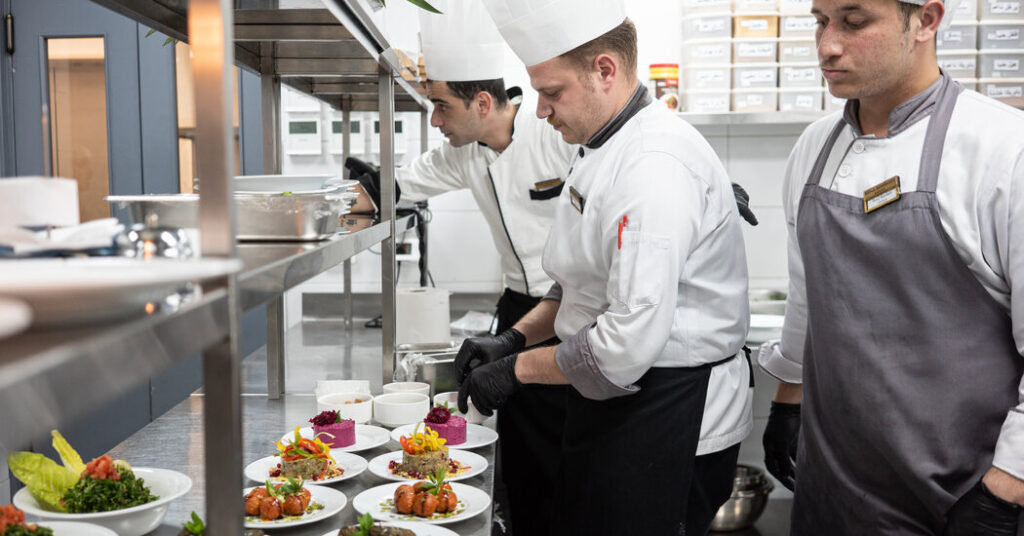
In a white-tiled hotel kitchen in the heart of Damascus recently, a chef stood at a specially designated counter rolling roasted red pepper dip into neat balls and spooning hummus into elegant swirls. It was a classic Syrian dinner, but kosher.
Nearby, plates and serving dishes were stacked behind layers of plastic wrap and two signs in English reading: “Only for kosher food. Don’t touch.”
“It’s nice to see new ideas and new cultures,” said the chef, Abd Alrahman Qahwahji, who works at the hotel, the Royal Semiramis. He said that he had fled Syria during the long civil war and had worked in various restaurants abroad.
“I was in Lebanon. I was in Iraq. And I saw different things. But this is the first time I see kosher,” he noted.
The offering of kosher food in Damascus, Syria’s capital, is just one of the many signs of how much has changed in the country since the ouster in late 2024 of the dictator Bashar al-Assad.
Syria once had a small but vibrant Jewish community, estimated at about 30,000 spread across three large cities, including the historic old city of Damascus. Many left as wars broke out in the years after the state of Israel was established and most of those who remained left in the early 1990s.
Today, only about half a dozen Syrian Jews remain in Damascus, according to members of the community inside and outside the country.
Now, as Syrian and non-Syrian Jews are starting to visit the country, there is increasing need for a kosher restaurant, a kosher butcher and a functioning synagogue.
Some Syrian Jews are also seeking to reclaim homes and other property that they or their families left behind decades ago. The government says that any Syrian who can prove ownership has the right to recover property.
Joseph Jajati, a 32-year-old businessman, was only 2 when his family left Damascus for New York. At home, they kept kosher, which meant that some of the classic Syrian dishes combining meat and yogurt were off the menu because of a prohibition on mixing meat and dairy. They attended a Damascene synagogue where sermons were delivered in Hebrew, he recalled.
The idea of a kosher kitchen at the Semiramis came about in September during a group visit organized by Mr. Jajati’s Syrian Mosaic Foundation, which arranges trips for Jews. He said that his plans for the foundation also include a cultural center in the old city of Damascus focused on traditional handicrafts, some of which Syrian Jews were once known for producing.
Rabbi Asher Lopatin, an Orthodox rabbi from Michigan, was part of the group that visited in September. He and others from the group were invited to a meal at the Semiramis by the hotel’s owner, Mounzer Nazha, along with government officials.
“We had a wonderful dinner,” Rabbi Lopatin told The Times in a phone interview after his visit. “But all I could eat was the fruit.”
Mr. Nazha recalled asking how hard it would be to have a kosher kitchen and whether it could be done in their restaurant.
When Mr. Jajati returned to Syria in December with another tour group, he brought five pounds of kosher meat from New York.
The hotel bought new meat skewers and grills, plates and utensils. Mr. Jajati went to the restaurant and ran the chefs and staff through the particulars of preparing kosher food. Days later, the restaurant hosted its first kosher dinner for Hanukkah.
For now, the kitchen at the Semiramis is “unofficially kosher,” according to Rabbi Lopatin, who inspected it. At some point, it will need to be inspected by a rabbi who specializes in kosher certification, he said.
In Mr. Jajati’s view, kosher restaurants are one way to encourage more Syrian Jews to come back to their country, either temporarily or permanently.
In early January, Mr. Jajati took a group of friends to visit the Elfranj synagogue, one of the many shuttered houses of worship in the Jewish Quarter of the Damascus old city.
Under the Assad regime, the keys to the synagogues were held by security agencies, he said. Now, the keys are held by a government committee under the Foreign Ministry.
On the day the group visited, an official from the ministry was in the courtyard overseeing workers cleaning and refurbishing the synagogue, said to have been founded in the 15th century by Sephardic Jews escaping the Spanish Inquisition. The official told Mr. Jajati that he did not have permission to allow visitors into the synagogue until the cleanup was complete.
“We are not guests. We are owners of this synagogue,” Mr. Jajati said, growing increasingly annoyed as he stood outside the site, where his parents were married and where he had his bris — the ritual circumcision of an 8-day-old Jewish boy.
Around him, workers swept away leaves from orange trees.
The interaction, Mr. Jajati said, was an unpleasant reminder of how he used to have to beg Assad regime officials, who would summon him for questioning each time he visited Syria, to open the synagogue for him.
“And now they are doing the same thing,” he said of the new government. Referring to other Syrian Jews, “How am I going to call them now and urge them to come?” Mr. Jajati added, an ever-present cigarette between his fingers.
Hours later, back at the restaurant in the Semiramis, the topic of discussion was still the matter of the synagogue and how the keys might be turned over to a member of the Syrian Jewish community.
In keeping with Syrian habits, dinner was vaguely set at 7:30 p.m. and attendees began trickling in a little after 8. Mr. Jajati strolled in around 8:30, an energy drink in hand.
In the kitchen, trays with broccoli, potato wedges and dairy-free dough were covered in plastic and labeled with handwritten notes in Arabic reading, “Special kosher.”
“Get me the kosher plates,” a sous chef, Majd Marina, yelled as he began grilling five rib-eye steaks in special racks, flipping them again and again.
Around him, dinner service for the restaurant’s non-kosher patrons was picking up, but the chefs made sure not to mix between plates, serving spoons and even their gloves.
Out in the dining room, waiters hovered, putting down plates of the roasted red pepper dip called muhammara, along with hummus, stuffed grape leaves and eggplant salad.
“This is just for starters,” Mr. Jajati said, referring not to the appetizers but to his hopes of eventually having an entire kosher restaurant in Damascus.
Nearly a year ago, during Mr. Jajati’s first trip to Syria after the Assad regime fell, he said he had vowed that, to encourage other Syrian Jews to return, he would try to organize at least one place where they could eat kosher food.
As the dinner progressed, he seemed content that his vision seemed to be coming to life. He popped a piece of kebab into his mouth and chewed.
“Promises made,” he said. “Promises kept.”
Raja Abdulrahim reports on the Middle East and is based in Jerusalem.
The post Eating Kosher in the Heart of Syria: Lamb-Stuffed Zucchini but Hold the Yogurt appeared first on New York Times.