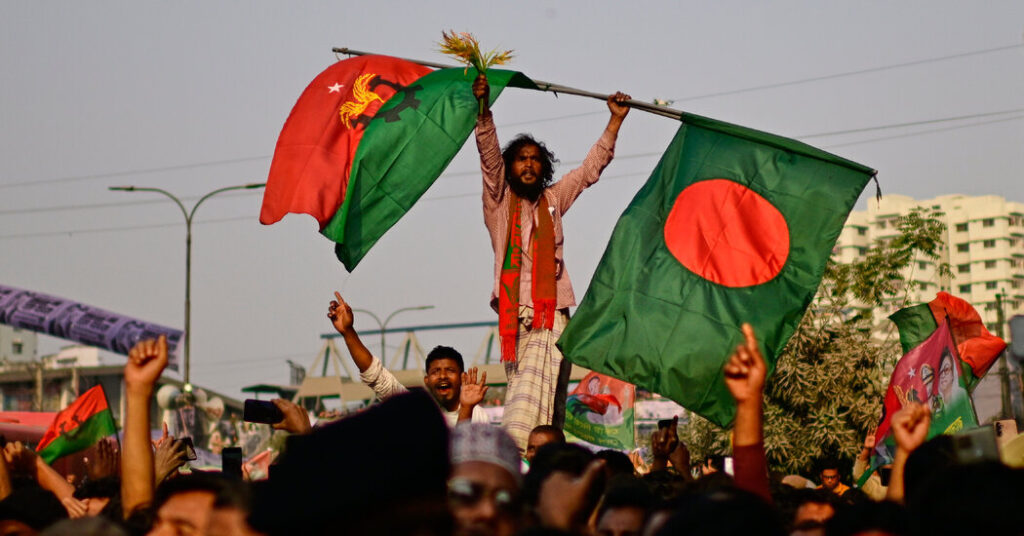
A year and a half ago, Bangladesh looked like it was on track to defy the global pattern of democratic reversal.
Mass protests led by an economically frustrated younger generation toppled the entrenched autocracy of Sheikh Hasina on Aug. 5, 2024, ending more than a decade of shrinking political space and rule by intimidation. The moment offered hope not only in Bangladesh but beyond — evidence that in an age when democracy is under pressure, citizens can still dislodge authoritarian regimes and bring about renewal.
A national vote on Thursday will be the first electoral test of Bangladesh’s political transition, but high hopes for a democratic reset have dimmed.
Instead of a period of healing, Ms. Hasina’s ouster has been followed by persistent violence, bureaucratic and industrial strikes, disruptive protests and political uncertainty. The experience has revealed a harsh truth with wide implications, from the developing world to President Trump’s America: Democratic renewal is elusive when the state institutions that democracy relies on have been hollowed out.
Bangladesh has become a case study of this.
From the early 1990s, politics in the country revolved around the fierce rivalry between Ms. Hasina, leader of the Awami League, and Khaleda Zia of the Bangladesh Nationalist Party. Despite only modest ideological and policy differences, the two women and their parties fought bitterly in elections for years.
Power was nevertheless transferred in a largely peaceful manner thanks to nonpartisan caretaker administrations that stepped in temporarily to run elections and manage handovers of government. That system was abolished in 2011 under the increasingly autocratic Ms. Hasina, ushering in a period of electoral irregularities and illegitimate polls. Cronyism and kleptocracy deepened, and her government used the courts, the police and other state bodies to intimidate opponents.
Millions of Bangladeshis had hoped the 2024 uprising would lead to a restoration of stability and accountability. One source of early optimism was the appointment of Muhammad Yunus, who was awarded the Nobel Peace Prize in 2006 for pioneering microfinance, to lead an interim government.
But Mr. Yunus has struggled to restore calm and discipline in a deeply politicized and fractured state. His administration has lacked a clear mandate and broad support from key political players, and he has been unable to assert effective control over state institutions like the police and the criminal justice system. Such institutions were further degraded after Ms. Hasina’s government fell and senior officials quit, fearing reprisals for past abuses. The rising cost of living, weak wage growth and other economic pressures have burdened many households since the revolution.
The credibility of Thursday’s vote has already been called into question by political violence, accusations of vote-buying and other irregularities, as well as a ban on the Awami League from taking part in the election.
The front-runner is the B.N.P., now led by Tarique Rahman, the son of Ms. Zia, who died in December. But there has not been a genuinely competitive general election since 2008, and the electoral outlook is difficult to read. A new generation of Bangladeshis is voting — 43 percent of the electorate is between 18 and 37 — and surveys indicate they are energized more by practical concerns such as law and order, jobs, education, health care and impartial governance than by the well-worn party rivalries of the past.
Islamist forces are another wild card. Long kept at the margins of politics in Bangladesh, which is a Muslim-majority nation, they have capitalized on the current political and institutional vacuum to become more assertive, raising questions about the commitment to secularism, one of the nation’s founding principles. A recent survey indicated that 37 percent of first-time voters planned to vote for candidates from Jamaat-e-Islami, Bangladesh’s largest religious political party. The party espouses a relatively moderate version of Islam and has gained support through organizational discipline and as an alternative to the discredited political duopoly. But other fringe Islamist groups have since 2024 called for enforcement of female modesty rules, imposing the death penalty for blasphemy and even the establishment of an Islamic caliphate.
Bangladesh is trying to rebuild its democratic institutions.
In November, the Supreme Court ruled that the previous caretaker government system would be restored for future elections, although not in time for this week’s polls. And Thursday’s ballot will include a referendum on a new national charter that would formally commit the state to enshrining fair elections, judicial independence and limits on executive power.
Translating such ambitions into reality will be difficult. The B.N.P. opposes some of the charter’s core provisions, including limits on the power of the prime minister and greater independence for oversight bodies. Several other parties have also raised objections. If the referendum is approved, implementing the charter will require legislation, constitutional amendments and a level of sustained political cooperation that looks unlikely now.
The stakes are high for Bangladesh.
In the past, rapid economic growth and trade cushioned the ill effects of Bangladesh’s political dysfunction. The economy weakened after the uprising, and although there have been signs of stabilization, new leaders will face a far less forgiving global environment marked by rising global protectionism, fragmented supply chains and climate stress.
Strains have also appeared with India, Bangladesh’s most important regional relationship. Ms. Hasina fled there after her ouster, angering Bangladesh’s interim leaders and protesters who want her to face justice at home, and India has accused Dhaka of failing to curb violence against Bangladesh’s Hindu minority. The tensions have already spilled into visa suspensions and trade disruptions.
The lessons of Bangladesh’s uprising reach far beyond its borders. From the Arab Spring of the 2010s to more recent upheavals in Sri Lanka, Nepal, South America and elsewhere, popular mobilization reopened political space, but the gains were lost or remain fragile in the absence of impartial state institutions capable of shepherding democratic transitions.
Even in the United States, the Trump administration’s actions threaten to steadily erode the pillars of American democracy by dragging courts, legal authorities and government agencies into partisan conflict and questioning election results.
Tyrants can be overthrown. Repairing the damage they cause may be democracy’s more enduring challenge.
Zahid Hussain is a former lead economist on Bangladesh for the World Bank. Tom Felix Joehnk is a political economist and a former Bangladesh correspondent for The Economist.
The Times is committed to publishing a diversity of letters to the editor. We’d like to hear what you think about this or any of our articles. Here are some tips. And here’s our email: [email protected].
Follow The New York Times Opinion section on Facebook, Instagram, TikTok, Bluesky, WhatsApp and Threads.
The post Bangladesh Has Exposed Democracy’s Deeper Problem appeared first on New York Times.