Could sports be the tonic that revives the luxury watch market?
Over the past few months, Swiss watch brands have lined up to announce multimillion-dollar deals with elite professional sports leagues and athletes, hoping to leverage their star power and the emotions of sports fandom to fire up a cooling market.
Last week, Breitling became the latest high-end brand to hitch its wagon to Formula 1, signing a deal with the Aston Martin Aramco Formula 1 Team, adding to a deal it announced in August to be the official timepiece partner of the National Football League (N.F.L.).
In November, Norqain became what it called the Official Luxury Sports Watch of the National Hockey League (N.H.L.), and in January Frederique Constant introduced its first sports sponsorship, connecting with the nascent Pro Padel League, in which athletes compete in padel, a game often described as a cross between squash and tennis.
Brands such as Rolex, Omega and TAG Heuer have built their profiles on ties with sports, but in today’s saturated market, can sports sponsorships really help brands achieve their goals?
“Opting out of sport increasingly means opting out of future audiences,” Merrick Haydon, the founder and chief executive of the sports marketing and communications agency ThirtyThree18 in London, wrote in an email. “It delivers scale, emotion and cultural relevance that traditional luxury marketing increasingly can struggle to achieve on its own. For most brands, sport is now a growth accelerator, not a nice-to-have.”
That may be the case, but the barrier to entry is high. In Formula 1, for example, it costs a minimum of $2 million a season to partner with a team, rising to $100 million to become an official partner of the sport, according to the Italian agency Drive Sports Marketing. TAG Heuer’s role as Formula 1’s official timekeeper is part of a 10-year deal between Liberty Media, the owner of Formula 1, and LVMH Moët Hennessy Louis Vuitton, the Swiss watchmaker’s parent company, that began in 2025 and is thought to total $1 billion.
But brands said spending big had become a necessary gamble. “We live in a world where if you want to make a big impact, you have to be willing to take a big bet,” TAG Heuer’s chief marketing officer, George Ciz, said about his company’s sports sponsorships, which also include golf, surfing and track and field.
Returns are not always measurable. While some maisons will make limited-edition watches aligned to their sports partnerships, others look for less tangible benefits such as brand awareness.
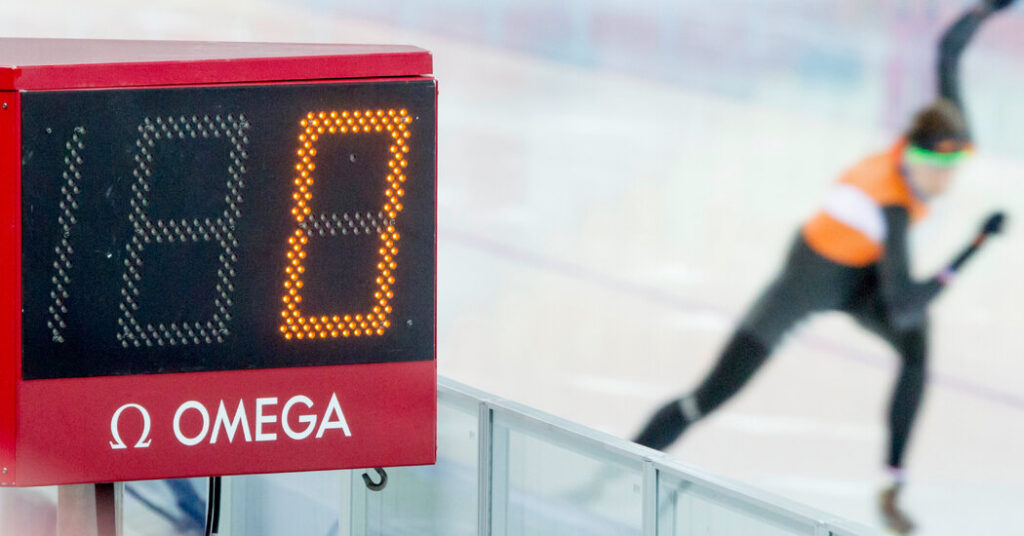
In some instances, organizing bodies will pay brands to time their events. Raynald Aeschlimann, Omega’s president and chief executive, said the International Olympic Committee pays for the technologies and services that his company supplies to the Summer and Winter Games, although he declined to say how much.
Mr. Aeschlimann said that, while showing Omega-branded split times or photo finishes during TV coverage had built brand trust among viewers, his company also had benefited from its long-term relationship with the Olympics. “Longevity is not always the case in the sponsorship world,” he said in a video interview, noting that in timing the Milan-Cortina Games in Italy this month, Omega would be attending its 32nd Olympics. “It’s created big value for us to have this extraordinary role.”
Sports’ growing audiences appeal, too. According to its organizers, Formula 1 recorded a 19 percent year-over-year increase in its social media following in 2025 and had an overall global fan base of 827 million (a term that Nielsen, a leader in audience measurement, says is a combination of claimed fans and active consumers). As a result, Formula 1 has declared it now is “the world’s most popular annual sporting series.”
For brands, increasingly the question is whether to compete for what marketers call “share of voice” or to find sports where they can go it alone. Omega is the only Swiss watchmaker involved in the Olympics, giving it sole access to billions of viewers. By contrast, Breitling, which has replaced Girard-Perregaux in Formula 1, shares the platform with TAG Heuer, Richard Mille, IWC, Tudor and H. Moser & Cie, Swiss brands that also have deals with the sport’s teams. “The rule in marketing is to be first or be better,” said Georges Kern, Breitling’s chief executive. “And we will be better.”
But according to Mr. Haydon of ThirtyThree18, brands should not be sidetracked. “Relevance now beats reach,” he wrote. “Brands choosing sports purely on audience size rather than narrative fit struggle to translate awareness into desire.”
Mr. Ciz said TAG Heuer’s deal had made an impact because buyers recognized that the brand first became affiliated with Formula 1 in the 1960s. The brand’s Formula 1 collection of watches had seen a 20 percent sales spike last year, he said, helped in part by a series of new releases tied to individual Grand Prix races. He also said foot traffic in TAG Heuer boutiques had increased almost 15 percent year-over-year.
And what about revenues and profits? LVMH does not report on individual brand performance, but according to its latest results, published Jan. 27, the watch and jewelry division that includes TAG Heuer reported 2025 revenues declined 1 percent and profits were down 2 percent from 2024 totals.
According to Mr. Ciz, the F1 deal protected TAG Heuer from a decline. “This partnership came at the best and the worst time,” he said. “We’re in the midst of geopolitical challenges with great uncertainty, challenges every brand has to face. But it was a beautiful mechanism to protect the brand from these challenges.”
Sports deals also can be a useful distraction from poor results. “Across the sector, brands are now judging success less on quarterly sell-through and more on brand salience, social amplification and audience reappraisal,” Mr. Haydon wrote, “the kind of future demand creation that doesn’t appear neatly in a P&L,” referring to profit and loss.
Yet sometimes, the costs are too much. Having been the official timekeeper for the FIFA World Cup since 2010, Hublot has withdrawn from the 2026 tournament, scheduled this summer in the United States, Canada and Mexico. “We have been owning football for years, which is great in one way,” said the brand’s chief executive, Julien Tornare. “But on the other hand, if you want to own such a big sport, there is a cost of opportunity where you don’t do other things, and you might miss some other people that love sport, but not football. Soccer doesn’t really resonate in the U.S.”
Mr. Haydon estimated that a World Cup sponsorship package could cost Hublot’s successor as timekeeper as much as $50 million and that “activation often matches or exceeds the rights fee again,” referring to cost of the media campaigns, venue branding, hospitality and events often associated with sponsorship. (There was no announcement of a successor as of early February.)
Mr. Tornare said sponsorship prices in soccer were “through the roof,” but Hublot would continue to sponsor and serve as the official timekeeper for the UEFA Champions League, the most-watched club competition in global soccer, because it was an annual event and enjoyed a worldwide following. He did not disclose the cost, but added that he had been spreading the brand’s bets.
In September, Hublot signed the Kansas City Chiefs quarterback Patrick Mahomes as an ambassador; neither the length of the contract nor the financial details were disclosed. Mr. Mahomes, who has led his team to three Super Bowl wins, was chosen in the brand’s bid to tap into the N.F.L.’s popularity and recoup some ground in the critical U.S. market. “We’ve been missing some communication channels with our American clientele,” Mr. Tornare said.
The United States has been the Swiss watch industry’s No. 1 export market by far in recent years. In 2025, for example, exports totaled 4.35 billion Swiss francs ($5.6 billion), more than double those to second-place Japan, according to the Federation of the Swiss Watch Industry — a situation that has prompted brands to zero in on American sports.
So as Breitling’s deal with the N.F.L. and Norqain’s with the N.H.L. are expected to open the door to hundreds of millions of domestic and international fans, Tissot has continued its relationship with the National Basketball Association and Oris has partnered with the New York Yankees and a number of Major League Baseball managers.
There even are options for ambitious brands that cannot afford such top-tiersponsorships, such as Frederique Constant’s tie-in with the Pro Padel League, founded in 2023 for players competing in North America — though, again, the amount was not disclosed.
“It’s a fast-growing sport that’s inspiring a new generation,” Jeffrey Cohen, the president of Citizen Watch America, which owns the brand, wrote in an email. “As padel continues its rapid global rise, Pro Padel League offers a platform that aligns with the new audiences we’re seeing embrace Frederique Constant.”
Even with newer sports, smaller brands may not have a lot of time to consider. Rolex, the dominant luxury brand in tennis sponsorship, recently signed Arturo Coello, the world’s No. 1 padel player, as one of its testimonees, as it calls its brand ambassadors.
Despite sports’ audience figures, brands acknowledge that connections are no guarantee of success. “You never know in marketing what will work, otherwise everyone would do the same thing,” said Mr. Kern of Breitling. “Music and sports are the strongest communication platforms you can imagine, and if they’re done well, they give a very good taste to the brand.”
Mr. Haydon said brands had been in a race to secure the best deals in sports, before they were out of reach. “Industry outlooks still forecast sponsorship growth and rights inflation,” he wrote. “The consequence is that midsized maisons must now be earlier, sharper and more creative in their choices, or accept that the biggest stages will become inaccessible.”
The post Watch Brands Increasingly Turn to Sports for Spark appeared first on New York Times.