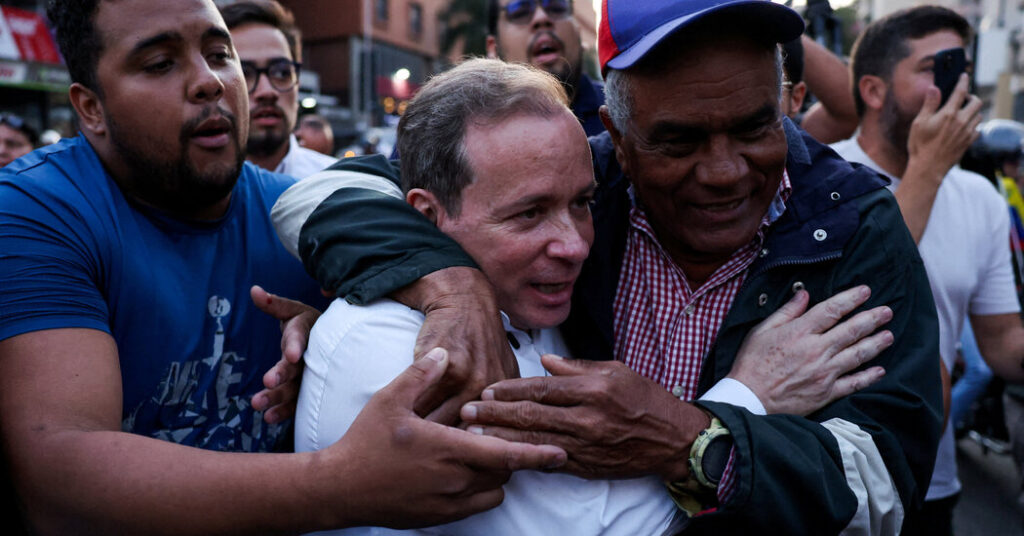
Venezuela on Sunday freed a group of prominent opposition leaders, according to statements from the country’s press union, the political opposition party and relatives of the freed prisoners. But one of the most prominent among them, Juan Pablo Guanipa, was apparently taken back into custody hours later, with his whereabouts unknown early Monday.
The confusion cast dark clouds over tentative hopes that Venezuela’s interim government might move away from the most repressive practices of its deposed president, Nicolás Maduro, and also suggests divisions within the security forces.
Ramón Guanipa Linares, Mr. Guanipa’s son, wrote on social media that his father had been “kidnapped” by a group of about 10 armed, unidentified men. The de facto opposition leader, María Corina Machado, wrote in a separate post, that “heavily armed men, dressed in civilian clothes, arrived in four vehicles and violently took him away.”
The Venezuelan Public Ministry, which is under the direction of the attorney general’s office, said shortly afterward in a statement that it had asked a court to revoke Mr. Guanipa’s release because of his “noncompliance” with court-imposed conditions. It did not say what those conditions were, but added that the government had asked for Mr. Guanipa to be put under house arrest “to safeguard the criminal proceedings.”
His whereabouts was unclear, and the family did not comment on the government’s statement. Hours earlier, it had welcomed on social media Mr. Guanipa’s release from the notorious El Helicoide prison. “Our entire family will soon be able to embrace each other again,” his son wrote.
Mr. Guanipa, a former congressman from a centrist opposition party, became governor of Venezuela’s oil rich Zulia state in 2017. But Mr. Maduro’s government dismissed him from office for refusing to swear allegiance to a legislative body that the president had created.
The authorities had released at least 35 political prisoners on Sunday, according to the rights group Foro Penal, which last week said that more than 650 were detained.
The government made no official statement about the releases, but Venezuela’s de facto leader, Delcy Rodríguez, has said in recent days that she would close El Helicoide, which rights groups have described as a torture center. She has also announced plans for a mass amnesty law.
Since the United States captured Mr. Maduro last month, his former vice president, Ms. Rodríguez, has moved quickly to realign Venezuela with Washington.
Ms. Rodríguez has worked closely with the Trump administration, redirecting oil exports toward the United States and consolidating power domestically by dismissing officials seen as loyal to Mr. Maduro — moves that have unsettled hard-line factions within the security apparatus.
Earlier moves had signaled closer cooperation with Washington, including the brief detention in Caracas of two prominent businessmen with ties to Mr. Maduro, Raúl Gorrín and Alex Saab, both of whom have faced U.S. money laundering charges. Their questioning had been widely interpreted as evidence of a political shift, an impression now complicated by the renewed detention of Mr. Guanipa.
There has been skepticism about whether Ms. Rodríguez can be the person who dismantles the same authoritarian system that she benefited from. The rearrest of Mr. Guanipa also raises questions about her ability to impose discipline on security agencies that control arrests and prisons.
Analysts say the true test will be whether former prisoners and exiled opponents are allowed to protest, organize politically and criticize the government without facing retaliation. The long-term goal is credible elections.
“It almost looks like they want to open up just enough to score points with Washington, but not enough to risk their grip on power,” said Geoff Ramsey, who studies Colombia and Venezuela at the Atlantic Council, a Washington-based research institute.
But others saw the releases as a genuine shift by the interim government, after years in which members of the opposition endured being arrested, disappeared and tortured, or were forced to flee into exile.
“There is a clear political will on the part of the Rodríguez government to move away from an intransigent and intolerant stance toward the opposition,” said Colette Capriles, a political analyst at Simón Bolívar University in Caracas.
Another prominent politician who was released was Perkins Rocha, who gave an interview to The New York Times weeks before his detention in August 2024. At the time, Mr. Rocha expressed anguish for his colleagues who were detained.
On social media, before Mr. Guanipa was taken back into custody, Ms. Machado, the opposition leader who remains in exile, welcomed the release of her “comrades in struggle” and the end to their “many months of captivity and injustice.”
They longed, Ms. Machado said, “to work side by side for the Venezuela we have dreamed of for years — and that we are now very close to building.”
Genevieve Glatsky is a reporter for The Times, based in Bogotá, Colombia.
The post Venezuela Frees Key Opposition Figures, Then Rearrests One appeared first on New York Times.