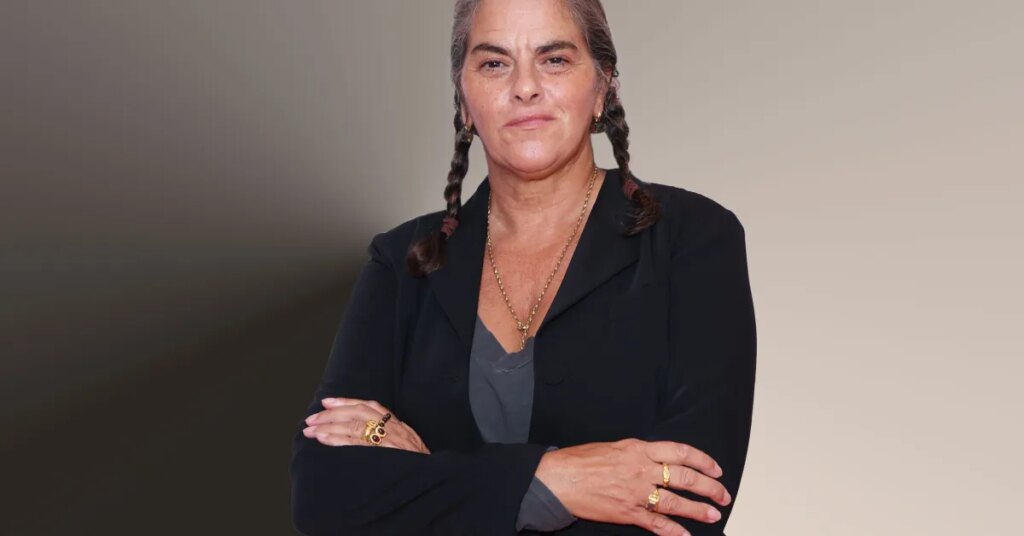
Tracey Emin, a member of the provocative and hard-partying group of ’90s artists known as the Young British Artists (YBAs), has her largest ever show opening at the Tate Modern in London on Feb. 27. She looks back on her troubled youth, her serious health setbacks, her incendiary artworks, and what she wishes she hadn’t done.
[time-brightcove not-tgx=”true”]
You’ve survived childhood sexual assault, a teen suicide attempt, rape, a botched abortion, homelessness, what looked to be destructive drinking, poverty, several devastating breakups, and, most recently, very invasive surgery for bladder cancer. What role has your art played in your ability to withstand it all?
Well, on a practical level, I’ve never had a boss. I never had to be at work on time. No matter what’s happened to me, it hasn’t affected my pattern of doing things, my routine. For example, if you have a broken heart and you spend six weeks crying, that’s what you do. So I’m extremely lucky. And on a cathartic, emotional, responsive level, I’m also extremely lucky because it means I feel things. I know where my heart is. I know where my tears are. I used to know where my bladder and my vagina were; they’re gone.
Is there any part of your life that’s too private, not something you would ever make work about? I’d never make my tent—Everyone I Have Ever Slept With, 1963 to 1995—now. Mind you, I wouldn’t be able to really make a very good tent now; I wouldn’t have slept with that many people. But I just wouldn’t make that work. I was a lot more up-front then, and I had less to lose. It’s quite good that [the tent] burnt. Now if it was standing there, I think a few people would be in prison, actually.
What was it like going through your body of work to prepare for this landmark show at the Tate Modern? Did you feel like it was more costly to you to make your work than less overtly confessional artists like Jeff Koons or James Turrell? Art has many rooms. I take one, Jeff takes another. Some people want a giant Jeff Koons on their garden lawn; it makes them feel good. Well, go on, feel good. My work isn’t necessarily going to make you feel good, but it might make you re-evaluate and slow down. I’m not going to say that I suffered more from my art, or my art is more meaningful. I’m just interested in my room and what I’m doing.
Would you have predicted that Everyone I Have Ever Slept With and My Bed would be the works that you would be known for?
They’re two seminal works, which is pretty incredible. By the age of 35, I made two seminal works. Some artists don’t make any seminal works in their lifetime. They might be really good artists, but they don’t make anything that changes people’s perception of art. When I was coming out of the [bladder-removal] surgery, I just thought, “F-cking hell, if I don’t survive this, I’m going to be remembered for being a sort of middle-ground ‘90s British artist.” So I’ve done probably more in the last five years than I have done in my lifetime. I got my priorities sorted out. I stopped drinking nearly six years ago. I focused only on art.
You have said that a lot of your work is about love. What’s the hardest thing about depicting love?
When I’m painting, I never know what I’m going to paint. It’s just kind of psychic and automatic, like I’m like a banshee whirling around, throwing my paint, and then it comes to me. If I make a painting of two people making love, I didn’t know that was going to happen.
Do you see your art as political at all?
Let me go and just pick up all my abortion work and hang it in a museum in Texas and see what happens, shall we? I traveled all over America. Did this road trip once with [gallerist and Emin’s former partner] Carl Freedman, and I come across some of the most racist, abhorrently disgusting, scary places I’ve ever seen in my entire life, places that I think a lot of people in L.A., San Francisco, New York have never seen or never been to, and are unaware was happening. And I think what is happening in America now is because half of America is like that, unfortunately.
In your lifetime, have you seen the status of female artists change? I talk about digging the little old lady up. You know, you’ve got all these galleries running around, saying, “Let’s try and find the old lady that’s got all her art in the attic,” you know? It’s really changed. And I don’t mean that in a cynical way either. For me, art is fundamentally a good thing that is made by humans. Probably one of the only positive, really good things that humans make is art. And it comes out of nowhere. It just presents itself. It’s like a garden. It’s like nature. It’s like our nature coming out of us. It sounds silly, but it’s like something that our souls can connect to.
You quite often incorporate poetry or words into your works, and this is true of lots of female artists—Shirin Neshat, Barbara Kruger, even Louise Bourgeois. Is that something women do more often than male artists?
I think a lot of women, especially in the ‘70s, said, like, “What can we do?” And overnight women became photographers, journalists, art writers, giving the message loud and clear, like Jenny Holzer. They were unapologetic about what they wanted to say. And the easiest way for them to say what they want to say was bold words. Read this message, no mistake.
Do you find that people in America react to your paintings differently than in Britain?
People said to me, “Why do you think you don’t have any career in America?” And I used to say, “It’s the Great Gatsby effect.” And they go, “What do you mean?” And I’ll say, “I’m really brash. And America has a lot of that and it’s not what they’re looking for.” And now I think I was maybe wrong. I think it was the timing and the context. What I didn’t know was that a lot of young people in America like my work. I had no idea. I just think America needs warmth, needs the human touch. I’ve got that. I’ve got loads of it.
How do you look back on your YBA days now?
I said to someone, “I don’t understand how we managed to make any work,” and they said to me, “It’s because you were up 24 hours a day.” It’s sort of true, but I never took drugs, ever, ever, ever, ever, I only drank and chain-smoked. I think that’s what also gave me a slight edge on things, because I saved my money.
Why did you decide to open an art school?
There’s an amazing building and some friends were going to buy it but then said, “Tracey, why don’t you get it?” And I went, “Yeah, what would I do with it?” And they went, “Art school.” And I went, “Genius.” And then within a week, I bought it. It was owned by a charity that was going into liquidation. It’s just incredible. We’ve got a cafe there, which is a trainee kitchen for long-term unemployed people with learning difficulties. There’s about 15 studios for professional artists, and then there’s the TEAR [Tracey Emin Art Residencies] program. I subsidize everything.
Two very important painters in your life are Egon Schiele and Edvard Munch. What about them appeals to you?
They were making work about deeply emotional things, whether it’s jealousy, anger, hurt, pride, love, whatever. I could relate to it, even at 14 when I discovered them.
How can you tell what a piece of work wants to be?
Like today, I’m definitely gonna have to draw my cats for this special town project in Margate. All the artists here do projects, and mine is that I put drawings of my cats in my windows. But I know when I’m drawing my cats, after a little while, I’ll start drawing something else and something else, and that’s how it happens. Or birthday cards—I think I’ll just make someone a birthday card, and 12 hours later, I’m painting 8-ft., 9-ft. foot canvases.
How is your prognosis? Is your health good?,
Living with a urostomy bag and having a hole on your side is difficult. It’s exhausting. And living without a bladder is really exhausting, because your kidneys are working overtime. I have to balance that end to end, because I don’t want to be ill. I had squamous cell cancer in my bladder; you have to have it cut away. You can’t have chemo, you can’t have radiation. Only removing it completely works.
Looking back, would you do anything differently?
After the cancer, I was laying there, not being able to move and just thinking, my biggest regret in my life is smoking. I knew it was wrong. I had quite a number of really unhealthy love affairs. And then I didn’t have sex for 10 years, I was celibate. Now, I sort of don’t regret that, but I think it was quite extreme. I wish I wasn’t so angry when I was young. I wish I had what I have now and my youth. I don’t mean my looks, I mean the physicalness. I used to swim a kilometer a day, cycle everywhere. But I swear on my life, I never felt quite so happy and content as I did really focusing on life [after the cancer]. I just thought, I want to live. It was such a game changer, from being nihilistic, being angry, being chippy, to suddenly jettisoning all that stuff. I reckon half the poisons were in my bladder.
You did have a couple of stints where you didn’t paint for a while too. Was there one where you tried to break your fast by locking yourself in a room for a few weeks?
That was Exorcism of the Last Painting I Ever Made. I was in a room with fish-eye lenses. I was naked, and I had all these giant canvases. And I spent three and a half weeks there, although I did come out to go swimming very early in the morning. It was awful, because I sat there naked—I had the Guardian newspaper sort of wrapped around me—thinking, What have I done? And the fish-eye lenses meant that if I was sitting faraway, people saw a tiny me naked, but then suddenly I’d go up to one wall, they’d get like a big boob or vagina in their face. After a week, I stopped thinking about people, and I just started really painting. I decided to go through my history of art painting. So I did a Picasso, an Egon Schiele. That one could be in the Tate show.
In the scheme of things, how big is this Tate Modern show for you? Do you think of it as a landmark?
Yeah, it’s a benchmark. It’s like, this is the beginning of the end. I’m never going to stop working. If I can’t physically work anymore, then I will just write. If I can’t write with my hands, then I’ll dictate my writing. I think the reason is because I was homeless twice, really badly homeless, with my family, my mom, my brother, and when you haven’t had a home and you understand how important home is, I swore I’d never be cold and never be homeless.
Are you still friends with Joan Collins?
Yeah, but Joan is one of my most glamorous friends, and I have not been so glamorous over the last few years. We’re neighbors in the South of France. She is so funny, and she’s kind, and she’s really lived. There’s actually nothing fake about her.
You put up lost-cat posters and art fans took them. What’s it like to have people want everything you touch?
I have got a thing in my will, which I call “the polystyrene cup syndrome.” If I bite into a polystyrene cup, it is not a work of art. Only what I say is a work of art is a work of art. That’s important to me. Because I thought I was going to die, we really polished my will. It’s amazing. Now, if I’ve got a hobby, it’s going out like a great Egyptian, with everything in its place.
The post Tracey Emin Lost a Few Organs and Got a New Lease on Life appeared first on TIME.