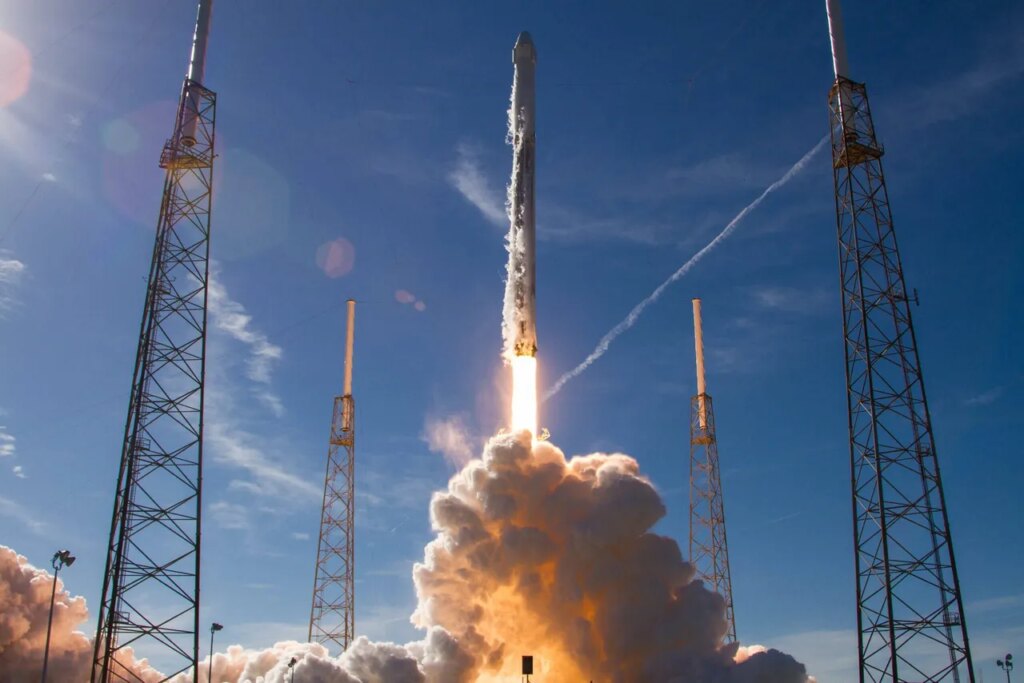
There’s been this hand-wave, this assumption, this yada yada at the core of our long-term space programs. If we can return astronauts to the moon, we’ll find ice there. And if we find that ice in sufficient quantities, we’ll break it down into hydrogen and oxygen, and yada yada, we’ll use that fuel to fly deeper into the solar system, maybe even to Mars. And if we get to Mars, we’ll find even more ice on the Red Planet. We’ll mine that, combine it with the carbon dioxide in the atmosphere, and yada yada, we’ll use that to fly the astronauts back.
It’s an idea that’s been around since the Apollo era and has been touted in recent years by the likes of former NASA administrator Bill Nelson and SpaceX’s Elon Musk. But here’s the thing: No one has ever successfully turned water into rocket fuel, not for a spaceship of any significant size. A startup called General Galactic, led by a pair of twentysomething engineers, is aiming to be the first.
This fall, General Galactic plans to fly an 1,100-pound satellite, using water to supply its only propellant in-orbit. If it works, it not only could start to solve the yada yada problem, it could make US satellites more maneuverable at a time when there’s a growing possibility of a conflict in space.
“Everybody wants to go build a moon base or a Mars base or whatever. Who’s going to pay for it? How does it actually work?” asks Halen Mattison, CEO of General Galactic. “Our vision is to go build a gas station on Mars,” he adds, “but also eventually build out the refueling network” in between.
That’s the very, very long-term plan, at least. For starters, Mattison, a former SpaceX engineer, and his CTO, Luke Neise, a veteran of Varda Space, have purchased a spot on a Falcon 9 rocket launch. Scheduled liftoff is October or later in the fall.
There are, to broadly oversimplify, two main kinds of engines that you can use in your spacecraft. You can take a fuel like liquid methane, maybe combine it with an oxidizer, and burn it. That’s called chemical propulsion, and every big rocket you’ve ever seen take off uses some variation of that method, because it provides a lot of thrust, even if it’s not terribly efficient.
Or you can take a gas like xenon, zap it with electricity, and shoot it out of the spacecraft, either as an ionized gas or a plasma. That’s called electric propulsion—again, I’m way oversimplifying. And “it’s very, very low thrust. People jokingly like to call it a burp in space,” Mattison says. “But it lasts forever. The efficiency is crazy.” Enough burps over time can actually be quite effective. Electric propulsion is used to keep satellites in their proper orbit and to power space probes like Dawn, which NASA sent to explore the asteroid belt.
Water isn’t ideal for either electrical or chemical propulsion. But it might be just good enough for both. Unlike, say, liquid methane, you don’t need to worry about water accidentally blowing up your spacecraft or keeping it cooled at -260 degrees Fahrenheit or having it boil off when your satellite faces the sun.
General Galactic plans to demonstrate the two methods during its Trinity mission. For chemical propulsion, it’ll use electrolysis to split the water into hydrogen and oxygen, then burn the hydrogen, with oxygen as the oxidizer. For the electrical propulsion system—this one’s called a “Hall thruster”—it’ll split the water, then apply enough electrical energy that the oxygen becomes a plasma. From there, you use a magnetic field to shape the plasma and shoot it out.
The idea is to show “we can provide both the long-efficiency maneuver but also sometimes folks need to get somewhere fast or respond really quickly to a dramatic event in the orbital environment,” says Niese, General Galactic’s CTO. “Sometimes you need more than a burp in space.”
For example, Chinese and Russian satellites increasingly have been flying in close proximity to American ones. Finding a method for maneuvering away from those rivals in a hurry is something the US Space Force and others are extremely interested in.
The hope, Mattison says, is that “we can give you five or 10 times the mission Delta-V,” using the jargon for the total change in velocity and direction a spacecraft can make over time.
Mattison and Niese met in grad school at Stanford and began riffing on this water-based propellant idea. They started geeking out on the idea—and started their company—even as they worked day jobs for folks like Musk. They hoovered up research papers and called anyone they could who’d worked on similar systems. “We then take it to modeling software. We’ll run the equations. We did a lot of Python scripts just looking at different mission cases,” Mattison says. Eventually, they got to a place “where we’re like, ‘This is pretty different. This is kind of exciting.’ And that’s how we knew we had something that was worth putting real money behind.”
So far, Mattison and Niese have raised $10 million in venture capital, a relative pittance in the aerospace sector but more than enough for this mission.
Of course, there are reasons this has never been done before. Ionized oxygen interacts with everything, potentially corroding the electrical propulsion system. “It’s not an easy element to work with,” says Ryan Conversano, a former Jet Propulsion Laboratory technologist who is serving as a consultant to General Galactic. “It makes material selection and design of the device or devices very, very challenging.”
As for the chemical propulsion system, it’s not clear whether General Galactic’s will be competitive enough with more traditional ones, once the added mass for the electrolysis system is added in.
“It could be a pretty, pretty clever way to provide thrust to a small satellite,” says Mark Lewis, CEO of the Purdue Applied Research Institute and the former chief scientist of the US Air Force. “But there are a lot of what-ifs.”
Lewis believes it’s very much worth trying, though. If General Galactic can meet or top its expectations for this introductory effort, it could begin to be an answer to that yada yada at the core of tomorrow’s missions to the moon and beyond.
The post This Startup Thinks It Can Make Rocket Fuel From Water. Stop Laughing appeared first on Wired.