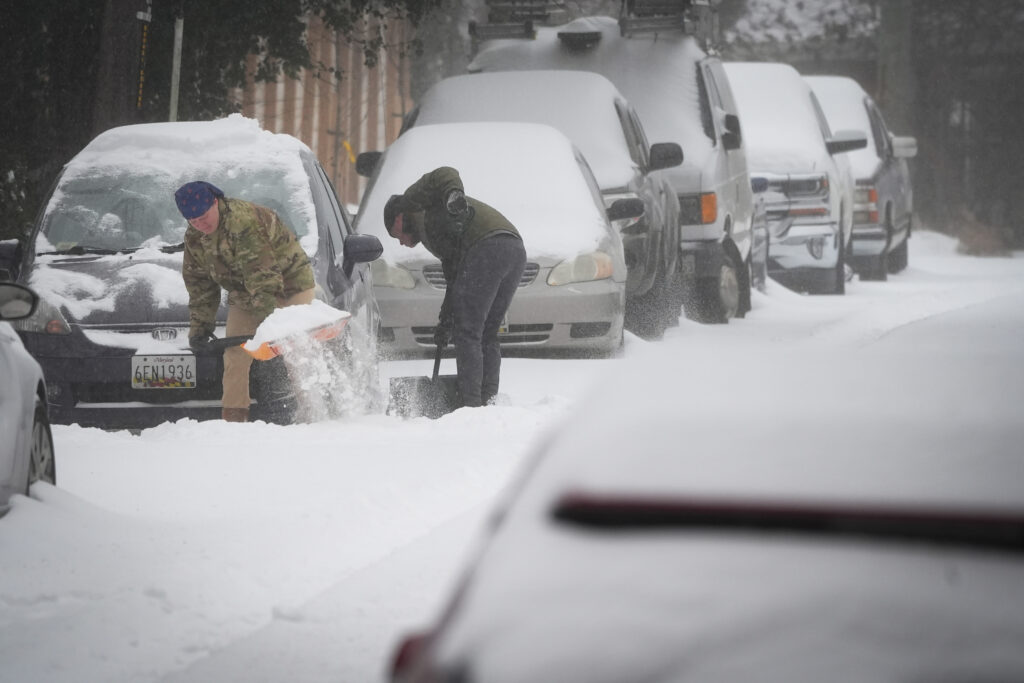
After the snowstorm on Jan. 25, Montgomery County Public Schools did not have a complete school day for seven days. The district informed parents that, to make up for that lost time, it would add one full day and one partial day to the calendar, and would try to get a waiver from the state to cover other days.
I want to remind folks, this was not an emergency: I took leave to watch three other families’ kids on the fourth day after the storm. Those kids were driven to my house on the cleared roads by parents who needed to go to their jobs at their offices, which were open.
The district’s choice to close its schools for over a week should have consequences. Not only are my children down several school days for the year, but to add insult to injury, one of the makeup days is a partial day at the end of the year. In the past, teachers have made it clear to us that there would not be serious instruction on those days.
Compulsory education is not a benefit for parents who are free to take advantage of it, nor is it a jobs program for those in the school system; it is a fundamental right our children are entitled to. The children of Montgomery County deserve to be educated every day the state promised, and they deserve full days of instruction. Anything less reeks of stealing kids’ futures because the school system couldn’t be bothered to shovel a few driveways.
Morgan Stern, Silver Spring
Appreciation for sanitation
The Feb. 1 Metro article “Final cost, impact on wildlife unknown in Potomac spill” did a good job of reporting on the environmental degradation that may result from the escaped sewage.
Readers might also consider another important part of the story: Employees of D.C. Water work around the clock on such emergencies, including in bone-chilling temperatures, with ice underfoot and very unpleasant working conditions. Readers might consider the herculean task they performed to contain the spilled wastewater and reroute the unending flow from the site of the break. After all, we push down a lever in our bathrooms and press a button to operate our sink disposals without a thought of this “secret service.” That is, until something untoward happens. We are lucky we don’t have to empty our chamber pots into the street. We have come a long way.
Roland C. Steiner, Ellicott City
The writer was a regional water and wastewater manager at the Washington Suburban Sanitary Commission.
D.C. Health needs scrutiny
The Jan. 27 Metro article “Hospital accused of many lapses” described problems at St. Elizabeths such as assaults on patients and staff, medication errors, chronic understaffing and deteriorating conditions. The Post has also documented serious issues across other health care institutions in D.C., including Cedar Hill Regional Medical Center and the Psychiatric Institute of Washington. Each story focuses on the individual facility, but the common thread connecting all of these crises has received far less scrutiny: D.C. Health, the agency responsible for oversight.
When multiple medical and behavioral‑health facilities experience repeated safety lapses under the same regulator, it reflects a broader breakdown in enforcement, complaint handling and accountability. Yet D.C. Health’s performance, and its long‑standing regulatory laxity, has largely escaped public examination.
The D.C. Council’s Health Committee has held hearings on specific facilities, but it has not meaningfully addressed the systemic oversight failures that allowed these problems to persist. If the District is to restore trust in its health care system, the regulator’s role must be part of the conversation.
The public deserves transparency not only from hospitals but also from the agency charged with holding them accountable.
David Keer, Washington
Crisis incoming
Regarding George F. Will’s Feb. 5 op-ed, “One path to U.S. fiscal disaster is most alarming — and most likely”:
The political and financial decision-makers in the U.S. are seeding Will’s last and most ominous debt crisis: the gradual one. It will be preceded by the sudden crises he described, but their interlinked nature suggests they could all occur one right after the other, or perhaps even simultaneously.
I don’t think it’s possible to head off the coming catastrophe without raising taxes and cutting spending. But Republicans and Democrats seem to be unwilling to do what it takes to balance the budget. Many politicians probably think “I’ll be gone by then.” (This is why we need younger politicians!)
For now, it seems that our political and financial decision-makers are victims of Boiling Frog Syndrome, which is the inability or unwillingness to react to significant changes that occur gradually. The water’s getting hot.
James L.P. Glidden, Holliston, Massachusetts
The post Snow should not be an emergency. Keep DMV kids in school. appeared first on Washington Post.