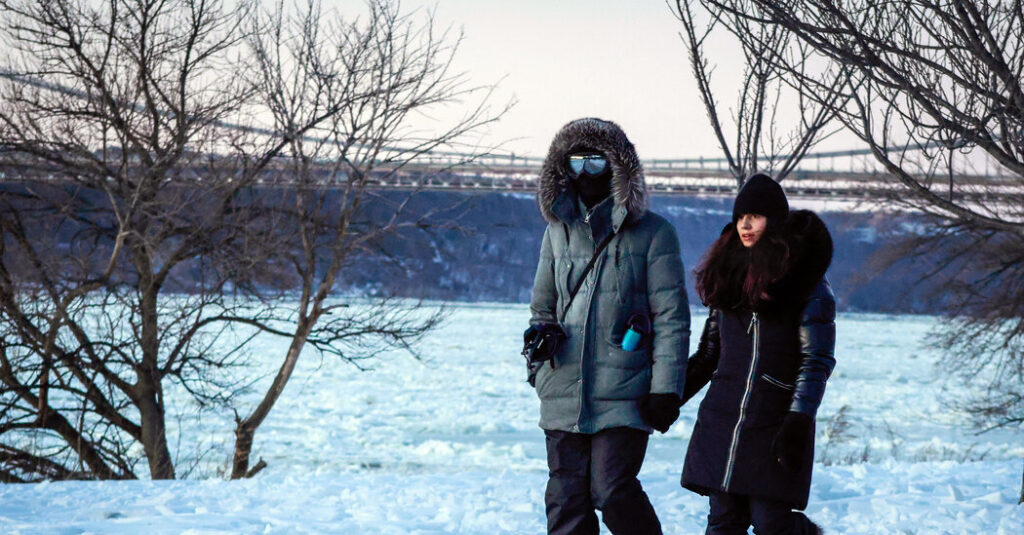
The bone-chilling cold that has blasted much of the Eastern United States since mid-January will finally begin to ease this week, with temperatures expected to increase by around 10 degrees on Monday, and 10 more on Tuesday, forecasters said.
Wind chills as low as the negative 30s were expected to persist across the interior Northeast and New England through Monday morning, but should lift relatively quickly, according to the National Weather Service.
“Compared to how we’ve been, it’s going to be delightful on Tuesday and Wednesday,” said David Roth, a meteorologist at the Weather Prediction Center.
Mr. Roth said that Sunday was likely to be the last very cold night for some time, with temperatures on Monday reaching the 30s in Richmond, Va., and Washington, and the upper 20s in New York City and Philadelphia.
Wednesday was expected to be the warmest day, Mr. Roth added, with temperatures expected to drop after that, particularly in Virginia and Washington.
“That’s the end of the worst of it,” he said. “But, yeah, it should get cooler again.”
The Eastern United States has endured weeks of bitter cold conditions cited in the deaths of more than a dozen people found outside in New York City.
Grimy snow and ice has blanketed the city, and the Hudson River has been covered in ice floes.
The Arctic blast brought a record low to New York City on Saturday, with 6 degrees recorded at Kennedy Airport. The previous record for that date at the airport was 7 degrees set in 1993.
A record low, at minus 3 degrees, was also set on Saturday in DuBois, Pa., which is about 100 miles northeast of Pittsburgh.
It was even colder on Sunday in northern New York, where the low temperature for the country was recorded at minus 34 degrees in Watertown, five miles east of Lake Ontario and 30 miles south of the Canadian border.
The average high in New York City in February is around 40 degrees.
Wind chills — the perceived temperature on the skin as wind strips away the body’s protective layer of heat — have also been a major concern.
On Saturday, strong winds gusting up to around 50 miles an hour pushed wind chill values down to minus 30 degrees in parts of New England.
Mr. Roth said that by Sunday, all of the Great Lakes would reach above freezing, and may even begin to melt a little.
“It could very well be that early next week it cools off again,” he added, “but Sunday’s probably the mildest day the Northeast and the Great Lakes have had in a while.”
Livia Albeck-Ripka is a Times reporter based in Los Angeles, covering breaking news, California and other subjects.
The post Respite From Wind-Driven, Bone-Chilling Cold Weather Is in Sight appeared first on New York Times.