In the five days since the last remaining nuclear treaty between the United States and Russia expired, statements by administration officials have made two things clear: Washington is actively weighing the deployment of more nuclear weapons, and it is also likely to conduct a nuclear test of some kind.
Both steps would reverse nearly 40 years of stricter nuclear control by the United States, which has reduced or kept steady the number of weapons it has loaded into silos, bombers and submarines. President Trump would be the first president since Ronald Reagan to increase them again, if he chose to do so. And the last time the United States conducted a nuclear test was 1992, though Mr. Trump said last year that he wanted to resume the detonations “on an equal basis” with China and Russia.
So far, the statements from the Trump administration have been vague. It has said that it is looking at a variety of scenarios that might bolster the arsenal by reusing nuclear arms now in storage, and that Mr. Trump has instructed his aides to resume testing. But no one has specified how many weapons may be deployed or what kind of tests could be conducted. The details matter, and may determine whether the three big nuclear powers are headed to a new arms race, or whether Mr. Trump is trying to force the other powers into a three-way negotiation on a new treaty.
“It’s all a bit mysterious,’’ said Jill Hruby, a longtime nuclear expert who, until last year, ran the National Nuclear Security Agency, a part of the Energy Department that designs, tests and manufactures American nuclear weapons. “It is very confusing what they are doing.”
The indications started within hours of the expiration on Thursday of New START, which limited the number of weapons that the United States and Russia could deploy to roughly 1,550 each. Mr. Trump turned down an offer from President Vladimir V. Putin of Russia for an informal extension of the 15-year treaty — which would not be legally binding — while both countries considered negotiating a successor treaty.
That same day, the State Department sent its under secretary for arms control and international security, Thomas G. DiNanno, to Geneva to address the Conference on Disarmament. The treaty, he complained in a speech, “placed unilateral constraints on the United States that were unacceptable.” And he noted that in Mr. Trump’s first term the president had pulled out of two previous treaties with Russia — the Intermediate Nuclear Forces Treaty and the Open Skies Treaty — because of Russian violations.
He repeated a familiar case, which many Democrats in the national security world have also voiced, that the New START treaty failed to cover whole new classes of nuclear weapons that Russia and China are developing, and that any new treaty would have to place limits on Beijing, which has the fastest-growing nuclear force on the globe.
Then he noted that the United States was now free “to strengthen deterrence on behalf of the American people.” The United States will “complete our ongoing nuclear modernization programs,” he said — a reference to hundreds of billions of dollars being spent on new silos, new submarines and new bombers — and noted that Washington “retains nondeployed nuclear capability that can be used to address the emerging security environment, if directed by the president.”
One option, he noted, is “expanding current forces” and “developing and fielding new theater-range nuclear forces,” the shorter-range nuclear weapons that Russia has deployed in abundance. (New START covered only “strategic” weapons that can be launched halfway around the world.)
One imminent surge centers on the nation’s Ohio-class submarines. Each of the 14 underwater craft have 24 tubes that can launch nuclear-tipped missiles. To comply with the New START limits, the Navy disabled four tubes on each sub. Now, relieved of those restrictions, plans are moving ahead to reopen the tubes — allowing the loading of four more missiles onto each sub. In all, that move alone will add up to hundreds of more warheads that can threaten the nation’s adversaries.
It is possible, of course, that such deployments are intended only to push other nuclear powers into negotiations, a familiar form of nuclear poker during the Cold War. But it is also possible that Russia and China decide they would rather expand their forces.
China has, until now, shown little interest in arms control, at least until its forces approximate the size of Washington’s and Moscow’s. As Franklin Miller and Eric Edelman, two nuclear strategists who served in past Republican administrations, noted in Foreign Affairs last year, China “regards any willingness to engage in arms control as a sign of weakness, and it views the transparency and verification process that would presumably undergird such an accord as intrusive and akin to espionage.”
Trump Administration: Live Updates
Updated
- Judge strikes down California’s ban on masks for federal agents.
- Oz offers forceful call for vaccination as measles becomes more dire.
- A MAHA group is pledging $1 million to help defeat Senator Cassidy in a Louisiana primary.
In his speech in Geneva, Mr. DiNanno also gave the first detailed explanation by a Trump administration official for what the president meant last year when he ordered a restart of nuclear arms testing. Mr. Trump made his carefully worded “on an equal basis” statement just before his October meeting with President Xi Jinping of China. In an interview last month with The New York Times, Mr. Trump said he had spoken at length with Mr. Xi on nuclear issues. But he gave no details.
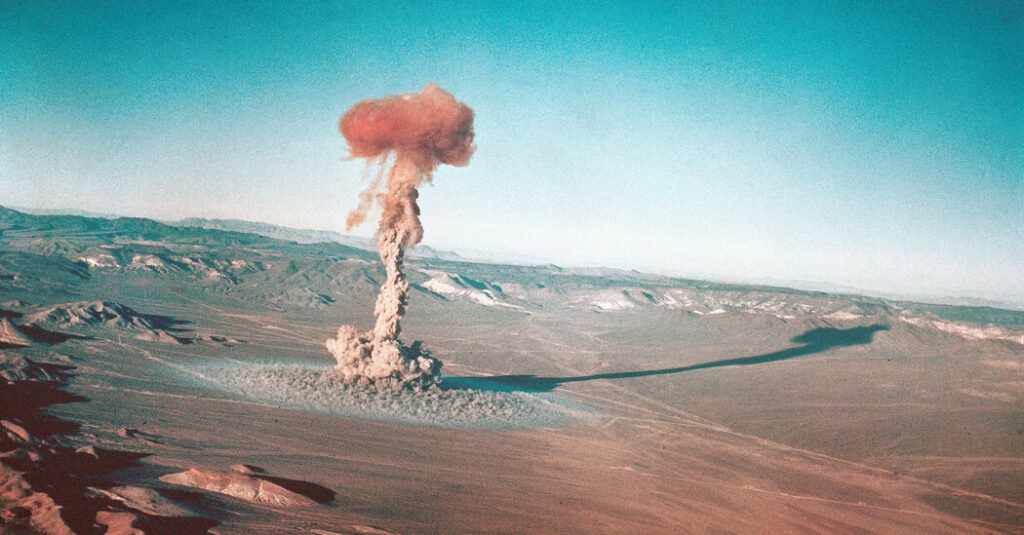
Initially, some American nuclear experts outside the government saw Mr. Trump’s remarks as meaning that the United States planned the kind of powerful underground nuclear tests that were frequent symbols of the tit-for-tat Cold War competition a half century ago. The tests were detonated underground, sending shock waves radiating into the earth’s crust and from there ricocheting around the globe. The blasts were easy to detect.
And while the United States, Russia and China have suspended those kinds of tests — observing the Comprehensive Nuclear Test Ban Treaty even though the U.S. Senate has never ratified it — North Korea ignored it. Between 2006 and 2017 it conducted six underground tests, shattering the hopes for a global moratorium.
The testing ban, which took effect in 1996, forbids tests that produce any explosive force whatsoever, no matter how minuscule. It is called a “zero-yield” treaty.
But some experts have long had a different view of Mr. Trump’s remarks, interpreting them as calling for relatively small tests that would release no detectable shock waves. The absence of earthshaking explosions make these tests nearly impossible to detect.
In his Geneva talk, Mr. DiNanno made clear that the Trump administration believed that Russia and China had already conducted such tests, and he suggested that the president’s call for testing “on an equal basis” might allow the United States to do the same.
Mr. DiNanno said the U.S. government knew that China had conducted “nuclear explosive tests” it sought to conceal. He specifically pointed to one on June 22, 2020, toward the end of Mr. Trump’s first term.
The main global network that seeks to monitor adherence to the test ban said in a recent statement that it had detected no test explosion on that date. And American officials say that over the past five years, American intelligence experts have debated whether or not the Chinese government actually conducted the test. But Mr. DiNanno expressed no doubt.
“DiNanno’s comments surprised me,” said Terry C. Wallace, a former director of the Los Alamos National Laboratory who long studied China’s program of nuclear experimentation. “They had no caveats” rooted in the field’s uncertainties, he said.
In his talk, Mr. DiNanno said Beijing used “decoupling” to hide its testing. He was referring to a technique that bomb designers use to separate the shock waves of a nuclear detonation so that they make no impact on the earth’s crust. The means include bottling up a small explosion in a container behind superstrong walls of steel.
The United States knows the process well: From 1958 to 1961, long before the global test ban, American nuclear weapons designers conducted more than 40 such tests, even though there was a U.S.-Soviet test moratorium.
In his talk, Mr. DiNanno did not detail the implications of his claims. But he repeated the “on an equal basis” wording, suggesting that the United States was headed in that direction, too. There was some ambiguity, however. He said that the United States was eager to “restore responsible behavior when it comes to nuclear testing” but gave no indication of what he meant by “responsible.”
David E. Sanger covers the Trump administration and a range of national security issues. He has been a Times journalist for more than four decades and has written four books on foreign policy and national security challenges.
The post Newly Unbound, Trump Weighs More Nuclear Arms and Underground Tests appeared first on New York Times.