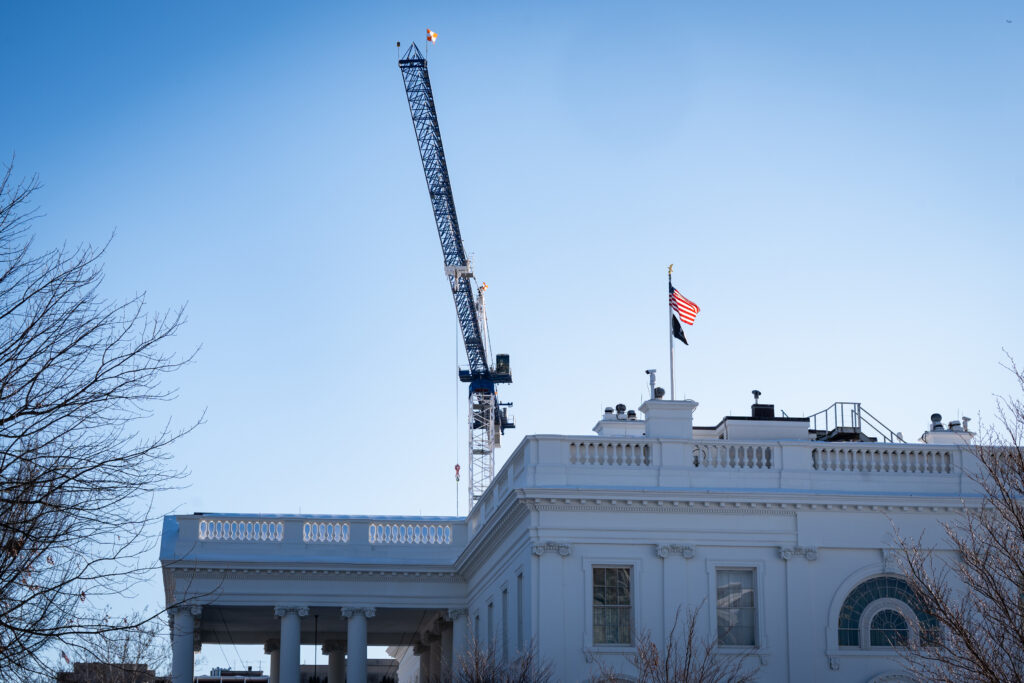
A federal judge is expected to soon rule on whether President Donald Trump’s planned $400 million White House ballroom project can proceed, zeroing in on whether the administration’s plan to rely on private donations allows it to bypass congressional approval.
Trump has argued that the approach spares taxpayers the expense, but the dispute has instead highlighted a lack of transparency over how the project is being financed. U.S. District Judge Richard Leon, congressional Democrats and watchdog groups have questioned an arrangement that relies on donations from corporations with business before the federal government, funneled through a nonprofit intermediary that stands to collect millions of dollars in fees, to fund the most significant alteration to the White House in decades.
Leon has said he may rule this month on the National Trust for Historic Preservation’s challenge to the project. As the decision approaches, watchdog groups have scrutinized the administration’s fundraising effort, arguing that it exploits gaps in federal disclosure rules that Congress should tighten.
Trump and White House officials have publicly identified about two dozen companies and about a dozen individual donors they say have already contributed hundreds of millions of dollars for the project, including major corporations such as Amazon, Google and Palantir that collectively have billions of dollars in contracts before the administration. (Amazon founder Jeff Bezos owns The Washington Post.)
Most of the donors have declined to specify to reporters and lawmakers how much they have given and whether they expect any additional access to officials or other perks in exchange for their gifts.
Citizens for Responsibility and Ethics in Washington (CREW) concluded that at least 22 companies involved in the ballroom project should have disclosed their donations in lobbying filings but did not.
“The public deserves real transparency around who is contributing and how much they are giving, but that is not what we are seeing,” Matt Corley, CREW’s chief investigator, wrote in an email.
Those concerns also have been taken up by Sen. Elizabeth Warren (D-Massachusetts), who has pressed the Trust for the National Mall — a nonprofit that is managing donations for the White House ballroom project — to clarify its role and specify the donations it has received. In a letter sent to Warren and shared with The Post, the organization declined to offer details about the gifts, but said that it stands to collect between 2 and 2.5 percent of each donation as part of its management fee. The planned $400 million project would be the largest in the organization’s history.
“These new details raise even greater concerns about whether Donald Trump’s gold-encrusted ballroom has become a vehicle for corruption,” Warren said in a statement to The Post. “Americans deserve to know which billionaire corporations are shoveling money to Trump’s vanity projects and what favors they may be seeking in return.”
Julie Moore, a spokeswoman for the Trust for the National Mall, in an email to The Post characterized the management fee as standard practice and said the money would support “our critical work and mission with the National Park Service to restore, preserve and enrich the National Mall and President’s Park.”
The organization, which has managed past fundraising campaigns to restore the Washington Monument and other projects, reported around $13 million in revenue and $17 million in expenses in 2024, according to nonprofit filings. Moore said the organization’s role had been “mischaracterized” by lawmakers and in the media, adding that the organization does “not play a role outside of that in soliciting gifts or in the planning or construction of the project.”
Moore did not say whether at least two board members who had active interests before the Trump administration when the project was discussed recused themselves.
The White House declined to specify how much money had been raised for the project or respond to questions about whether or how contributors could benefit. Trump in October hosted donors for a celebratory dinner in the East Room of the White House.
“President Trump is generously donating his time and resources to build a beautiful White House ballroom, a project which past presidents only dreamed about,” White House spokesman Davis Ingle said in a statement. “Since announcing this historic plan, the White House has been inundated with calls from generous Americans and American companies wishing to contribute.”
Just one company — organ-therapy firm Vantive US Healthcare — disclosed its ballroom gift as part of semiannual lobbying filings, saying that it gave $2.5 million to the Trust for the National Mall on Oct. 13. The filing was first reported by Bloomberg Government.
Vantive declined to respond to questions about why it made the donation or about its lobbying priorities, referring to the filing. The company on its forms disclosed spending more than $2 million in 2025 to lobby the Trump administration on Medicare billing, organ-support devices and other issues. That total included $340,000 for Ballard Partners, which employed Pam Bondi and Susie Wiles before they joined the Trump administration as attorney general and White House chief of staff, respectively. Neither Bondi nor Wiles reported lobbying for Vantive.
The administration has argued that the White House has the legal authority to accept gifts through the Department of the Interior, and that Congress has authorized the president to make changes to the White House grounds by setting aside a small annual fund for renovations. Lawyers for the National Trust for Historic Preservation, which is charged by Congress with preserving historic buildings, have countered that those provisions do not authorize a project of this scale and that the ballroom required express approval and funding from Congress.
“Rather than admit that [no authorization] exists, the Defendants invent a Rube Goldberg machine” to justify proceeding, the National Trust’s lawyers argued in court filings last month, invoking the expression about an overly complicated device designed to perform a simple task.
Leon, an appointee of President George W. Bush, appeared to agree with that critique at a Jan. 22 hearing, repeatedly referring to the Trump administration’s funding initiative as a “Rube Goldberg” machine and saying that the construction plan functioned as an end run around congressional oversight.
Justice Department lawyers have rejected that characterization, arguing that the administration’s funding approach is legal and consistent with past projects on White House grounds.
“This is not a circumvention of the appropriations process — it is a funding mechanism that Congress knowingly authorized and has long been aware is available to support projects on White House grounds,” Justice Department lawyers wrote in a Feb. 2 filing.
Justice Department lawyers also framed any pause as a potential national security risk and said they would immediately appeal if Leon grants a stay on the project.
Leon said that, regardless of how he rules, he expects the case to be appealed to the Court of Appeals for the D.C. Circuit and even the Supreme Court.
The post Legality of Trump’s $400M in private funding for White House ballroom at issue appeared first on Washington Post.