When most people think of ocean waste, they often picture mounds of plastic that wash up on the sandy beaches of remote islands in the Pacific. But environmentalists face a hidden scourge in abandoned fishing nets that drift beneath the waves and blanket the ocean floor.
These discarded “ghost nets” are typically made of durable nylon and can last for centuries, trapping marine life and damaging coral reefs. Getting them off the ocean floor can require dayslong dives from expert teams. A mission from 2024 spanned five days and pulled up 4,900 kilograms of netting — roughly the weight of an African elephant.
Now, some start-ups are trying to tackle the problem by recycling the nets into commercial products that will appeal to consumers interested in saving the oceans and companies eager to prove they are environmentally friendly. Some are making soccer and volleyball nets; others are making surfboards or bracelets.
A brother and sister in Spain started a company to collect and turn the ghost nets into furniture, decorative materials and plastic pellets.
“Our goal is to create value through impact, not just clean up the oceans,” said Amaia Rodríguez Solá, who with her brother, Julen Rodríguez, started Gravity Wave in 2019.
Gravity Wave works with companies that want to finance cleanup operations to burnish their green credentials, as well as partners that buy the recycled materials to use in items ranging from furniture to stadium seating. The initiative supports waste collectors, recycling facilities and manufacturers.
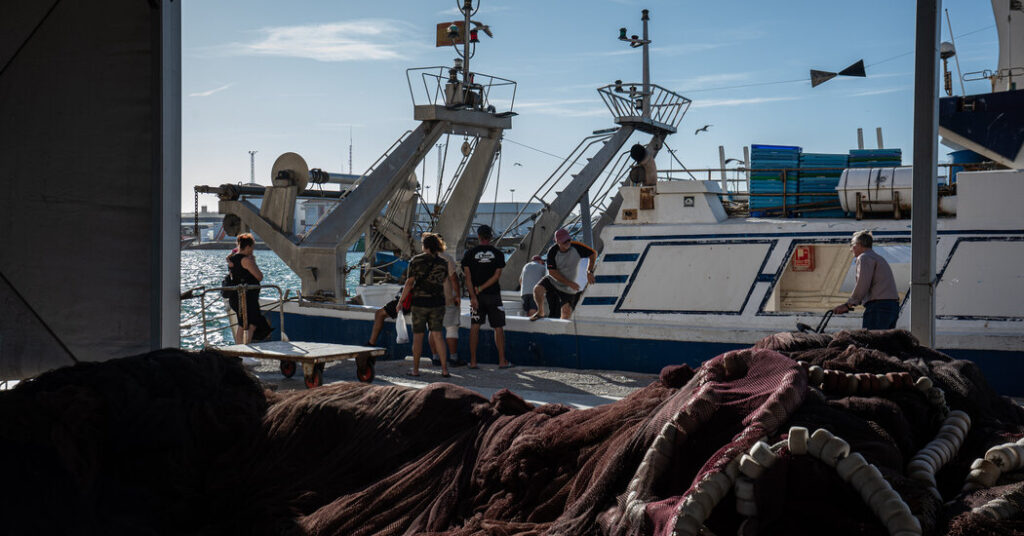
The port in Motril, a small town in southern Spain, was one of the first to join Gravity Wave’s efforts. Today, Gravity Wave works with more than 7,000 fishermen in 150 ports in Spain, Italy and Greece to recover discarded nets and other ocean plastics.
But fishermen cannot collect all of the nets in the ocean. To retrieve the ones tangled on the seafloor, a team of experienced divers must head to the bottom of the sea to tie the nets together with large ropes, which a crane then hoists to a boat, an endeavor that can take days. Gravity Wave teams up with specialized dive teams for those operations.
In September 2024, Gravity Wave workers and members of Coral Soul, a marine restoration group, headed out for one, called Mission Salobreña.
Thirty meters below the surface, fishing nets from an abandoned fish factory covered the seafloor. The site off the coast of Salobreña is a so-called special conservation zone and is protected under a European Union directive meant to conserve natural habitats and species.
On the ship, José Maria Fernandez, who oversaw a crew of 32 professional divers, controlled the divers’ air supply and monitored their depth.
Over five days, the divers and operational staff on four boats removed nearly 5,000 kilograms of plastic from the water.
Marina Palacios Miñambres, the founder and director of Coral Soul, worked with other boats to set up a safety perimeter. “It’s very sad to see how the ecosystem of the ocean is damaged,” she said.
Gravity Wave stands out from similar initiatives because it is a for-profit company that controls the whole process — from collection of the materials to product design and sales — while using blockchain technology, a public ledger of digital transactions, to certify the environmental impact.
The enterprise has not been without its challenges. European regulations on transporting waste across borders have forced the company to source local recycling partners in Italy and Greece.
Many recyclers were initially hesitant to process ocean plastics, particularly fishing nets, which could damage machinery.
In an industrial area on the outskirts of Valencia, the former ghost nets reach their final stage: shiny, turquoise plastic pellets and panels. Cutting machines drill the panels, transforming them into decorative letters, industrial pieces, and furniture for hotels, architects and industry partners.
To date, the company has collected 1,400 tons of plastic and fishing nets, more than 700 tons of which has been processed.
“We are showing that plastic can have a second life, and that businesses can profit while protecting the environment,” Ms. Rodríguez Solá said.
The post From Fishing Nets to Furniture: Turning Ocean Plastic Into Usable Products appeared first on New York Times.