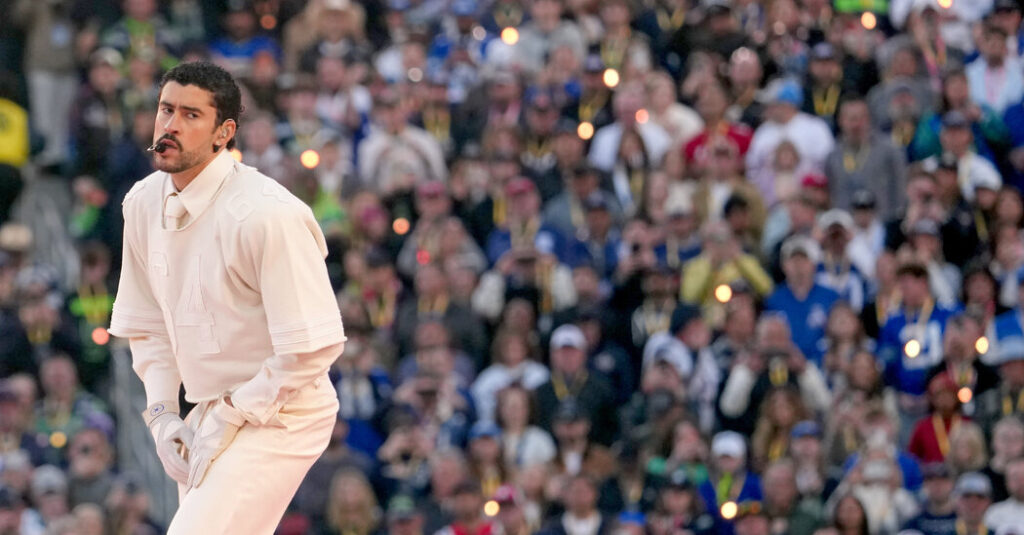
There is perhaps no stage more visible than the Super Bowl halftime show, viewed each year by upward of 100 million people. And there are few, if any, performers in pop more popular and embraced than Bad Bunny, the 31-year-old Puerto Rican superstar who has been one of music’s dominant global innovators for a decade.
It would seem like an ideal match — an epic platform for an epic performer, an alignment of grand-scale ambition and execution.
And yet Bad Bunny did something quite novel with his Super Bowl LX performance in Santa Clara, Calif., on Sunday night, turning it into an extended presentation on how to make a global opportunity intimate, personal and historically specific. Like his sixth solo album, “Debí Tirar Más Fotos,” which a week ago made history as the first Spanish-language album to win the Grammys’ top honor, and his 31-show residency in San Juan, Puerto Rico, last summer, he assiduously brought people to him, on his terms.
Here, it started in the sugar cane fields — once Puerto Rico’s cash crop, and a source of rampant labor exploitation. Bad Bunny began his show with the frisky “Tití Me Preguntó” from 2022, walking amid laborers in pavas chopping at stalks and tall plants forming something of a labyrinth. He strode past vendors of coco frio, tacos and piraguas; a pair of boxers sparring; a table of older gentlemen playing dominoes; women at a nail salon.
This was Bad Bunny’s private Puerto Rico, a place of cultural joy and political complication. The first two minutes of his 13-minute show took place largely within that maze, an almost-protected space that projected safety and ease, just before he emerged on the roof of La Casita, the replica of a traditional Puerto Rican home that served as the centerpiece of his set here (and also his residency performances), and began serenading the world.
Almost every minute that followed — performed almost entirely in Spanish, a Super Bowl first — featured a combination of musical astuteness, familial exuberance and sociopolitical statement. This combination was most vivid leading up to and during “El Apagón” (“The Blackout”), a 2022 song that has become something of a resistance anthem in part because its video includes a minidocumentary about inequities in Puerto Rico. The Super Bowl rendition began with workers falling from utility poles in a flash of sparks, a nod to the blackouts that crippled the U.S. territory for several months following Hurricane Maria in 2017.
Just before that, the Puerto Rican pop star Ricky Martin sang — huskily, perhaps pushing beyond his vocal limits — part of “Lo Que Le Pasó a Hawaii,” a 2025 song warning about modern-day colonialism. Martin was a star of an earlier Latin pop wave, and Bad Bunny’s inclusion of him was a sharp nod to how Puerto Rico has long been interwoven into American music.
Bad Bunny underscored that further by playing quick snippets of early to mid-2000s breakthrough reggaeton songs from Don Omar, Tego Calderón, Héctor El Father and Daddy Yankee, whose 2004 hit “Gasolina” was a foundational track of the genre’s global explosion. (Sadly, none of those stars were present.) He also showcased Toñita, the matriarch of a long-running Puerto Rican social club in Williamsburg, Brooklyn, which Bad Bunny appeared at last year and shouted out on his “Debí Tirar Más Fotos” track “NuevaYol.”
“Debí Tirar Más Fotos” is a narratively and sonically ambitious album about restoring one’s connection to home, and to heritage. Part of understanding history is honoring it, and part of understanding history is knowing when to call attention to its tragedies. Which is why early in his set, Bad Bunny performed an ecstatic “Yo Perreo Sola,” an anti-misogyny statement from 2020 that’s one of his most popular songs, and also one of his most provocative, taking the reggaeton community to task for its dismal treatment of women.
His delivery of it here, on the roof of La Casita, was emphatic, and also the soundtrack to a party. At his residency, La Casita was a place for the well-known to watch the show while also being a part of it. Members of the porch crowd on Sunday included Cardi B, who has collaborated with Bad Bunny, and is partly of Dominican heritage; the Colombian superstar Karol G, another collaborator; the Hollywood star Pedro Pascal, who was born in Chile; the Mexican American actress Jessica Alba; the Venezuelan baseball star Ronald Acuña Jr.; and the rising Puerto Rican star Young Miko, something of a Bad Bunny protégé. It was a quietly pointed array of cultural forces across media, a statement of Latin American unity and independence. (The influencer Alix Earle and the nightlife impresario David Grutman were there, too.)
The night’s only hiccup was Lady Gaga’s fine but arbitrary performance of “Die With a Smile,” a song with no true connection, thematic or musical, to Bad Bunny’s catalog, and the only one performed in English. It was something of a mystery, notwithstanding the added salsa rhythm section provided by the Puerto Rican outfit Los Sobrinos. (For what it’s worth, Cardi B was literally right there — a version of “I Like It,” their genre-crossing pop smash with J Balvin, would have been welcome.) The blue of Gaga’s dress was perhaps a nod to the Puerto Rican independence flag, which, later in the show, Bad Bunny hoisted over his shoulder while he delivered “El Apagón.”
There are many modes of political positioning: outright sloganeering, encoded messages, visual cues. Freedom and joy themselves can be acts of resistance. All of those were present during this performance, though there was no moment as direct as Bad Bunny’s “ICE out” call at the Grammys a week ago. Instead, he led dozens of dancers in ornate choreography, pointedly including same-sex pairings.
There was a narrative through line which went from a proposal to a wedding (an actual one) to the appearance of a child watching Bad Bunny’s Grammy acceptance speech, though that thread was slightly muddy. Online, people speculated the young boy was Liam Conejo Ramos, the child at the center of a recent contentious federal immigration action in Minnesota. He was, in fact, an actor, but the confusion underscored the urge to apply an unwieldy political literalism to Bad Bunny’s performance.
For some, the mere fact of Bad Bunny’s selection for the halftime show could only be read as a political statement. It even inspired a counterprogramming event: the “All-American Halftime Show,” presented by the right-wing organization Turning Point USA and headlined by the rabble-rouser Kid Rock, along with the country stars Brantley Gilbert, Lee Brice and Gabby Barrett. That lineup purported to place a tent over musical styles deemed sufficiently American, an act of exclusion masquerading as an embrace of unity.
But Bad Bunny’s tent was, and always has been, far bigger, far more musically generous and far more imaginative. Near the end of his performance, he shouted “God bless America,” then ran through a list of the countries that make up South, Central and North America, from Chile all the way up to Canada. He held out a football that read “Together, We Are America,” and then spiked it before his final song, “DtMF.” Dozens of people surrounded him, waving flags of the countries he’d just named, virtually swaddling him as they ushered him off the field and back to protected, private space.
Jon Caramanica is a pop music critic who hosts “Popcast,” The Times’s music podcast.
The post Bad Bunny’s Halftime History Lesson appeared first on New York Times.