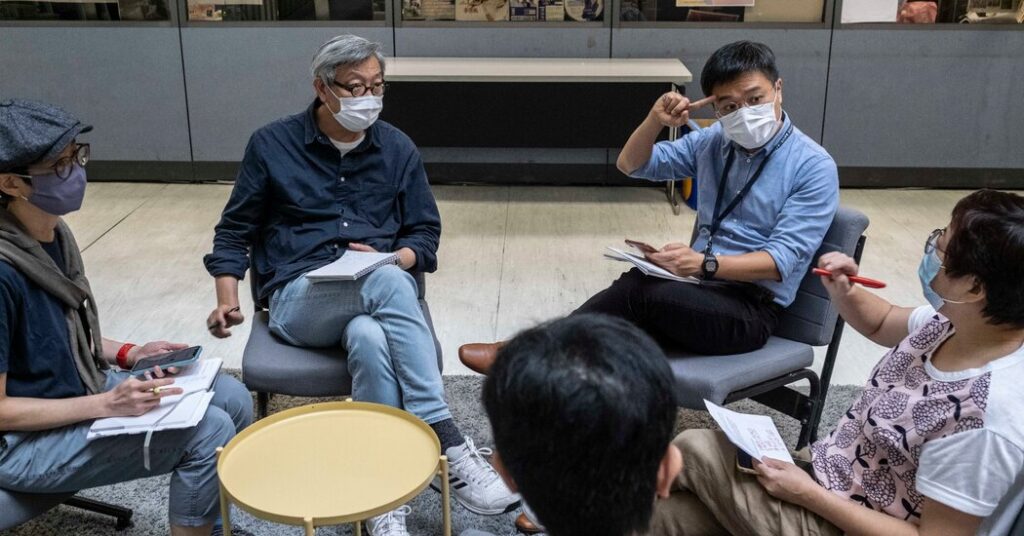
The Hong Kong court that sentenced the pro-democracy media mogul, Jimmy Lai to 20 years in prison on Monday also issued heavy sentences to six former employees of his now-shuttered newspaper, setting a new standard for the city’s limits on press freedom.
The newspaper, Apple Daily, was one of Hong Kong’s most independent and widely read news outlets for years until it was forced to shut in 2021 as part of a crackdown on dissent. It was rambunctious, often sensational and proudly pro-democracy. Many Hong Kongers see it as a symbol of the civil liberties that have been lost as Beijing has tightened its grip over the city.
On Monday, the court handed down 10-year prison terms to the paper’s leading editorial voices: Editor-in-Chief Law Wai-kwong, Executive Editor Lam Man-chung, and an editorial writer, Fung Wai-kong.
Others received significant terms as well: Yeung Ching-kee, another editorial writer, was sentenced to seven years and three months; an associate publisher Chan Pui-man, seven years, and Cheung Kim-hung, a publisher, six years and nine months.
The sentences were longer than those given in 2024 to two editors who ran another pro-democracy news site, Stand News, also now defunct. Two of the new outlet’s journalists, Chung Pui-kuen, and his successor, Patrick Lam, were convicted of conspiring to publish seditious materials. Mr. Chung was sentenced to 21 months, and Mr. Lam, who has a serious health condition, to the time he had already served between his arrest and his release on bail — slightly less than a year.
Rights activists and journalist groups have said the prosecution of editors and journalists in Hong Kong illustrated the decline of press freedom in the city and raised questions about what journalistic activities the authorities might consider illegal. The government has hit back at those criticisms, saying that journalists have to abide by Hong Kong’s laws.
But the lines have clearly been redrawn. Several journalists and photographers have been denied work visas or barred from entering the city, including an Associated Press photographer who previously photographed Mr. Lai walking in a barbed wire enclosure.
Many local news outlets have stopped reporting on efforts by Hong Kong activists, now in exile, who draw attention to China’s crackdown on the city. Press freedom advocates say the territory’s national security laws significantly raise the risks for journalists operating in the city. Hong Kong’s vague definition of external interference can be broadly applied to regular journalistic work, the activists say.
“The rule of law has been completely shattered in Hong Kong,” Jodie Ginsberg, the chief executive of the Committee to Protect Journalists, said in a statement after Mr. Lai’s sentencing. “Today’s egregious decision is the final nail in the coffin for freedom of the press in Hong Kong.”
David Pierson covers Chinese foreign policy and China’s economic and cultural engagement with the world. He has been a journalist for more than two decades.
The post Apple Daily Sentences Show a New Era of Media Peril in Hong Kong appeared first on New York Times.