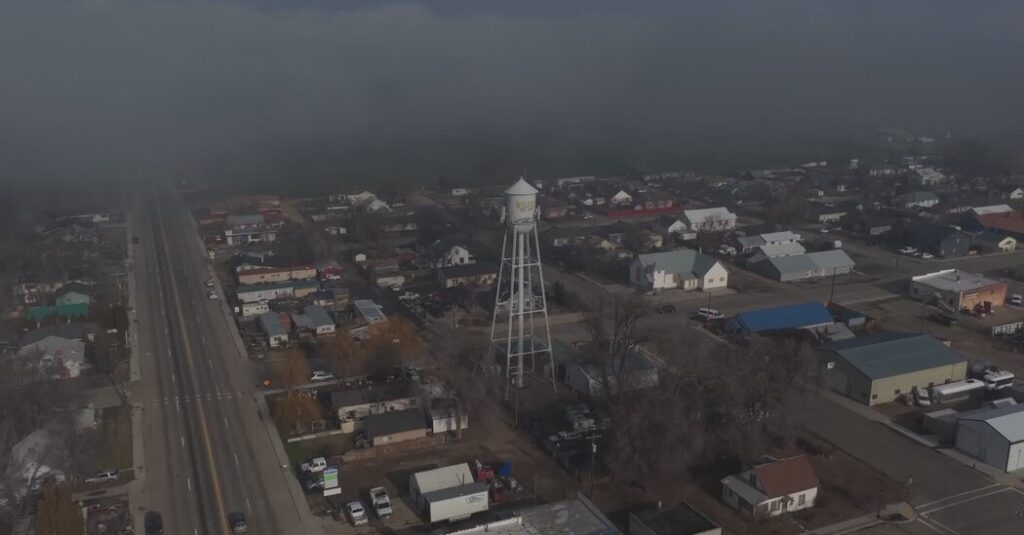
People in Wilder, Idaho, didn’t give much thought to the dusty horse track west of town known as La Catedral Arena, where, on Sundays in the summer and early fall, vendors sold horchata and tacos, announcers called race results in Spanish and immigrant families gathered for reasonably priced fun.
But when federal agents swarmed the track on Oct. 19 — weapons drawn, a helicopter overhead, unmarked S.U.V.s screeching in on dirt roads — they did more than crack an alleged gambling ring and increase deportation numbers. They shattered Wilder’s innocent belief that its out-of-the-way location and deep-red politics could isolate the town from the raids overtaking other parts of the country.
“We rely on Hispanic labor,” said Chris Gross, a second-generation farmer who grows sweet corn seed and mint in Wilder. She added, “Nobody thought something like this could happen here.”
The raid on La Catedral may not have made the national headlines that immigration sweeps in Minneapolis, Chicago and Los Angeles did, but it illustrated the depth and breadth of President Trump’s effort to find and rid the country of undocumented immigrants; 75 people rounded up that day have since been deported, according to local immigration lawyers.
Beyond the economic impact, there is the social one — the profound sense of uncertainty and suspicion that has filtered down, even to a town like Wilder, Idaho.
The raid “nearly destroyed” the community, said David Lincoln, a longtime Wilder resident and executive director of a nonprofit economic development agency serving rural towns in western Idaho. Wilder won’t really know the impact until planting season begins this spring.
“What happens if everyone who is Hispanic thinks they’re at risk?” Mr. Lincoln asked. “There’s fear now that didn’t exist here before. I don’t know how you make that go away.”
Optimism, sometimes of the cockeyed variety, had been a defining feature of this small town, which has a population of 1,725 and is 10 miles from the Oregon-Idaho line. Farmers founded the community in the early 1900s, with the correct belief that federal irrigation projects would improve crop yields on the high desert between the Owyhee and Blue Mountains, and the mistaken hope that a railroad line connecting Montana and California would pass this way.
Early settlers planned to name the place “Golden Gate” after what they hoped would be the train line’s final destination, until the magazine editor Marshall Pickney Wilder offered favorable coverage in return for naming their town for him.
The early presence of seasonal migrant workers from Mexico evolved into a permanent community of Latino immigrants, some U.S. citizens, some on H-2A agricultural visas and some undocumented, most serving the farmers of Canyon County who depend on them.
At 84 percent white, Idaho is one of the most racially homogenous states and one of the most solidly Republican; 91 percent of voters in the precinct that includes Wilder backed President Trump in 2024, a higher percentage than in Idaho as a whole. About 60 percent of the population in Wilder identifies as Latino, but their voting preference is unclear.
In 2015, Wilder elected an all-Latino City Council, a coincidence perhaps, since the five candidates didn’t run as an organized block, but it was also a watershed.
“People treated it like a curiosity even though, given the population, we should have been surprised that it took us so long,” said Mariza Fernandez, a local teacher whose younger brother, Ismael, was elected to the council as a 19-year-old College of Idaho freshman.
He made headlines as a symbol of Wilder’s harmony.
“Then came the negatives,” his sister said.
Ms. Fernandez’s brother died in a car accident in 2017. The Latino council majority collapsed. The town’s first Latina mayor lost a re-election bid in 2019.
“They were too busy being Latino and not running the city,” said the current mayor, Steve Rhodes, adding that race was not something people worried about in Wilder. “I don’t know anyone in town that sees a race,” he said.
Then came the raid on La Catedral. The mayor said he had known little about the track. The police chief, Dusty Tveidt, whose department was not included in the local, state and federal task force involved in the raid, said most of the people apprehended that day had been “from California or Washington.”
But plenty of people in Wilder’s Hispanic population either attended the races on Peckham Road or had friends who did.
“It wasn’t a secret,” Ms. Fernandez said. “It just wasn’t something white people went to.”
Between races, children were allowed to run down the track.
“You’d have brothers, sisters, grandparents all meeting up out there,” said John Carter, a white Trump voter whose company provided security at La Catedral. “They’d put up canopies, have someone get there early to snag a spot right along the track.”
According to court documents and county land-use permits, the owner of the 24-acre farm, Ivan Tellez, had run races for several years. In February 2025, a confidential informant complained to the F.B.I. about gambling, and federal investigators found betting brackets posted on the Facebook page of a man whom Mr. Tellez frequently called or texted. Investigators used court warrants to track transactions on smartphone apps. An undercover agent who attended a day of races in August and September reported seeing couriers in backpacks taking cash from people in the crowd.
The F.B.I. arrived first on Oct. 19, Mr. Carter said. Agents pointed automatic rifles and set off flash-bang grenades as they arrested Mr. Tellez and searched several buildings. Other federal, state and local agencies, including Immigration and Customs Enforcement, showed up soon after, sending many in the crowd running into neighboring fields or hiding in their cars. The local sheriff rode through on horseback, and a black, military-style helicopter circled low in the sky.
Alex Zamora, a superintendent for Wilder school, was home prepping for the upcoming week when his phone erupted.
“There was just such confusion,” he said. “‘What in the world is going on in Wilder?’”
Nikki Ramirez-Smith, an immigration lawyer in nearby Nampa, began receiving panicked calls.
“When I answered, it was someone crying,” she said. “The only thing I could understand at first was, ‘They’re here. It’s ICE.’”
Eventually, everyone there was herded to the end of the track. Most adults, including parents caring for toddlers, and many teenagers had their hands bound. Mr. Carter said he saw federal officers pointing guns at people simply for asking questions, and young teenagers being zip-tied, including Mr. Carter’s 14-year-old daughter.
Homeland Security Secretary Kristi Noem and an F.B.I. spokesman initially dismissed reports of children being zip-tied and hit with rubber bullets as “completely false,” though the F.B.I. later amended its statement to say no “young children” were bound. Several hundred people were detained for four hours.
“They could have gone first thing in the day with a few F.B.I. agents and just arrested the people they had warrants for,” Mr. Carter said. “Instead, they went in at the busiest time with maximum force.”
State and federal leaders praised the raid as a successful gambling crackdown, with immigration enforcement being a fringe benefit.
Civil rights activists accused the federal government of using gambling charges as a front to round up people of color who they believed were in the country illegally simply because they spoke Spanish. Almost everyone in the crowd was herded through a large tent for questioning.
“The one thing everyone got asked was, ‘Where were you born?’” said Neal Dougherty, an immigration lawyer. “Not, ‘Did you see gambling?’ Not, ‘Did you participate in gambling?’ Just, ‘Where were you born?’”
Mr. Tellez and four other people are scheduled for trial later this year on gambling charges. Another 105 people were held on immigration charges, and 75 of them have been deported.
Four months later, the full impact of the raid on Wilder varies depending on who is doing the talking.
On the day after the raid, half the students in Wilder, where more than 70 percent of the school population is Latino, skipped class. Ms. Gross, who is white, said anyone who sees a black S.U.V. roll through town, regardless of their race, “freezes up.” Ms. Ramirez-Smith predicts that civil rights lawsuits are coming.
Yet Mayor Rhodes insisted there had been “zero impact” on the town.
“These were not our people,” he said of the raid. “What happened out at that track had nothing to do with Wilder.”
Anna Griffin is the Pacific Northwest bureau chief for The Times, leading coverage of Washington, Idaho, Alaska, Montana and Oregon.
The post A Raid in a Small Town Brings Trump’s Deportations to Deep-Red Idaho appeared first on New York Times.