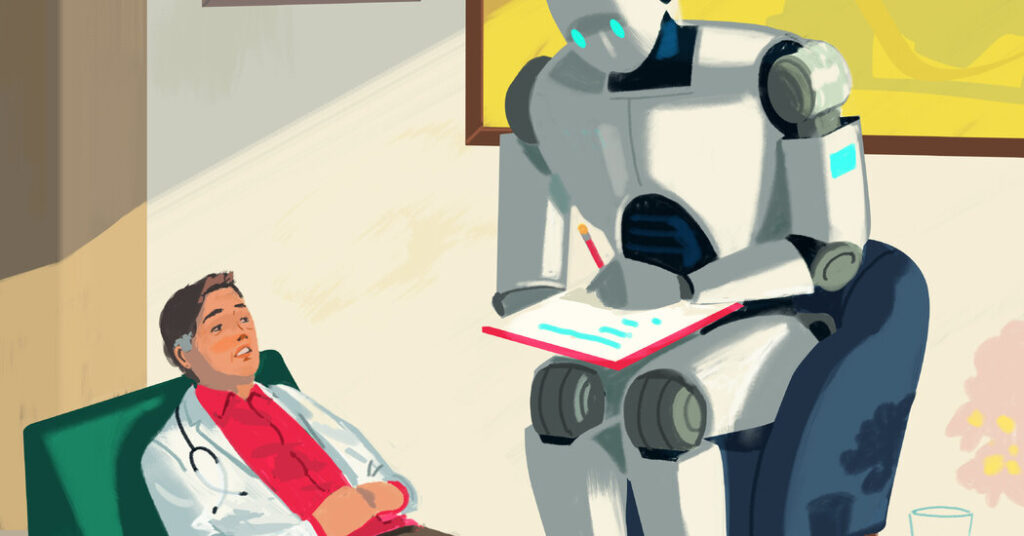
When it’s time to have a difficult conversation with a dying patient about whether to insert a feeding tube, Dr. Jonathan Chen, an internist at Stanford, practices first with a chatbot. He asks the bot to be a doctor while he plays the role of the patient. Then he reverses the roles.
He feels uncomfortable doing it. The bot is so good at finding ways to talk to patients. Doctors also know it is so good at diagnosing and so good at reading scans and images — better than many doctors, in fact — and so good at answering patient questions in portals and writing appeals to insurance companies when a medication or procedure is denied.
So what is a doctor for?
A.I. programs are becoming “existentially threatening,” for doctors, Dr. Chen said. “They threaten your identity and your purpose.”
Dr. Harlan Krumholz, a cardiologist at Yale and adviser to OpenEvidence, an A.I. program for doctors, agrees.
“A.I.’s reasoning and ability to make diagnoses is already outpacing what physicians can do,” said Dr. Krumholz, who is also a co-founder of two start-ups using A.I. to interpret medical scans and digital data.
Many doctors who have thought deeply about the role of A.I. in medicine have also worked with A.I. companies. Dr. Chen is one who has not, but he said that he and many of his colleagues were being forced to ask “When is it time to just get out of the way and let a computer take over?”
Dr. Chatbot isn’t quite ready to see you now, researchers say. But A.I. is starting to change what some doctors do, and which patients they see.
A.I., said Dr. Robert Califf, a cardiologist at Duke and former Food and Drug Administration commissioner, is taking over what he called “some of the scutwork” that doctors have to do now, like making notes about patient visits. But even with the sum of medical knowledge in its servers, it may not be enough to let the bots take over care for patients. (Dr. Califf worked for Alphabet for six years and is advising a start-up that uses A.I. to prescribe medications.)
“There is an overwhelming amount of information and how to think critically about that information is complicated,” Dr. Califf said.
Dr. Lee Schwamm, a neurologist and associate dean for digital strategy and transformation at Yale School of Medicine, gives an example.
The patient says, “Yesterday I woke up dizzy. My arm was dead, and I had trouble speaking.”
What does “dizzy” actually mean? It could mean the patient is lightheaded and about to faint. Or it could mean that the room is spinning.
A “dead” arm might be numb rather than weak. Someone with an arm that is partially paralyzed may say it feels numb. But a patient might feel a pin if Dr. Schwamm pricks their arm.
Is the patient having a stroke? Is this a medical emergency?
Dr. Schwamm has years of training that helps him figure out who is sick and who isn’t, he says, and who to not be worried about and who should be admitted to the hospital.
He has learned to read subtle signs and synthesize information that is difficult to make explicit and almost never written down.
And, Dr. Schwamm said, he “can use reasoning in the face of limited or imperfect information to select the most likely diagnoses for further evaluation, balancing thoroughness with pragmatism.”
That’s not a chatbot’s forte.
“It is just really good at matching patterns and making predictions,” Dr. Schwamm said. “But it can only do this based on the data that it is given about the patient. It has no way to extract that information itself.”
And patients with serious diseases need a human connection, he added.
“In the end you want to look someone in the eye,” he said, and explain that the patient has 10 years to live, or just six months.
But he’s not dismissing chatbots, which he concedes can expand doctors’ reach, and alter the structure of our medical system.
Already, Dr. Schwamm said, A.I. can outperform doctors in some situations, like reading an electrocardiogram. It can find heart conditions by detecting patterns cardiologists can’t see, and that would ordinarily require an expensive echocardiogram.
That means that a job for cardiologists can now be done by general practitioners.
It can also help reduce the caseload of some medical specialists so patients who need their expertise will not have to wait weeks or months to get an appointment.
That’s already happening in the practice of Dr. John Erik Pandolfino, a specialist in gastroesophageal reflux disease, or GERD, at the Feinberg School of Medicine at Northwestern University.
Most patients who were worried about GERD symptoms had to wait weeks to get an appointment with him. He said that “a good proportion of the time” the patients had less serious cases that didn’t require his care.
Dr. Pandolfino created an A.I. solution he calls GERDBot. It triages patients, steering those who don’t really need to see him to other providers. The goal is to expedite care for those with more worrisome symptoms.
Patients start by answering the bot’s questions. Those whose symptoms indicate a serious problem are seen right away. The others get a call within a week from a nurse practitioner or a physician assistant who allays their fears and gives them medicines, if necessary, that can help.
Dr. Pandolfino, who licensed a different A.I. model he made to the medical device company Medtronic, sees fewer patients, but they are the ones who need his expertise.
“Most people are appreciative that they get started with their care and get information right away, and if they fail treatment, or have warning signs, they get triaged to the doctor,” he said.
He concedes that a small minority feel that they are being shunted to second-rate care. But the old way — with as much as a six-month wait for an appointment — was so much worse for people who wanted help and reassurance.
The next step is to offload even patients with more severe GERD symptoms.
Dr. Pandolfino has developed an A.I. algorithm that he calls Eso-Instein (“Eso” is for esophagus) that will help a less specialized gastroenterologist decide the most likely diagnosis from a patient’s symptoms, endoscopy scans and physiologic testing. Then it tells that doctor how to treat the patient and the prognosis.
“Eventually, when the algorithm is working better than a human, I will have to find something different to do,” Dr. Pandolfino said.
A.I., he says, “will make people like me less and less valuable.”
Just as Dr. Pandolfino’s A.I. algorithm may let specialists hand over many of their patients to generalists, there’s also a hope that the same sort of strategy might make generalists more available by handing off some of their jobs to nurse practitioners.
There’s a serious lack of primary care doctors, not just in rural areas but even in major cities with multiple hospitals and large medical schools.
Dr. Isaac Kohane, chairman of the department of biomedical informatics at Harvard Medical School, said that when a new faculty member asked him to recommend a primary care doctor in Boston, he was unable to find practices that were taking on new patients.
“Access is absolutely a problem,” said Dr. Daniel Morgan, professor of epidemiology and public health and medicine at the University of Maryland School of Medicine. “We’d like to see patients more expeditiously. I don’t know a single physician who loves to say, ‘Oh yeah. It’s six months to see me.’”
But A.I. can help patients, said Dr. Adam Rodman, an internist at Beth Israel Deaconess Medical Center. It can triage patients and let nurse practitioners do more of a primary care doctor’s work, freeing the doctor to see more patients with complex needs. And when it comes to a choice between no doctor who is taking new patients or a doctor who refers patients to a nurse practitioner or a physician assistant, patients are likely to accept these other medical professionals.
He and other researchers acknowledge, though, that there are risks that chatbots can recreate the biases medical institutions already have. In one example, a study found they might pay less attention to a woman or to a person who made mistakes in spelling or grammar.
Such concerns lead some experts to warn against treating A.I. as panaceas for the medical system.
“The real concern isn’t A.I. itself,” said Dr. Leo Anthony Celi, the clinical research director of M.I.T.’s laboratory of computational physiology. “It’s that A.I. is being deployed to optimize a profoundly broken system rather than to reimagine it.”
“Today’s patients,” Dr. Celi said, “may not realize how badly the current system is failing them.”
His colleague, Marzyeh Ghassemi of the Healthy ML group at M.I.T., has similar concerns. A.I. has “enormous potential,” she said, but it seems to be mostly used now to hike profits for medical systems by “increasing billing, replacing frontline care staff for disadvantaged patients or advertising medication.”
The internist, Dr. Rodman, formerly a visiting researcher at Google, said medical systems and their patients needed to be aware of these problems.
“But,” he added, “it is not a reason not to go ahead with the technology.” He is hopeful that with A.I., researchers can document and then reduce the bias. With humans, who have the same biases, “it is really hard to mitigate,” Dr. Rodman said.
And, Dr. Rodman said, at least for some tasks, A.I. will be better than doctors. It will be better at paying attention to screening guidelines and counseling patients about their sleep and eating habits, for example.
Those are the tedious parts of doctoring, said Dr. Jeffrey A. Linder, an internal medicine specialist at Northwestern.
“There are a lot of tasks we do in primary care that feel like check the box,” Dr. Linder said. And, he said, that’s not what drew him to medicine.
Dr. Linder said he worried that some doctors would rely too much on A.I.
“The last thing you want is a stupid A.I.-dependent doctor,” he said, in which, “I turn my brain off and A.I. tells me what to do all the time.”
The problem, though, is that while A.I. might not be ideal, neither is today’s medical system.
And it is becoming increasingly clear that the role of a doctor is going to undergo a transformation.
“Medicine is going to change,” Dr. Pandolfino said. “You can’t fight it.”
But physicians still have important roles to play.
“Internal medicine is a people-facing specialty,” Dr. Linder said. “You get to know patients over time. You know their values. You know their families.”
Dr. Joshua Steinberg, a primary care physician at SUNY Upstate Medical University in Binghamton, N.Y., agreed.
“Even if an A.I. has read all the medical literature, I will still be the expert on my patients,” Dr. Steinberg said.
“I think our doctoring role may look a little different, but I will still be sitting on a little rolling stool, talking to the patient,” he said.
Gina Kolata reports on diseases and treatments, how treatments are discovered and tested, and how they affect people.
The post A.I. Is Making Doctors Answer a Question: What Are They Really Good For? appeared first on New York Times.