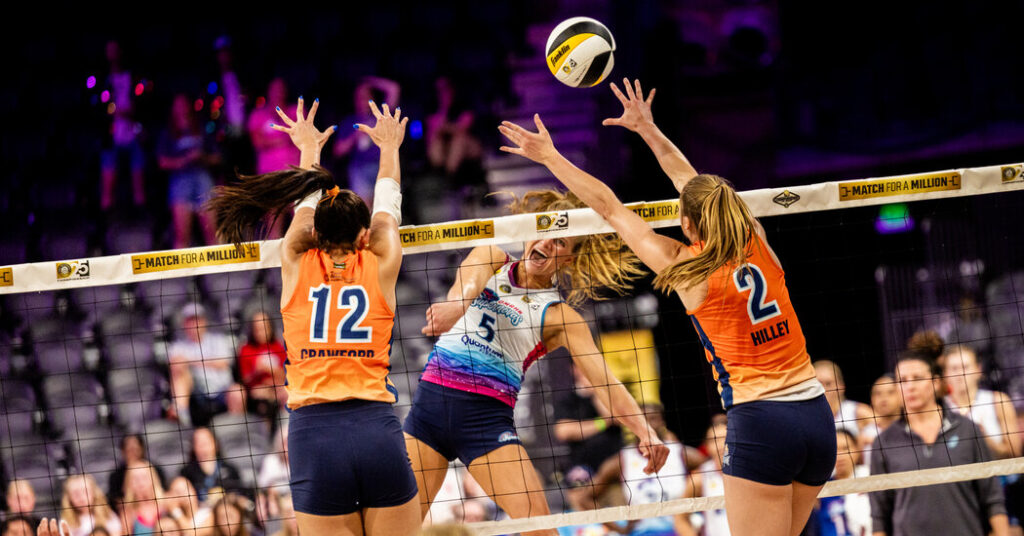
In the month leading up to their first All-Star game last February, the staff of the Pro Volleyball Federation was worn thin. Even for established leagues, All-Star games are a headache to plan. And as a brand-new league, P.V.F. had to conceive the entire event from scratch.
The match would be airing on CBS, the first time a major U.S. network would carry a professional game. How could P.V.F. get viewers to stick around? Not just to the end of the match, but with the sport.
Landing a random sports celebrity seemed to be P.V.F.’s strategy to hook potential fans. The league had made an offer to the former National Football League player Rob Gronkowski to host the match. He had a big following and stage presence, but it was like asking Simone Biles to host a men’s lacrosse tournament.
On a video call to discuss the plans, Leonard Armato, a longtime sports marketing executive and a consultant for P.V.F., urged the board of directors to try something else. “Nobody’s going to tune in to watch Gronk, you know, jump around,” he said. “They’re going to tune in because it’s the Pro Volleyball Federation All-Star match, the first ever women’s professional all-star match.”
They should consider other options, he argued. “There’s a lot of volleyball dads,” Mr. Armato said. LeBron James, Jamie Foxx. “Those are the kind of people we need to try to get. Because they love volleyball and they have daughters.”
Gronk didn’t work out, but the league ended up hiring different celebrity hosts with no obvious connection to volleyball, either: Jalen Rose, the former N.B.A. player, and Shawn Johnson East, the former Olympic gymnast. The 8,000-person venue in Indianapolis was nearly full, and more than 400,000 people watched at home.
The broadcast, in other words, was a success. But would the league be one?
When P.V.F. started in 2024, it was the only traditional professional women’s volleyball league in the United States. But by its sophomore season, P.V.F. had a competitor: League One Volleyball, or LOVB. Both leagues’ new seasons started last month. The competition is down to two leagues, a relief for those in the sport: Last year, there was a possibility of a third league entering the fold.
Everyone involved in volleyball acknowledges that America cannot sustain multiple leagues. The business of sports is much like a sport itself. There can be only one winner. At one point, there were two major football leagues, two major basketball leagues and two major hockey leagues. All of these stories ended the same way, with one league swallowed by the other.
Hoping for even one successful pro league might seem overly optimistic. Major League Volleyball, which started in the 1980s, lasted less than three years.
But industry analysts say that volleyball, which is popular abroad, has the bones of a sport that could become, if not the national pastime then a national pastime. In 2014, volleyball surpassed basketball as the most popular team sport for high school girls. A 2023 college match in Lincoln, Neb., drew 92,003 people, making it the best-attended women’s sporting event in history.
Viewers appear to be tuning in on television, too. Beach volleyball is among the most-watched summer Olympic sports, and viewership of the 2025 N.C.A.A. indoor volleyball season was up 36 percent from the year before, after several years of a steady climb.
Boosters hope volleyball can be the next W.N.B.A., though both leagues are quick to say they don’t expect this to happen right away. The W.N.B.A. was founded almost 30 years ago and only recently began to regularly sell out games. It has yet to turn a profit. It also benefits from its relationship with the N.B.A.
Volleyball, on the other hand, is a test case of what happens when the women’s sport comes first, without a male counterpart. The leagues will have to convince people to care when they might not understand the sport’s rules or lingo.
But if they do manage to build volleyball into a major league sport, hundreds of opportunities will open for women who, until now, had to leave the country if they wanted to make a career out of the game they love. And the leagues will be creating not just a new business category but a new cultural force.
“We intend to be the last one standing,” said Scott Gorsline, the co-chair of P.V.F.’s board. LOVB, of course, has the same plan.
The Volleyball Culture War
The two leagues have taken drastically different approaches to building a culture.
LOVB — pronounced “love,” with a silent B — has attracted a number of celebrity investors, including Kevin Durant, Chelsea Handler, Amy Schumer and Billie Jean King. In July, LOVB announced a partnership with Kim Kardashian’s loungewear company, Skims. “I’ll never forget the day when I saw the images of that Nebraska-Omaha game, and I realized we’ve been sleeping on this,” said Jens Grede, the chief executive and co-founder of Skims, referring to the college game in Lincoln with record-setting attendance. The partnership with LOVB followed.
The league also has a multimillion-dollar deal with Adidas, which designs its uniforms and merchandise, including a “Volleyball Is the Next Major League” hoodie.
LOVB’s business strategy is inspired by the European soccer model, where professional teams commonly have a youth sports arm. (LOVB operates more than 75 youth clubs.) Instead of a draft, teams are managed by a central office, and league executives build the teams with a goal of distributing talent in a fair and equitable way.
Then there’s the branding. Each LOVB team is named after its city — LOVB Houston, LOVB Atlanta — and has an abstract logo. (The league described them as “unique marks built from two or three interconnected letterforms that are recognizable but not necessarily ‘readable.’”)
Rosie Spaulding, president of LOVB’s professional league, argues that its true advantage is neither its celebrity backers nor its built-in youth audience; it’s that the league tends to recruit more-experienced athletes than P.V.F. Months before LOVB’s first match in January 2025, the league announced that it had raised $160 million and had signed 10 of the 17 athletes on the U.S. Olympic roster in Paris. (P.V.F. declined to share its fund-raising numbers.)
On “Volley Talk,” however, the online chat forum for volleyball fans, many commenters found that between the two leagues, P.V.F. games were more fun to watch: Though its athletes may not be as well-known as LOVB’s, P.V.F. understands how to make games into spectacles, leaning more into the familiar trappings of American sports, with large arenas, mascots, halftime performances and T-shirt tosses. It holds a draft each fall for the top college players.
All eight teams have fun names, like the Omaha Supernovas or the Atlanta Vibe. And in its first two seasons, P.V.F. teams played for real, material stakes — the championship team won a million dollars. LOVB’s champion takes home a sleek, sterling silver trophy designed by Tiffany’s.
It’s tempting to label LOVB, with its centralized model, European influences and muted pink branding as left-coded, and P.V.F., an old-fashioned American sports league, as right-coded — especially when you learn that for its first couple years, P.V.F. was propped up by Dan DeVos, a longtime Republican backer, who owns the Grand Rapids Rise with his son Cole. (Mr. DeVos’s sister-in-law is Betsy DeVos, who was the secretary of education during the first Trump administration.) When two of the league’s teams, one in Las Vegas and the other in Columbus, Ohio, went stretches with shaky ownership they got their funding from Mr. DeVos.
The Star-Making Machine
Morgan Hentz, 27, who was an alternate for the U.S. Olympic team in Paris, considered joining both leagues. But P.V.F. was launching first and she didn’t want to wait another year to play at home. “I needed a chance to make a living,” she said.
Ms. Hentz played in Germany after college, but the salary was low and she missed her family. In European volleyball leagues, players often receive about $20,000, plus room and board, for a nine-month season. Both P.V.F. and LOVB offer a base salary of $60,000, and more than double that for some players.
Before P.V.F.’s first season, Ms. Hentz reached out to hundreds of players to pitch them on joining the nascent U.S. league. Its original founders were not volleyball people; they didn’t have her connections and Ms. Hentz was intent on making the league work.
“Coming out of college, there weren’t opportunities to stay and play in the U.S.,” she said. “And now that they’re here I just want it to last so badly.”
After Caitlin Clark transformed the W.N.B.A. with her fame, a general sense emerged that volleyball would need a star or two to achieve cultural relevance.
It hasn’t happened yet, but there are only six players on each side, so TV viewers can easily recognize them. And a well-known but possibly uncomfortable fact about volleyball players is that they tend to have the kind of look that sells. The official indoor volleyball uniform includes short-shorts, and the unofficial uniform, embraced by many, includes jewelry and makeup.
Mr. Gorsline, the P.V.F. board co-chair, was noncommittal in an interview about whether players’ looks were good for business. “I don’t think it’s a bad thing,” he said, carefully. But Brooke Nuneviller, a top player for the Omaha Supernovas, who has a sponsorship with the jewelry company Gorjana and around 180,000 followers on Instagram, was blunt about the feedback she was getting from some higher-ups. “They say we’re marketable because of the way we look, because of what we wear on the court,” she said.
A Name Change
One weekend in May, P.V.F. held its playoffs and championship in Las Vegas, as well as a summit for sponsors and owners.
Derrick Heggans, a sports investment adviser, had flown in from Washington to attend. He had a few “girl dad” contacts, like the former N.B.A. stars Patrick Ewing and Jermaine O’Neal, who he thought might be interested in investing. But Mr. Heggans pointed out that the fact that there was more than one league was likely to intimidate some investors.
“That would have somebody who’s interested in investing in volleyball maybe just watching from the sidelines for a little while,” he said.
In August, P.V.F. announced a name change: Major League Volleyball, the same name as the short-lived league from the 1980s.
It was the result of a summer of negotiations: The owners of the Omaha Supernovas — the most successful team in either league — had announced their intention to start yet another competing league they were calling Major League Volleyball, with a supposed $100 million in funding. Now, though, they had agreed to a merger with P.V.F., but under the name M.L.V., which everyone agreed sounded more like an established American sports league. The influx of cash meant that the league could transition to a business model that would reduce its dependence on the DeVos family.
Vivek Ranadivé, the chairman of the N.B.A.’s Sacramento Kings, had been involved with the upstart league, and would now own a team in the M.L.V. He was the kind of established sports executive who could help the league get to the next level.
In its last big social event before the name change, M.L.V. held an awards gala at a Hard Rock Cafe in downtown Vegas to celebrate the end of its season. There was a red carpet at the entrance and a selfie station on the terrace where the athletes took photos in their evening wear.
Fran Flory, then the general manager of the Vegas Thrill, stood at the bar chatting with three season-ticket holders. One of them, Shawna Jaramillo, 53, who works as a mail carrier, started playing volleyball when she was 9. When she heard that Vegas would host a professional volleyball team, she screamed and immediately bought season tickets, she said. Her wife and sister were skeptical. They thought it looked boring.
But as soon they saw their first match, they fell in love with the sport. They marveled at the speed of it, how the women hit the floor to make a save and, moments later, jumped high to spike the ball and score. “They play so well together,” said her sister, Denise Jaramillo, who is a full-time caretaker for their elderly parents. Shawna now designs custom Thrill necklaces and pendants.
The competition to be the last volleyball league standing shows no sign of abating. M.L.V. has a new team in Dallas this season, and plans to start teams in Minnesota, Washington and Northern California for its 2027 season. Its All-Star Game will air on CBS next month. And LOVB is adding three new teams for its 2027 season, in San Francisco, Los Angeles and Minnesota. Some of their games this season will air on USA Network and ESPN2.
Ms. Flory said she was among a minority of volleyball people who thought that multiple leagues were good for the sport.
Ms. Flory’s team, the Thrill, will not be playing with the M.L.V. this season because the league couldn’t find an owner. Even though she’s out of a job, Ms. Flory remains excited about the future of volleyball.
“No one makes it professionally without competition,” she said. “Competition is what makes people with money commit.”
The post Two Volleyball Leagues Want to Be the Next W.N.B.A. Only One Can Win. appeared first on New York Times.