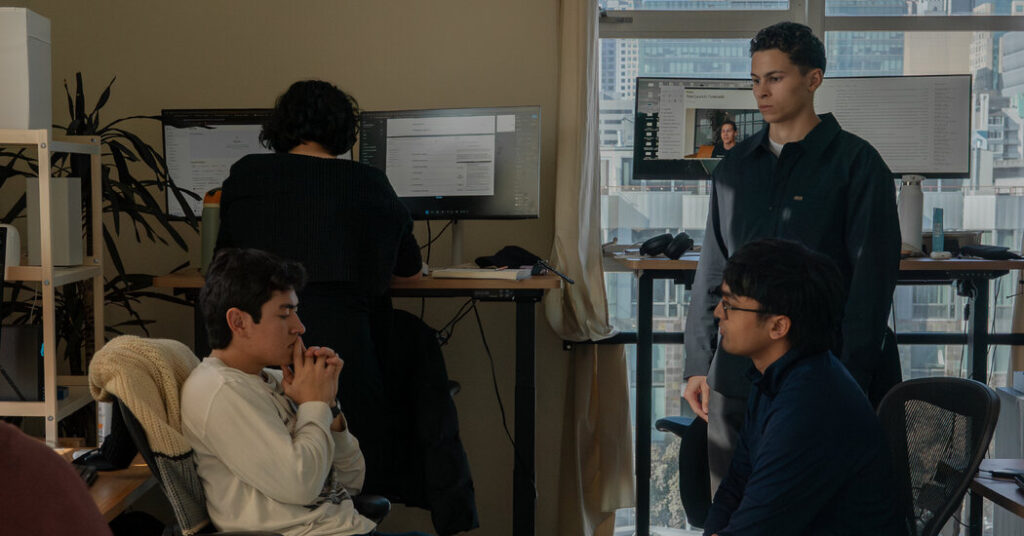
Marshall Kools shares an apartment in the NoPa neighborhood of San Francisco with two roommates, sleeps Harry Potter-style in a nook-like room beneath the stairs, owns no designer clothing beyond a dress shirt from Giorgio Armani and plays Sade’s “Love Deluxe” on repeat.
Sade’s multiplatinum album was released in October 1992, a month or so before the introduction of a device generally considered the progenitor of the smartphone. Back then, the marketing of advanced computation as a form of anthropomorphized sentience did not exist. Neither, for that matter, did Marshall Kools.
At 24, he — like a great many of his generation at this moment in this city — is a prospector in the field of artificial intelligence. A co-founder of a start-up, he hopes to use A.I. to “streamline” white-collar administrative work and, in the process, may eliminate your job.
Spend an hour in this city, and you are bound to hear the talk. In the Marina boîtes like Céleste and Roaming Goat, in the driverless Waymos that glide through the hills like cartoon conveyances, the main subject of discussion is A.I. This makes sense given that the boom has already produced digital jackpots equivalent to the richest veins at Sutter’s Mill in the days of the gold rush.
Take Matt Deitke, a researcher born the same year as Mr. Kools. He was hired last year — on a four-year $250 million contract — to work at the Meta Superintelligence Lab, part of the company’s $14.3 billion investment in Scale AI.
Other rising stars in the field include Alexandr Wang, a co-founder of Scale AI and a self-made billionaire, and Ruoming Pang, Apple’s former head of foundation models, whom Meta signed to a multiyear deal said to exceed $200 million.
“It’s a cowboy era,” Mr. Kools said one recent morning. “You hope your proposition hits and you get that valuation and then you can ride that rocket ship.”
For now, Mr. Kools and his business partner William Alexander are scraping by on salaries in the low five figures. “I probably paid myself about $10,000 last year,” Mr. Kools said. Still, he added, “there is not a day that I don’t wake up and work without the expectation that this will be impactful and make a bunch of money.”
The odds, he knows, are stacked against him. “Statistically, there is a very good chance this will not work,” Mr. Alexander, 21, said of their start-up, Arzana. “Any of us could get a consulting job at Bain and make a lot of money.”
Mr. Alexander grew up hunting and fishing in Okoboji, Iowa. He taught himself Mandarin Chinese during a semester in Hong Kong and Italian through the Duolingo app. He learned to throw the discus well enough to achieve state ranking by watching videos on YouTube. When he met Mr. Kools, they were classmates at Stanford, and neither one had a background in tech.
“I took, like, one coding class in my life,” Mr. Alexander said. Despite that, the lure of once-in-a-lifetime payouts proved too potent to resist. “There is no Plan B, because that assumes you will fail,” he added. “We’re going to do the start-up thing until we die.”
Or until the boom goes bust.
“Founders are everywhere,” said Isobel Porteous, who works at a space computing start-up that installs “neuromorphic” A.I. chips on satellites, with the ultimate goal of bypassing the technological shortcomings of current global positioning.
“Right now, the whole city is full of young founders building frontier tech companies quickly, and it’s a very ambitious culture,” Ms. Porteous, 24, said one afternoon in a paved park outside Ritual Coffee, a popular caffeine pit stop in the Hayes Valley neighborhood. “People are embracing higher-risk paths, whereas they might otherwise have gone into consulting, finance, law or safer traditional industries.”
The reasons are self-evident. “It’s a once-in-a-century moment to ride the A.I. wave,” she said. “And to build tech that will define the future.”
During the tech boom of the 1990s, before smartphones and the rise of social media, entrepreneurs promised innovations meant to improve daily life. Scientific studies and the lived experience of the digital age have demonstrated that has not always proved to be the case.
Many of the fledgling A.I. companies coming out of heavily capitalized start-up accelerators like Y Combinator are in the business of targeting inefficiencies. Few bother to pretend these will not come at the cost of jobs. “Upskill” is a word often heard to describe what workers should do when A.I. makes them redundant.
“My friends and I could talk for 200 hours about whether A.I.’s impact will be good or bad,” said Mr. Kools, who often debates the subject with his third roommate, Oliver Gomez, who has a start-up of his own.
In 2024, Mr. Gomez, 21, and his former Stanford roommate Jarren Reid, 22, came up with a start-up idea aimed at hacking problems in the vast federal bureaucracy and later developed under the aegis of Y Combinator. It was their third attempt at breaking into the elite funding program that produced internet success stories like Airbnb and DoorDash, and the A.I. start-up was created during a deadline all-nighter fueled by Red Bull.
That start-up, Usul, is meant to help vendors navigate the contracting labyrinth of the Department of Defense, which is one of the world’s largest employers. “Like Amazon for government” is how Mr. Reid described it.
Asked why, in his early 20s, he would found a company — which has a staff of 10 — to service a government agency whose core pillar is “restoring a warrior ethos,” he answered flatly: “The money.” But, he added, “there is also less the goal of making $20 billion than solving a problem that affects millions of people.”
On a brisk morning, Mr. Gomez and Mr. Reid were seated on a bench in South Park, a leftover centerpiece of a planned urban settlement created in the 19th century for San Francisco’s gentry. Evolving over the decades, South Park settled into its current guise as a tech industry hub.
Usul headquarters is, appropriately, located in this gentrifying though still scruffy part of town. As Mr. Reid and Mr. Gomez sat for an interview, a man from an encampment under a nearby freeway wandered about with his belongings stuffed into a Safeway cart.
Mr. Reid grew up in Washington, D.C., the son of a bureaucrat employed by government subcontractors and a health care worker specializing in dementia. “On my dad’s side, the family emigrated from Ukraine during World War II, and my mom’s side, historically, was slaves,” he said. “We didn’t have luxuries growing up. We didn’t have TV. Our parents’ approach was, ‘Go play in the woods and fall out of a tree.’”
Both men were early to financial self-sufficiency, they said. Neither conformed to the stereotypes of tech bros raised in privilege. “I paid for Stanford myself,” Mr. Reid said, adding that he had dropped out after his second year to join the A.I. gold rush.
Mr. Gomez, for his part, was raised by parents who emigrated to the United States several decades ago from Central America. “My mom is from El Salvador and lived in a dirt-floored house with seven other siblings,” he said. “It was, basically, horrible poverty.”
Settling originally in Los Angeles, Mr. Gomez’s mother eventually divorced his father, remarried and transplanted her family to a small town outside Oklahoma City. “Edmonton was like living in the most anti-tech place you can think of, where everyone grows up to become a welder or work on a golf course,” Mr. Gomez said. “And our high school had, like, one computer.”
His goal in attending Stanford, he said, “was to give my mother a different kind of life.” Like Mr. Reid, he left university after his sophomore year, anxious about missing out on a jackpot. “There’s over a trillion dollars being poured into the top funds,” he said. “Normal guys I know are now worth a couple billion dollars each.”
It’s probably worth remembering that the greatest wealth from the original gold rush went not to the miners but to the merchants who sold hardgoods at markup — men like California’s first millionaire, the canny Mormon elder Samuel Brannan, who hawked gold pans and pickaxes, or Levi Strauss, who created the riveted denim trousers not yet marketed as dungarees (or bluejeans).
As in 19th-century San Francisco, the boom has drawn young prospectors looking for gold in places and ways no one yet knows how to anticipate.
“Not at any time in history have we seen so much capital mobilize in one direction,” Mr. Kools said. “You’d be crazy not to want to get in on that.”
Guy Trebay is a reporter for the Style section of The Times, writing about the intersections of style, culture, art and fashion.
The post These A.I. Dreamers Don’t Fit the Stereotype appeared first on New York Times.