The U.S. Senate has long been considered the pinnacle of American politics. Governors, in particular, saw the deliberative and dignified body as a natural last stop when their time in the executive mansion was up, a place to confront the big issues before the nation in momentous debates.
Those days are over.
Frustrated by Senate dysfunction and the inability to accomplish much of substance, senators this year are reversing the steady migration from state capital to Capitol Hill as a record four sitting senators are running for governor.
It is one of the best indicators yet of how the Senate, plodding and polarized, has lost its allure.
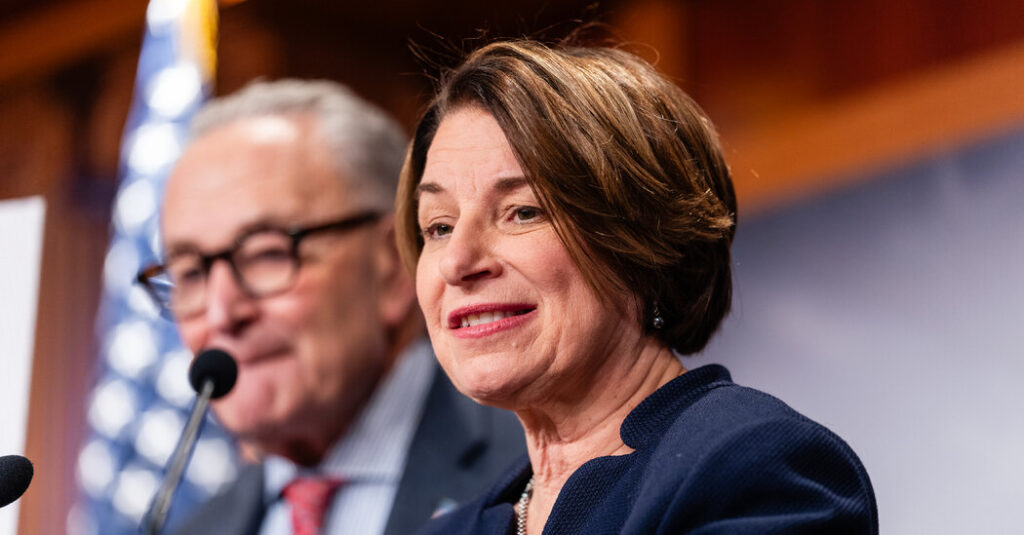
“I like my job in the Senate,” said Senator Amy Klobuchar, Democrat of Minnesota, in declaring at the end of January that she wanted to head home to head up her state’s government. “But I love our state more than any job.”
Senator Michael Bennet, Democrat of Colorado, was candid about his decision to run for governor there rather than stick it out in the Senate.
“I think what is driving people the other way — what is driving me the other way — is the feeling that the real battle now is going to be in the states, that it is not going to be in D.C.,” Mr. Bennet said in an interview, noting the “dysfunctional nature” of the Senate. “It just isn’t working for the American people.”
Besides Mr. Bennet and Ms. Klobuchar, Republican Senators Marsha Blackburn of Tennessee and Tommy Tuberville of Alabama are also running for governor in their states. Senator Lisa Murkowski, Republican of Alaska, explored the possibility of running for governor there like her father, Frank Murkowski, had done as a senator in 2002, but she has made no firm move in that direction, with time running short to do so.
It is a definite phenomenon. In the last 50 years, just eight sitting senators in total have run for governor — though 15 former senators have run for the top state job after having been out of the Senate for varying lengths of time. In contrast, 32 sitting governors and about 50 former governors have run for the Senate in that same period. (The House has always been an incubator of governor candidacies, since lawmakers there see statewide office as a big promotion. Eleven House members are running for the top job in their states this year.)
The potential Senate exodus illustrates the deep unhappiness in the upper chamber as the chances to move big legislation are severely limited and so much time is consumed with confirmations that the Senate has become a sort of glorified human resources department. The Trump administration is also usurping much of the legislative branch’s power, with little resistance from Republican senators in charge, and once it is gone it is unlikely to be reclaimed no matter which party is in the White House in the future.
The lure of being one of one instead of one of 100 is becoming irresistible.
Mr. Tuberville, a former football coach used to calling his own plays, is heading for the exits after just one term.
“I’ve learned a lot in six years,” Mr. Tuberville said. “And one of the things I’ve learned is I can probably be more beneficial back in the state than I can here. Here, if you don’t have a lot of seniority, you don’t have a lot of say. I would have to be up for a couple more terms where you really had any kind of situation where you could make a difference. I go back immediately and make a difference in Alabama.”
That dynamic has not been lost on governors who arrive in Washington fresh from being their state’s chief executive. Over the years, many have expressed dissatisfaction with the pace of the Senate and that lost ability to move the government machinery with a phone call or two. The Senate is hard to bend to one’s will.
“It takes us all a while to get used to this place,” said Senator Mark Warner, a former Democratic governor of Virginia. “We go from driving the bus to being told we are at the back of the bus and shut up for your first few years.”
Ms. Klobuchar struggled with her decision. She clearly enjoys her Senate job; she is a member of the Democratic leadership and was a fixture in the social life of Washington. But with the turmoil back home in Minnesota and Gov. Tim Walz’s declining a run for a third term, she seemed to view running as an obligation to the future of her state.
Ms. Blackburn, one of the most conservative members of the Senate, could become Tennessee’s first female governor and wants to take her MAGA-infused ideology back home to the Volunteer State.
“I love Tennessee, I believe in Tennesseans, and I’m ready to deliver the kind of conservative leadership that will ensure our state is America’s conservative leader for this generation and the next,” she said in announcing her candidacy.
Ms. Blackburn and two of the other governor hopefuls, Ms. Klobuchar and Mr. Bennet, have a political advantage in their runs. Should they lose, they can remain in the Senate because they are not up for re-election this year. Mr. Tuberville, on the other hand, will vacate his seat no matter the result. For the three with unexpired terms, a prize for winning the governor’s race is the possibility that they can appoint a temporary replacement.
The path to the Capitol from state house has not totally disappeared this election cycle. Democrats have one former governor, Roy Cooper of North Carolina, and one current one, Gov. Janet Mills of Maine, running for Senate. Both were recruited by Senator Chuck Schumer, the New York Democrat and minority leader, who is certainly not ready to give up on the Senate.
“It is still a place, with all the difficulties, where you can get some things done,” Mr. Schumer said.
Mr. Warner is also not ready to give it up. The Virginia senator, who is seeking a fourth term this year, said things could turn around.
“What still gives me hope,” he said, “and why I’m trying to do this one last time, is while we are all bemoaning the demise of Congress, it wasn’t all that long ago — like three years ago — when we were putting up all kinds of bipartisan wins and everyone was saying, ‘Is this the return to the glory days of the Senate?’”
Others see their glory days elsewhere, even if the Senate somehow rebounds from its current struggling state.
“I don’t think that’s permanent, but I think it is going to be true for the foreseeable future,” Mr. Bennet said. “It is still a great privilege to serve there. But I don’t think that is where the change is going to come from in our country. I think it is going to come from the bottom up.”
Carl Hulse is the chief Washington correspondent for The Times, primarily writing about Congress and national political races and issues. He has nearly four decades of experience reporting in the nation’s capital.
The post The Troubled State of the Senate Has Members Eyeing Governorships appeared first on New York Times.