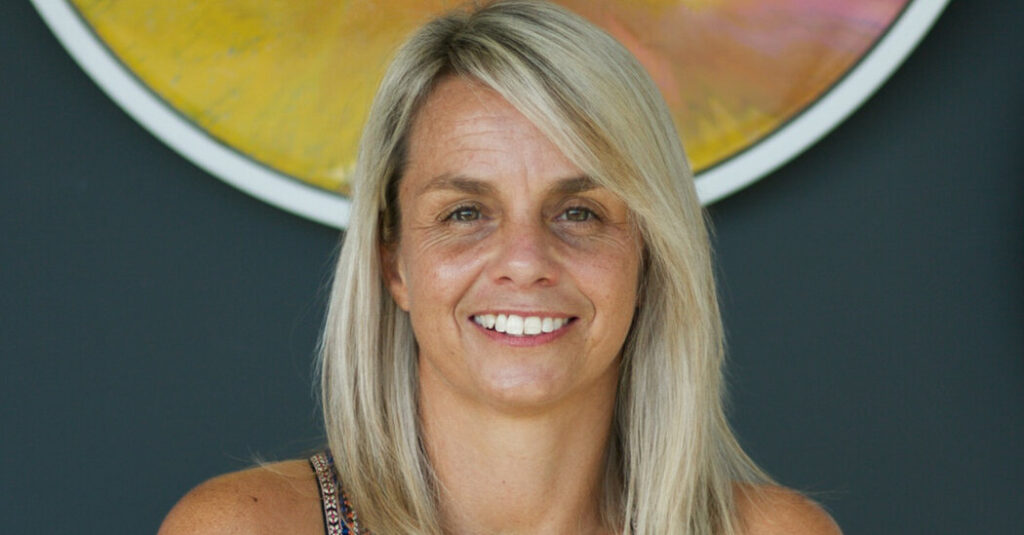
Last February, the writer Coral Hart launched an experiment. She started using artificial intelligence programs to quickly churn out romance novels.
Over the next eight months, she created 21 different pen names and published dozens of novels. In the process, she discovered the limitations of using chatbots to write about sex and love.
Some programs refused to write explicit content, which violated their policies. Others, like Grok and NovelAI, produced graphic sex scenes, but the consummation often lacked emotional nuance, and felt rushed and mechanical. Claude delivered the most elegant prose, but was terrible at sexy banter.
“You are going to get hammering hearts and thumping chests and stupid stuff,” said Ms. Hart, who lives in Cape Town in South Africa. “At the end of every sex scene, everyone will end up tangled in the sheets.”
Chatbots were also bad at building sexual tension — the slow-burn, will-they-or-won’t-they plotlines that romance readers crave. When told to craft a love scene, the bots usually jumped straight to the obvious narrative climax.
Ms. Hart found Anthropic’s chatbot to be the most versatile, and developed ways around Claude’s prudishness. Among her techniques: feeding Claude very specific instructions and a list of kinks, and stressing that sex was not gratuitous, but crucial to the plot.
A longtime romance novelist who has been published by Harlequin and Mills & Boon, Ms. Hart was always a fast writer. Working on her own, she released 10 to 12 books a year under five pen names, on top of ghostwriting. But with the help of A.I., Ms. Hart can publish books at an astonishing rate. Last year, she produced more than 200 romance novels in a range of subgenres, from dark mafia romances to sweet teen stories, and self-published them on Amazon. None were huge blockbusters, but collectively, they sold around 50,000 copies, earning Ms. Hart six figures.
While we spoke over Zoom, an A.I. program she was running ingested her prompts and outline and produced a full novel, about a rancher who falls for a city girl running away from her past. It took about 45 minutes.
Ms. Hart has become an A.I. evangelist. Through her author-coaching business, Plot Prose, she’s taught more than 1,600 people how to produce a novel with artificial intelligence, she said. She’s rolling out her proprietary A.I. writing program, which can generate a book based on an outline in less than an hour, and costs between $80 and $250 a month.
But when it comes to her current pen names, Ms. Hart doesn’t disclose her use of A.I., because there’s still a strong stigma around the technology, she said. Coral Hart is one of her early, now retired pseudonyms, and it’s the name she uses to teach A.I.-assisted writing; she requested anonymity because she still uses her real name for some publishing and coaching projects. She fears that revealing her A.I. use would damage her business for that work.
But she predicts attitudes will soon change, and is adding three new pen names that will be openly A.I.-assisted, she said.
The way Ms. Hart sees it, romance writers must either embrace artificial intelligence, or get left behind.
“If I can generate a book in a day, and you need six months to write a book, who’s going to win the race?” she said.
Romance at the Vanguard
Whenever the publishing industry is rocked by a technological shift, it usually hits romance first. Romance writers are prolific and their readers are voracious, so they’ve been early adopters of e-book subscription services, self-publishing, social media networking and online serial releases.
Romance is also the publishing industry’s best-selling genre. It accounts for more than 20 percent of all adult fiction print sales, according to Circana BookScan, and has continued to grow in recent years even as overall adult fiction sales have stagnated.
The genre may be especially vulnerable to disruption by A.I., for all the reasons that readers love it. Romance relies on familiar narrative formulas, like the guarantee of an “H.E.A.” or “happily ever after.” And romance novels are often built around popular plot tropes — like enemies-to-lovers or forced proximity — that can be fed into a chatbot.
A.I. remains contentious in the romance community. A vocal contingent of readers oppose its use and are quick to call out suspected transgressions. Furor erupted on social media last year when two romance authors published works with A.I. prompts accidentally left in. “You’re an opportunist hack using a theft machine,” the fantasy writer Rebecca Crunden wrote in an expletive-laced message on Bluesky.
Many readers seem to share her distaste, she said in an interview: “The comment I keep seeing is, ‘Why should we pay for something that you couldn’t be bothered to make?’”
But without such obvious slip-ups, it can be hard to spot A.I.-generated romance. Amazon asks authors who use its Kindle self-publishing platform to disclose if they relied on A.I., but does not require writers to include any public disclaimers on their books.
“The A.I. detector can be gotten around,” said Christa Désir, vice president and editorial director of Bloom Books, a romance imprint that often signs successful self-published authors. “It will become undetectable at a certain point.”
The Stalled Ski Lift and Other Prompts
In early December, Ms. Hart woke up shortly before 2 a.m. in Cape Town to teach a class on how to write sex scenes with artificial intelligence. Around 20 people from around the world logged on for the course: “Write Dirty With Me.”
Early on, Ms. Hart issued a cautionary note.
“If you’re expecting a perfect sex scene from A.I. on the first draft, lower your expectations a lot,” she said, warning that the “pearl clutching” restrictions barring X-rated material on some popular A.I. programs posed a challenge.
Ms. Hart shared a variety of prompts that can coax a chatbot to set aside its reservations, like telling the A.I. that sex was an essential part of the narrative arc.
Awkward or repetitive prose presented another pitfall. Left to their own devices, chatbots will default to odd or euphemistic phrasing, Ms. Hart said, noting that an A.I. program had recently written “his turgid manhood” to describe a character’s erection.
To prevent the program from overusing its favorite words — including shiver, unravel, tangled and exploded — Ms. Hart recommended compiling an “ick list” of phrases and prohibiting the chatbot from using them.
She also advised the class to propose creative locations for romantic trysts — otherwise, the chatbot would resort to vanilla sex in the bedroom or shower. She shared a suggested list of settings for sex scenes, including a winery fermentation tank, stalled ski lift, rooftop greenhouse, horse stable and back row of a classic car show. And she recommended students give the A.I. a detailed inventory of sexual kinks; her proposals included common fetishes like dirty talk, blindfolding and light spanking, and more unusual ones, like using a dead spouse’s old silk robe as a restraint during bondage.
“Be shameless,” she said. “It’s not going to judge you.”
Does Human Connection Still Sell?
It’s impossible to gauge how many romance novels are produced with artificial intelligence. Many authors don’t reveal they use chatbots, for fear of alienating readers. (A survey of more than 1,200 authors across genres showed that about a third were using generative A.I. for plotting, outlining or writing, and the majority said they did not disclose their A.I. use to readers, according to BookBub, a book discovery site that released the poll last May.) Even some authors who publicly oppose the technology are secretly signing up for Ms. Hart’s classes, she said.
The rapid incursion of A.I. generated stories is rattling some in the romance business. Publishers and authors worry that books by real writers are getting lost in the sea of digital slop, as A.I.-enabled novels flood the market.
“It bogs down the publishing ecosystem that we all rely on to make a living,” said Marie Force, a best-selling romance novelist who doesn’t use A.I. and was disturbed to learn that more than 80 of her novels had been used to train Anthropic’s chatbot. “It makes it difficult for newer authors to be discovered, because the swamp is teaming with crap.”
Many fans are also put off by the notion of computer-generated love stories.
Zoë Mahler, an avid romance reader who leads two book clubs at The Ripped Bodice, a romance bookstore in Brooklyn, said she would never knowingly pick up an A.I.-generated novel.
“Romance is about human connection, and there’s nothing more human than being vulnerable and falling in love,” she said. “Why would I want to read a story written by a machine trying to emulate that?”
Even writers who have embraced A.I. agree that it’s often bad at conveying human intimacy.
“It doesn’t understand the human experience,” said Sonia Rompoti, a psychologist who lives in Athens. “It will tell you, in a biological way, what goes where, but it will not add any emotions.”
Ms. Rompoti began writing romance novels with the help of artificial intelligence in 2024, using the program Sudowrite. As a plus-size woman, Ms. Rompoti, wanted to see heavier-set heroines she could relate to in romance fiction.
A.I. supercharged her writing process, enabling her to produce 10 novels in a little over a year, including “The Billionaire’s Curvy Match” and “Curves to Own: Pregnant by the Billionaire.”
But while the program made writing faster and easier, it was terrible at describing a plus-size heroine, perhaps because there are so few in mainstream fiction, which many A.I. programs were trained on. Whenever Ms. Rompoti’s curvy protagonist, an event planner named Sienna, was in a scene, the A.I. constantly referenced her weight, for example, noting that a chair groaned when she sat down. “When you make a point that someone is plus size, it will exaggerate, somebody is suddenly humongous,” she said.
This was especially vexing in erotic scenes where the heroine was supposed to feel confident and sexy. Ms. Rompoti wound up revising those passages to make her protagonist seem like a real person and not a caricature, she said.
“People don’t read romance to see what bodies do,” she said. “They read it to feel seen.”
A Ragged Prayer
A.I.-generated sex scenes tend to rely on generic erotic language, with “waves of ecstasy crashing” over everyone. But sometimes, the chatbots get fancy and, like human writers, fall in love with their own florid prose.
In several romances written with A.I. programs, a peculiar metaphor recurs: in the throes of passion, the hero utters his lover’s name “like a ragged prayer.”
In Sydney Marsh’s “Bridesmaids & Bourbon,” the phrase pops up when Beau, the ruggedly handsome owner of a distillery, and Taylor, a stressed out maid of honor, have sex in a gazebo before her sister’s wedding: “‘Taylor… ’ My name was a ragged prayer on his lips.” A more tortured variation occurs during a sex scene in Dana Winston’s “Flight Path to Forever,” a romance novel about a flight nurse who falls for a helicopter rescue pilot: “Sloane: her name came out ragged, prayer-rough.”
It also shows up in Ms. Rompoti’s romance series. In “Curves to Own,” Sienna’s billionaire lover says her name with reverence: “Her name was a ragged prayer on his lips. Sienna.” In a later love scene, he again says her name like “a ragged prayer, a desperate vow,” and then, in a slight twist, he calls out her name like “a jagged prayer.” (Ms. Rompoti couldn’t recall whether A.I. had written those lines or if she had added them during revisions, but she believes she wrote them herself during editing, she said.)
“Bridesmaids & Bourbon” and “Flight Path to Forever” were published by Future Fiction Press, a new publishing company that produces A.I.-generated novels. So far, the press has released 19 romance novels that have been downloaded 20,000 times.
The writer Elizabeth Ann West, one of Future Fiction’s founders, who came up with the plot of “Bridesmaids and Bourbon,” believes the audience would be bigger if the books weren’t labeled as A.I. The novels, which are available on Amazon, come with a disclaimer on their product page: “This story was produced using author‑directed AI tools.”
“If you hide that there’s A.I., it sells just fine,” she said.
Ms. West, who also teaches classes on how to write with A.I., has gotten blowback from opponents of the technology, including occasional death threats on social media. But she believes that in time, A.I. generated fiction will become widespread and popular.
“Eventually” Ms. West said, “readers will not care.”
Alexandra Alter writes about books, publishing and the literary world for The Times.
The post The New Fabio Is Claude appeared first on New York Times.