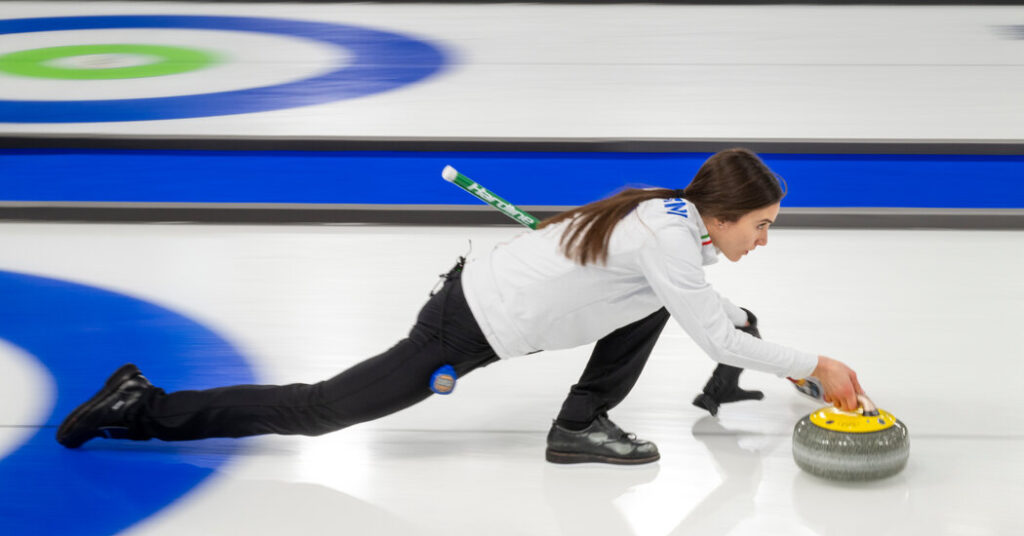
On a recent morning in her hometown, Cortina d’Ampezzo, Stefania Constantini, an Italian curler defending her gold medal at the Olympics this week, left a cafe and bumped into her old next-door neighbors.
“Sunny as always,” one of the neighbors, Michele Giovanni, 65, said after they had all caught up about the comings and goings of Cortina. “She’s the same.”
Ms. Constantini, 26, with a broad smile, humble mien and nails painted with daisies, is the girl-next-door of the 2026 Winter Games, much of which is occurring in the town where she spent her childhood. A winner at the 2022 Beijing Olympics and at the 2025 world championships, Ms. Constantini attended the Cortina elementary school, where her mother still teaches, and played flute in the town’s band. She went from sliding in the long hallway of her childhood home — playing imaginary curling matches — to spending a decade training in the same local arena that is now hosting the curling championship at this year’s Games.
Cortina, she said, is “the home where I grew up and where it all started.”
If not “Jenny from the block,” Ms. Constantini — or Stefi, as she is known in Cortina — calls herself “Stefania from the town.” She is a native daughter done good who, in addition to the gold in Beijing, has won a silver and a bronze in two separate European Curling Championships, and now captains the national women’s team. She has a pizza named after her at a local restaurant (mozzarella, cherry tomatoes, basil, prosciutto). And she adores and still frequents the pastry shop where her boyfriend — a minor-league hockey player who works in a nearby ski rental — bought her a personalized cake when she qualified for the Olympics in 2021. It featured her face and the Olympic rings.
“We can say she is our top athlete,” said Cortina’s mayor, Gianluca Lorenzi, who himself once played on the national team and is the son of a founding father of curling in Italy. It is no surprise, then, that her setbacks also hit home. In the days before the Olympics, her coach stunned “Team Constantini” by replacing one of her teammates with his own daughter. The switch was the talk of the town and the local papers, especially after Ms. Constantini’s mother signed a petition protesting the substitution.
“Curling: In Cortina, the Constantini Case Explodes,” read a headline in Il Gazzettino, a daily in northeastern Italy.
But Ms. Constantini didn’t want to talk about it.
“Unfortunately, in this moment, I prefer not to say anything,” Ms. Constantini said, a pained expression subbing for her usual smile. “The situation is delicate.”
She preferred to discuss how her growing public role, which included reading the Olympic oath at the opening ceremonies, could promote her sport.
Curlers glide forward in a lunge position and push a sliding stone toward a target at the end of a strip of ice, shouting orders at teammates who then use brooms to furiously sweep the ice to ease the stone’s passage to the bull’s-eye. It’s not big in Italy. To the extent that the sport provokes conversation in the country, it’s often regarding a decade-old comedy about down-on-their-luck Romans who don’t know how to skate and who learn to curl by sliding pots filled with minestrone across a corridor.
Ms. Constantini hasn’t seen the film, she said, but she hopes that for her performances, “There will be a lot of fans.”
There were. On her first day of competition Thursday morning, fans watched her take hold of a yellow stone that matched the color of the flowers on her nails and shout, “Good, good,” “Perfect line,” and other directions to Amos Mosaner, her teammate in the mixed doubles. The stands erupted in chants of “I-ta-lia!” when the duo triumphed against South Korea and members of a youth curling club from Bormio, in northern Italy, held up letters spelling out “Stefi.”
“They’re seeing their idols,” said Margherita Lumina, 48, the group’s chaperone.
Before the Games began, Ms. Constantini walked around her hometown in a dark blue overcoat dusted with snow, carrying a small, sky-blue sling bag. She contrasted with what she called “fur coat Cortina,” adding, “not my habitat.”
Ms. Constantini prefers a pizza with friends, she said, or spending time with her boyfriend, Domenico Dalla Santa, whom she has known since she was 12, dated since she was 15 and called “my rock.” Mr. Dalla Santa said that despite his girlfriend’s expertise in ordering teammates how and where to sweep, their decision making was “50-50.”
By the Duca D’Aosta elementary school, where Ms. Constantini’s mother still works, Ms. Constantini recalled meeting the girl who introduced her to curling at age 8. A sign on the school door promoted lessons for “Curling, the sport of the Cortina Olympic Games.”
On the town’s main drag, Ms. Constantini walked past stores where she sold clothes until 2022. Days before the Olympics began that year, the Italian police recruited her to a special unit for athletes that allows them to draw a salary while essentially concentrating on their sporting careers.
Finally, Ms. Constantini had achieved “my dream to play curling for a living,” she said.
Driving recently to see her mother in an S.U.V. provided by sponsors, she spoke intensely about curling — its complicated rules, the micro-calibrations she felt gliding on the ice, the spin of the wrist.
She proudly held up her hand to show off her nails. Any longer, she acknowledged, and they would affect her Olympic performance. “I’d start to have trouble holding onto the handlebar” attached to the stone, she said. Despite suggestions that she cut them shorter, she refuses to do so in part because her manicurist, she said, is a genius.
Her family said her stubborn streak was the secret to her success. They all joked that Ms. Constantini used her long nails to get out of cleaning the house.
“But who do you think keeps house where I live now?” Ms. Constantini, showing a flash of frustration, said. “There’s this old way of thinking.”
Ms. Constantini has stayed close to her family. Her maternal grandfather, Luciano Dalus, 80, can recite her Olympic schedule — “I mean, if a grandparent doesn’t know it … ” he joked — and her maternal grandmother, Elisabetta Menardi, 78, still knits clothes for her, including a new winter headband “to warm her ears.”
At her father’s house, where she was brought up, pictures of her and her siblings line the stairs to her old room. On a recent afternoon, she warmed herself, as she did as a child, between the kitchen table and a wood-burning furnace, as her paternal grandmother, Maria Rosa Lorenzi, 78, dabbed tears from her eyes. She recalled the moment her granddaughter had won the gold. Then she rubbed her fingers together.
“That gold medal cost me,” she said. “All the coffees and Proseccos I had to buy for my friends. We’re in Cortina!”
Over by the heater, between bites of cake, Ms. Constantini took a gold medal out of a tote bag.
“At the end,” she said with a shrug, “if you win a competition, you’re still the same person.”
Jason Horowitz is the Madrid bureau chief for The Times, covering Spain, Portugal and the way people live throughout Europe.
The post She’s the Olympics’ Hometown Hero. To Her Neighbors, She’s Just ‘Stefi.’ appeared first on New York Times.