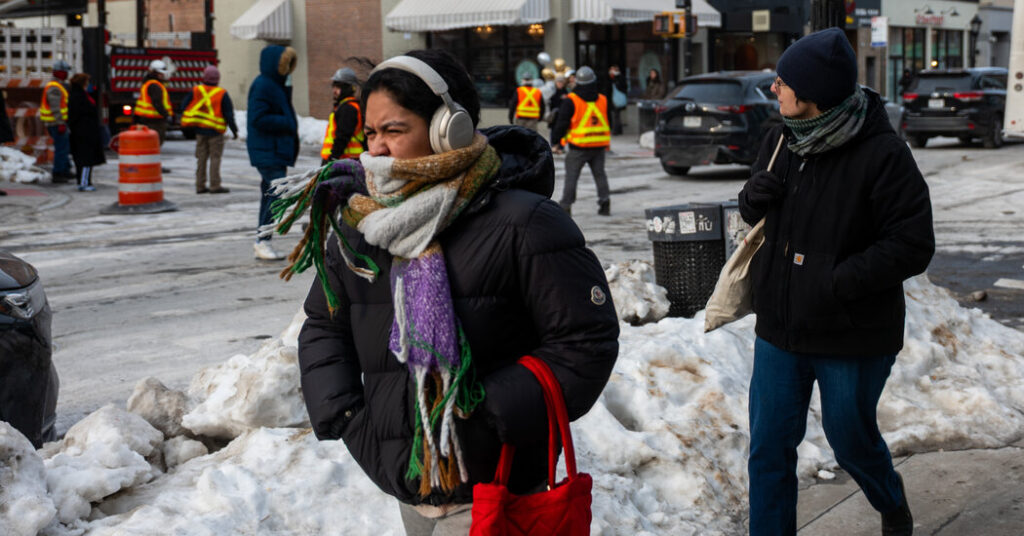
Much of the eastern United States has felt like a meat locker since mid-January, particularly in the Northeast, where temperatures have been as much as 30 degrees below normal.
The Arctic blast brought a record low to New York City on Saturday, with 6 degrees recorded at Kennedy Airport. The previous record for that date at the airport was 7 degrees set in 1993.
A record low, at minus 3 degrees, was also set on Saturday in DuBois, Pa., which is about 100 miles northeast of Pittsburgh.
It was even colder on Sunday in northern New York, where the low temperature for the country was recorded at minus 34 degrees in Watertown, five miles east of Lake Ontario and 30 miles south of the Canadian border.
“That’s impressively cold,” said Andrew Orrison, a meteorologist at the Weather Prediction Center, who said that the extreme conditions were driven by repeated surges of Arctic air.
Mr. Orrison said that another Arctic air mass was expected to bring record-low daytime high temperatures across parts of the Mid-Atlantic and Northeast on Sunday.
“In Washington, D.C., today is expected to see a high of 24 degrees,” he said. “And New York City will probably be near 20 degrees.”
The average high in New York City in February is around 40 degrees.
Mr. Orrison said that parts of New York State and Vermont would struggle to get above 10 degrees on Sunday.
At the same time, many areas across the Northeast are still recovering from heavy snowfall caused by two recent winter storms.
“The snow pack is pretty extensive right now across the Northeast,” he said, noting that the existing snow cover, combined with fresh accumulations over the weekend, had further contributed to the persistent low temperatures reflecting sunlight.
Less of the sun’s warmth is absorbed by the ground, and the air near the surface. At nighttime, snow radiates heat away — especially if it’s a starry clear night — allowing the air at the surface to cool quickly.
Winds chills — the perceived temperature on the skin as wind strips away the body’s protective layer of heat — have also been a major concern.
On Saturday, strong winds gusting up to around 50 miles per hour pushed wind chill values down to minus 30 degrees in parts of New England.
In New York City, wind chills were between minus 15 and minus 20 degree on Saturday.
On Sunday, extreme cold warnings remained in effect across much of the Northeast through Monday morning, including New York City, where wind chills could bottom out at minus 30 degrees.
Looking ahead, temperatures are expected to gradually improve as the new week begins.
“Today is really the last day of the very cold air in the Northeast U.S.,” Mr. Orrison said. “Then after that, things moderate, and we’re not likely to see much in the way of record cold for the week ahead.”
In Watertown, Mayor Sarah Compo Pierce said that the 24,000 residents of the largest city in New York State’s North Country region near the Canadian border were accustomed to dealing with bone-chilling cold weather.
Sunday was no exception.
“It is that type of cold that you walk outside and it takes your breath away,” she said in a phone interview on Sunday, as the temperature hovered around minus 4 degrees.
She said that most residents knew how to handle the cold by starting their cars to make sure they were warmed up and pulling up as close as they could to a door or entrance.
“Yes, it is extremely cold, but this is something our region of the state is used to for the most part,” Ms. Pierce said of her city, which is home to Fort Drum and the Army’s 10th Mountain Division.
She said that citywide operations were running as usual but that she was concerned for workers who were outside dealing with recent water main breaks.
Still, the mayor said she was able to take her 3-year-old daughter to the local Y.M.C.A. after staying indoors all day on Saturday.
“She had a swim lesson, ironically,’’ the mayor said, noting that “the Y.M.C.A. was packed” and the parking lot was full.
Ms. Pierce and her family are planning one more trip outside on Sunday to Target but will then hunker down at home for the rest of the day.
“We will have a Super Bowl party later at our house so we don’t have to go outside again,” she said.
Johnny Diaz contributed reporting.
Adeel Hassan, a New York-based reporter for The Times, covers breaking news and other topics.
The post Polar Plunge Persists in the Northeast as Low-Temperature Records Are Set appeared first on New York Times.