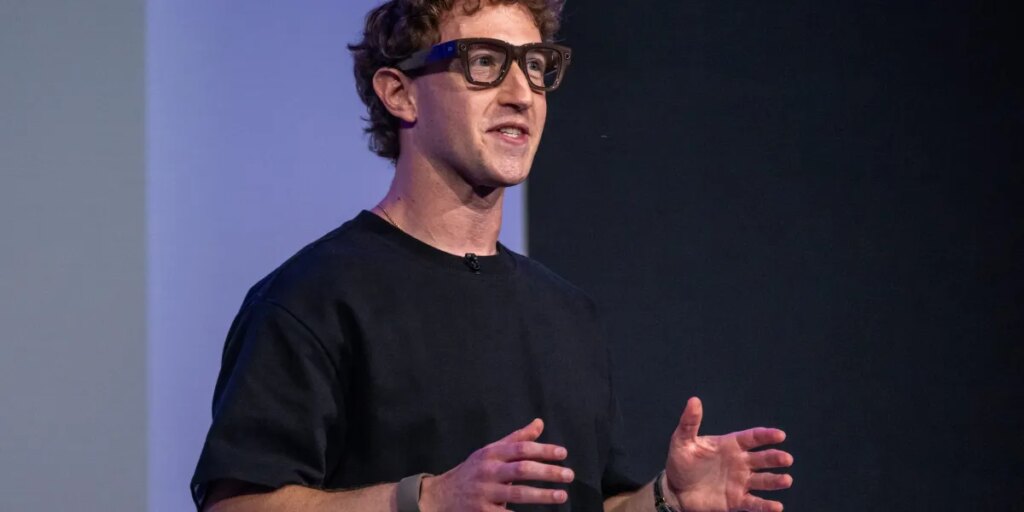
With its Super Bowl commercials this year Meta is leaning into advertising’s biggest stage as Mark Zuckerberg ramps up his spending on AI.
The company’s two ad spots, which are set to air during the first and third quarters of Sunday’s matchup between the New England Patriots and the Seattle Seahawks, highlight the company’s AI-enabled Oakley Meta smart glasses, and feature ex-Seahawks player Marshawn Lynch, YouTuber Darren Watkins Jr. (also known as IShowSpeed) as well as director Spike Lee.
While in 2006, a 30-second Super Bowl ad slot cost about $2.5 million, NBC said this year slots averaged about $8 million for 30 seconds, with a handful selling for $10 million or more.
While it’s unclear exactly how much Meta paid, the network’s price tag is only one part of the overall cost, said Kimberly Whitler, an associate professor of business administration at the University of Virginia’s Darden School of Business. The company also has to take into account celebrity talent, popular music licensing, and production costs, which can add $5 million or more on top, she told Fortune.
Meta did not immediately reply to Fortune‘s request for comment on the cost of its Super Bowl ads.
And the spending rarely stops when the final whistle blows. In the days and weeks after, the company may continue to amplify the ad with social media posts and campaigns to extend its shelf life.
“When you add together, not just the cost of the airtime but also the cost to produce and deliver the ad, and then all of the other things that go into supporting, amplifying the awareness and effect of the ad, the cost can be really significant,” said Whitler.
And yet, the potential price of Meta’s advertising efforts linked to the Super Bowl is nothing compared to the spending spree CEO Zuckerberg has embarked on as he goes all in on his vision of “personal superintelligence.”
Zuckerberg has previously said smart glasses, like its own, could become “our main computing devices” thanks to AI. Meta is already pouring billions into its AI efforts and expects 2026 capital expenditures to hit $115 billion-$135 billion, nearly double the $72 billion it spent last year.
At the same time, Meta laid off 10%, or around 1,500 people, in its Reality Labs division as the company shifted its focus from virtual reality and the metaverse to wearables such as its Meta AI Glasses, the Wall Street Journal reported.
Whitler, who has studied Super Bowl advertising over the past 11 years, said Meta’s goal may not only be to boost sales of its smart glasses. She noted that Meta’s Reality Labs division, which includes its Meta AI Glasses operation, brings in marginal revenue at around $2.21 billion for 2025, or about 1% of the company’s total revenue of about $200 billion.
“They’re not just communicating to consumers, they’re also communicating to investors who watch these ads,” said Whitler. “They’re reinforcing this kind of view that the company is very innovative.”
Investors, she added, are always looking for additional insight into the company’s future performance, and a Super Bowl ad can make a product feel more real than a press release or earnings-call mention.
“The ad that brings the technology to life, I can read about it, but when I see the ad, I experience it in a much more visceral, vivid way,” she said.
Unlike other tech companies such as Microsoft whose AI spending has partly held back its stock, investors for now have rewarded Meta’s big AI bets as the company’s revenue increased 24% year over year thanks in part to strong advertising results fueled by AI. Until this week, when tech stocks retreated across the board, Meta’s shares had been steadily rising, putting the company’s shares up year-over-year at its recent peak close of $738 on Jan. 29, compared to $676 a year prior.
While brands get sticker shock on ads for the big game, the Super Bowl is still important, even in a fragmented attention economy, Whitler said, and there’s no other comparable way to reach Americans en masse.
“There’s no other time during the year where people actually treat the ads as if they’re something to be watched versus something to be ignored.”
The post Meta’s multi-million-dollar Super Bowl ads may not just be about its smart glasses—but about selling Wall Street on Zuckerberg’s AI future appeared first on Fortune.