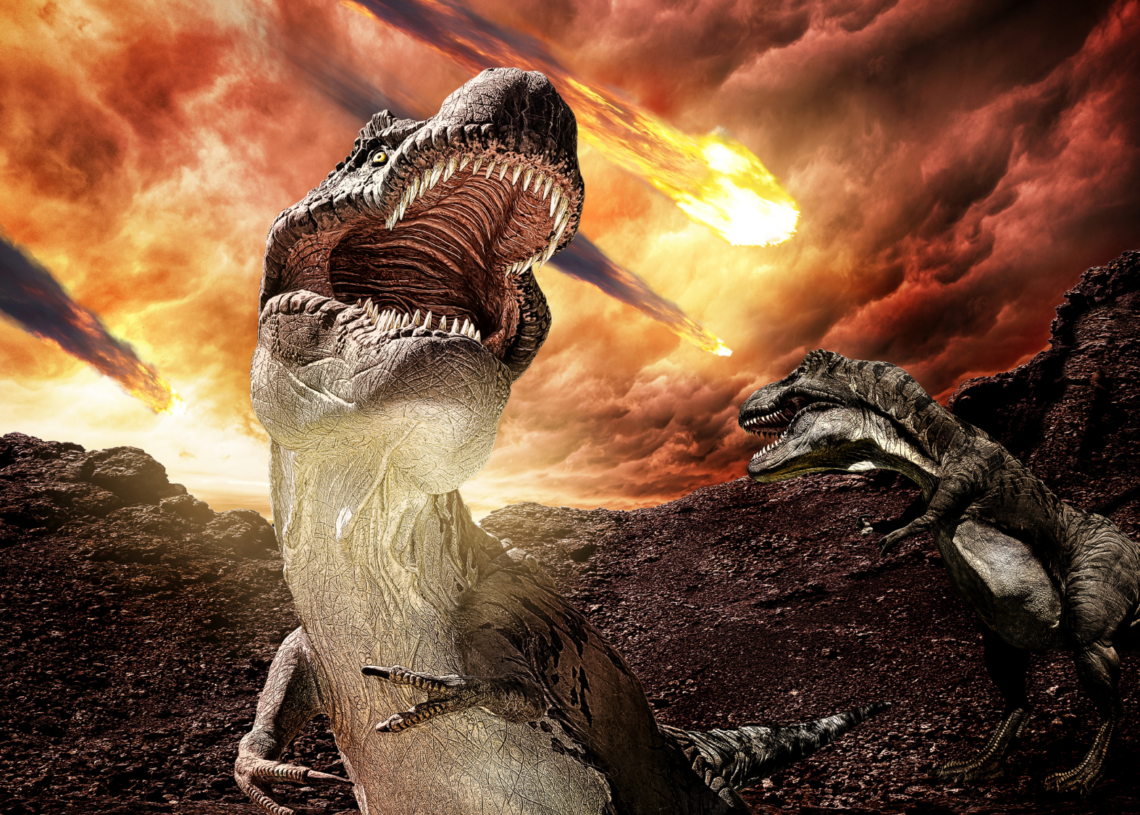
The asteroid that wiped out the non-avian dinosaurs has sort of been viewed as nature’s ultimate reset button. Sixty-six million years ago, Chicxulub hit, the lights went out, and around three-quarters of life on Earth disappeared. The story usually focuses on the massive devastation. What happened next was assumed to be slow, grim, and drawn out over tens of thousands of years.
New research suggests that assumption badly undersells life’s urgency.
A study published in Geology argues that new species began appearing way sooner than expected after the impact, possibly within a couple thousand years. On a geologic clock, that’s barely a blink. According to the authors, the ocean didn’t sit around waiting to recover. It got busy.
“This is ridiculously fast,” Chris Lowery, a paleoceanographer at the University of Texas Institute for Geophysics and a co-author of the study, said in a statement. He added that the findings help show “how quickly new species can evolve after extreme events and also how quickly the environment began to recover after the Chicxulub impact.”
The team focused on microscopic plankton, specifically foraminifera, which leave behind fossil shells that settle into ocean sediments. One species in particular, Parvularugoglobigerina eugubina, has long served as a marker for post-impact recovery. Previous estimates suggested it emerged around 30,000 years after the asteroid hit. That timeline rested on the assumption that sediments accumulated at a steady pace.
After Chicxulub, steady was not happening.
Instead of relying on just the sediment thickness, the researchers used helium-3, a rare isotope delivered to Earth by interplanetary dust at a consistent rate. By tracking helium-3 levels in sediment layers from six sites, they recalibrated the clock. The result places P. eugubina at roughly 6,400 years after impact on average, with some sites pointing to new species appearing in under 2,000 years. Between 10 and 20 plankton species showed up within about 11,000 years, though the authors acknowledge ongoing debate about how to define species in the fossil record.
Timothy Bralower, a geoscientist at Penn State and co-author of the study, called the pace startling. “To have complex life reestablished within a geologic heartbeat is truly astounding,” he said in the statement.
That speed doesn’t erase what happened after that meteor. Seventy-five percent of species still vanished, and the planet endured a decade of darkness and cold as soot and dust choked the atmosphere. What it changes is how we think about recovery. New species don’t always wait millions of years for conditions to improve. Under pressure, evolution moves pretty damn fast.
There’s an uncomfortable resonance there. If life reorganized itself this quickly after a planet-altering catastrophe, it raises questions about resilience, stress, and adaptation in today’s world. The past suggests that life pushes forward fast when it has to. Whether modern ecosystems get the same chance remains an open question.
The post Life Recovered After the Dinosaur Extinction Way Faster Than We Thought appeared first on VICE.