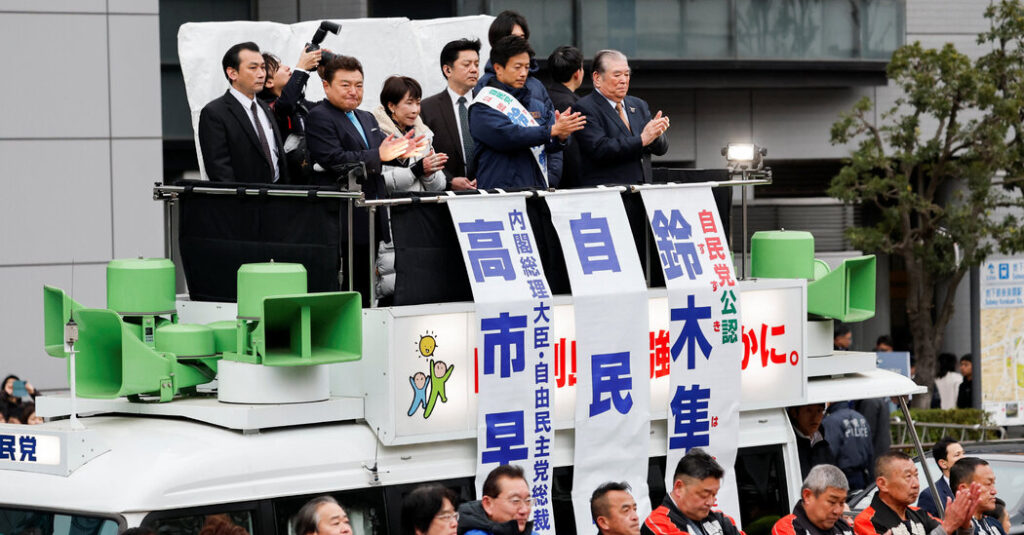
Sanae Takaichi made history last fall when she became the first woman to lead Japan as prime minister. Now, after just over 100 days in office, she is making her biggest bet yet.
Ms. Takaichi, a hard-line conservative, has called a snap election, which takes place on Sunday, in a bid to capitalize on her popularity and to gain the seats she needs in Parliament to push through her economic and security agenda.
If Ms. Takaichi prevails, she could emerge as a powerful figure at a precarious moment for Japan. The country is caught up in a feud with China, which has taken actions that are hurting Japan’s economy, and faces the unpredictable foreign policy of the United States under President Trump.
Ms. Takaichi hopes that her popularity, especially among young people, will help propel her to victory. She runs a coalition government and is looking for an absolute majority; polls have suggested that her Liberal Democratic Party could win big on Sunday.
That would be a remarkable revival in the fortunes of the party, Japan’s dominant political group for seven decades, which has recently been fighting for survival.
“Her star would be golden,” said Sheila A. Smith, a senior fellow at the Council on Foreign Relations. “She would have rescued the party from the abyss.”
But she is vulnerable on some issues. Her opponents have denounced her expansionary economic policies as irresponsible, and they say that she has unnecessarily inflamed tensions with China.
There are other challenges. Ms. Takaichi called the election last month without much notice, leaving little time to prepare. And voters face treacherous journeys to cast their ballots as snowstorms blanket parts of Japan, including Tokyo.
A Resurgent Right Wing
Ms. Takaichi has energized right-wing groups with promises to tighten immigration and build a “strong and prosperous” Japan. She shares the conservative vision of her mentor, Shinzo Abe, Japan’s longest-serving prime minister, who was assassinated in 2022 after he had left office.
A big win for Ms. Takaichi could push Japan even further to the right. She has promised to increase military spending, to strengthen Japan’s security laws and to reduce the cost of living. She could push other changes long sought by conservatives, including enacting an anti-espionage law and amending a pacifist clause in the Constitution to unfetter Japan’s military.
“We must restore Japan’s backbone,” Ms. Takaichi said in a recent campaign video.
Seizing on Popularity
Ms. Takaichi, 64, is a rare figure in modern politics: a popular leader. She has inspired memes, murals and a variety of products, including folding fans and cookies.
Her approval ratings are consistently above 60 percent, about double the rating for the Liberal Democratic Party. She has earned praise for forging close ties with foreign leaders, including Mr. Trump, whom she is set to meet with in Washington next month.
Ms. Takaichi’s choice to call an election so early in her tenure appears to reflect her desire to capitalize on her high levels of support. Still, the decision could backfire, as it has for other leaders, including President Emmanuel Macron of France, who suffered a stinging blow in snap elections in 2024. Ms. Takaichi has promised to step down if the Liberal Democrats do not win a majority.
The China Factor
Ms. Takaichi caused a stir in November when she said that Japan could intervene militarily if China were to attack Taiwan, a self-governed democracy that Beijing claims is part of its territory. The Chinese government unleashed a wave of reprisals, including discouraging tourism to Japan . (Chinese tourists represent more than a fifth of tourists in Japan.)
Her comment broke with a previous policy of avoiding any explicit mention of Taiwan in the context of “survival-threatening situations.” But it seems to have helped Ms. Takaichi win over some voters, including young people, who have shown a willingness to question the nation’s longstanding pacifism.
Ms. Takaichi’s critics say that she has unnecessarily exposed Japan to economic coercion by China and that the dispute could threaten Japan’s access to rare earth minerals from China.
Komeito, one of the main opposition parties, called Ms. Takaichi’s remarks “ill advised.”
“It is regrettable that Japan-China relations are continuing to deteriorate,” the party said in a recent commentary.
A Frenetic Campaign
This election cycle is one of the shortest in modern Japanese history. Some candidates did not have enough time to print posters, making handmade signs instead. There have also been shortages of trucks equipped with loudspeakers, which candidates and their backers use to broadcast their messages in the streets.
Daisuke Tanaka, who runs a campaign car rental company in Osaka, said he has had to turn down a flood of requests.
“The election came so suddenly,” he said. “For Osaka, it is a crazy situation.”
Some Japanese residents have complained about Ms. Takaichi’s decision to call an election in the middle of winter, with many regions grappling with heavy snowfall. It is also happening as tens of thousands of students take university entrance exams, prompting some grumbles from students and parents.
The weather has proved a challenge for many of the 1,285 candidates on the ballot.
Kosuke Kita, 38, is running for Parliament from Yamagata, a prefecture in northern Japan, as a member of the Democratic Party for the People, an opposition party. He spent a recent day shoveling snow that was blocking an election poster board.
He sleeps only about four or five hours a night, he said, but he is trying to keep his energy high by eating four meals a day: soup, sushi rolls and bowls of rice with deep-fried pork.
“People don’t stop long enough to listen to me or shake hands with me in town because it’s snowing,” he said. “I am trying to convey my political message from the bottom of my heart.”
Hisako Ueno and Kiuko Notoya contributed reporting.
Javier C. Hernández is the Tokyo bureau chief for The Times, leading coverage of Japan and the region. He has reported from Asia for much of the past decade, previously serving as China correspondent in Beijing.
The post Japan’s Leader Makes a Bold Election Bet. Here’s What to Know. appeared first on New York Times.