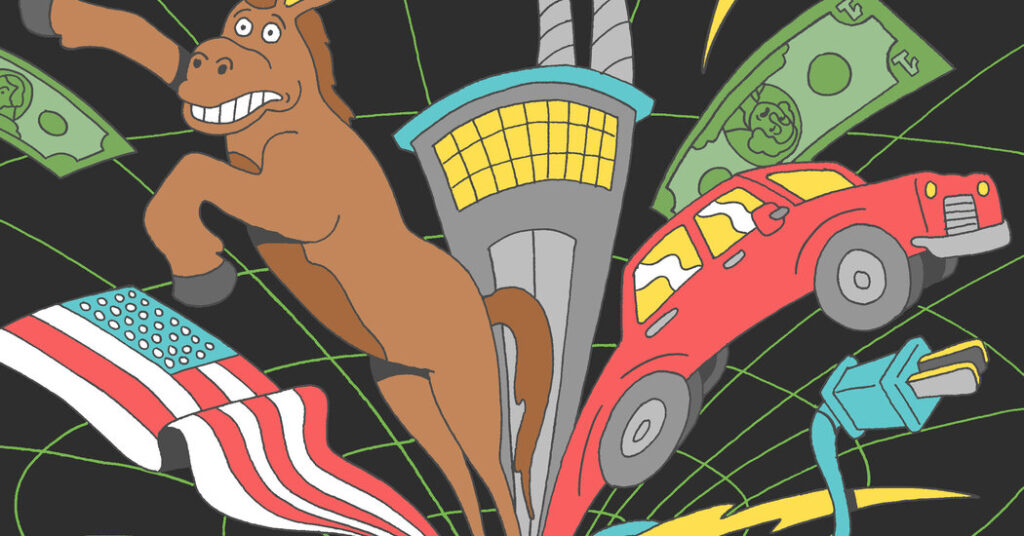
Dario Amodei, the chief executive of Anthropic, has predicted that artificial intelligence could displace half of all entry-level white collar jobs within five years. Already, layoffs are on the rise. Recent college grads are struggling to find work. And even for those of us fortunate enough to be employed, our retirement savings are increasingly dependent on the fortunes of a small handful of high-growth tech companies.
The economics of A.I. may not be as politically urgent as President Trump’s latest international entanglements or Immigration and Customs Enforcement’s extrajudicial campaign of terror, but it is steadily if quietly becoming the country’s biggest political issue. It won’t define this year’s midterms, but it will almost certainly define the 2028 elections.
The Democratic Party needs to be better prepared. The coming A.I. revolution threatens the urban professional class that constitutes a central pillar of its political coalition — which already seems too small to win a national election. Even some Republicans have managed to sound the alarm, as when Senator Josh Hawley of Missouri helped introduce bipartisan legislation (with Senator Mark Warner, Democrat of Virginia) in November that would require companies to report A.I.-related layoffs. It’s the kind of policy that may resonate with voters whose jobs are in danger. Democrats need to monopolize this issue, lest we risk losing voters we take for granted.
That has happened before. Democrats did not adequately prepare to address the disruptions caused by globalization, automation and the internet, which devastated blue-collar workers in the United States and cost us their support. Since then, our party has adopted a more cosmopolitan, professional sensibility, while Republicans have gravitated toward a rougher, angrier populism. In the process, Democrats lost our identity as the party of the disaffected.
But as Mr. Trump, Vice President JD Vance and other G.O.P. figures flaunt their cozy relationships with the tech overlords driving much of today’s economic anxiety, Democrats have an opening both politically and substantively. Americans feel pessimistic about A.I. Polling indicates that they are much more concerned than excited about the increasing use of A.I. in their lives. Much as the 2012 presidential campaign, set against the backdrop of Occupy Wall Street, allowed Democrats to focus on income inequality, the 2028 campaign, set against the backdrop of discontent with A.I., will provide an opportunity to campaign against Big Tech’s excesses and a Republican Party that has enabled them.
Trying to stop A.I. altogether is by no means the solution, but A.I. boosters consistently present it as inevitable — something that will happen to us, not something we can shape and guide to our purposes. Being told you have no agency over a force that will reshape your job prospects, your community and your family’s future is a recipe for backlash. Democrats shouldn’t dismiss that anger. We should be the party that channels it and does something about it.
For the past few years, Silicon Valley elites have been working furiously to prevent A.I. regulation, spending hundreds of millions of dollars to influence elections and lawmakers — including the hundreds of thousands of dollars spent opposing the U.S. congressional campaign of Alex Bores, a Democratic state lawmaker in Manhattan who supports A.I. regulation. Democrats should not capitulate. We should make A.I. companies pay the costs for powering and building data centers, implement A.I. child safety standards and prohibit the technology from being centrally involved in tasks we can’t trust it to do fairly, like hiring and firing workers. Such policies are surely more politically popular than standing back and letting A.I. companies do whatever they like in the name of innovation.
If Democrats regain control of Congress and the White House, we will have an opportunity to think and act more ambitiously about the future of A.I., which will require reimagining America’s social bargain. To that end, there are three major questions that Democrats should be asking — and we should be letting voters know how we answer them.
The first question: Who is in charge? A small number of corporate executives are building technologies that will shape the economy for decades. No one elected these people. When a technology becomes essential infrastructure, as A.I. soon will, we don’t treat it as a purely commercial concern — we regulate it in the public interest. We did this with railroads, telecommunications and utilities. Democrats should be the party of ensuring these platforms operate safely, transparently and democratically.
The second question: Who benefits? A.I. could represent one of the largest upward transfers of wealth in human history, with nearly all the financial gains going to a handful of companies. But these A.I. systems were trained on data produced by all of us: our writing, our photos, our conversations. That imbalance isn’t fair or sustainable. We’re allowing for an enormous concentration of wealth and power while making it harder for much of the country to make a living. The Democrats must be the party that stands for reclaiming some of that wealth through aggressive taxation that funds health care, affordable housing and child care — and with an A.I. dividend modeled on Alaska’s oil dividend. If traditional employment becomes less stable, the basics of middle-class life can’t depend on having a traditional job.
The final question: Who are we, as a nation? A.I. is going to disrupt more than the economy. It will disrupt our sense of identity, purpose and belonging. As jobs become more precarious, loneliness and social fragmentation will deepen. The government can’t solve that problem, but it can help. Much as the Democratic Party invested in people and communities through government projects like the Works Progress Administration during the Great Depression, Democrats today should be insisting that government invest in civic spaces, national service and other institutions that bring Americans together in real life — across lines of class, geography and heritage.
With the rise of A.I., the coalition of the disaffected will only grow. Policy choices in the next few years will determine whether A.I. becomes a tool for shared prosperity or a driver of downward mobility. It is ultimately in everyone’s interest to bring about a broader wealth. In the meantime, Democrats have a chance to unite the unemployed 25-year-old software engineer in Tucson, Ariz., and the underemployed middle-age autoworker in Detroit in a coalition big enough to win nationally and locally. But that will happen only if we offer both accountability and hope: not just someone to blame, but also something worth fighting for.
Rob Flaherty is the founder of Narrowcast Media, a digital media company, and was a deputy campaign manager for Kamala Harris in 2024.
The Times is committed to publishing a diversity of letters to the editor. We’d like to hear what you think about this or any of our articles. Here are some tips. And here’s our email: [email protected].
Follow the New York Times Opinion section on Facebook, Instagram, TikTok, Bluesky, WhatsApp and Threads.
The post It’s the A.I. Economy, Stupid appeared first on New York Times.