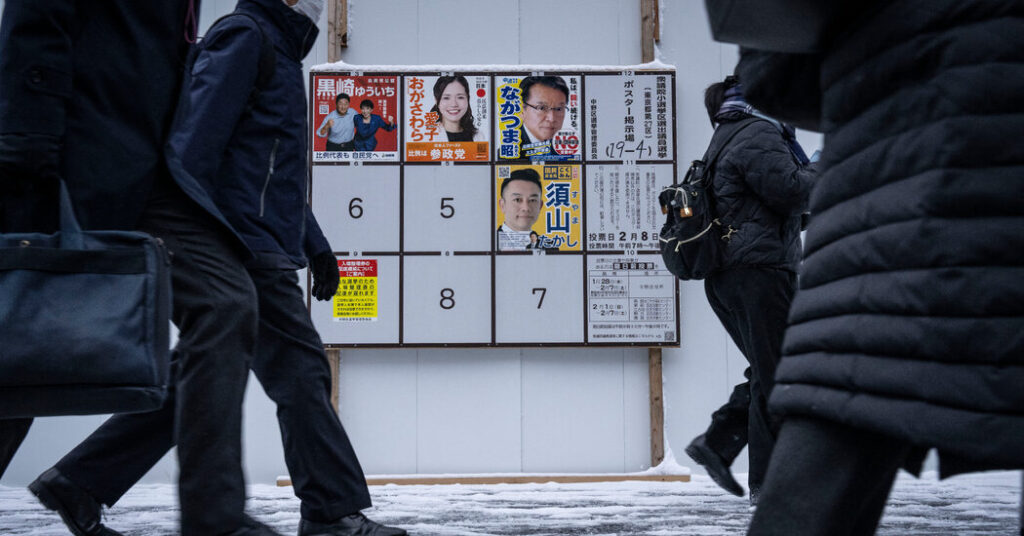
Heavy snowfall forced many polling stations to open late or close early during Japan’s snap election on Sunday, and some opposition politicians expressed concern about the impact on voter turnout.
In Tokyo, voters braved icy roads and wintry winds to cast their ballots in an election seen as a referendum on Sanae Takaichi, the country’s first female prime minister. The city received a rare coating of snow overnight, and polls opened at 7 a.m. in temperatures of around 28 degrees Fahrenheit.
Japan usually holds its elections in months with milder weather. This time, Ms. Takaichi, a hard-line conservative, called a snap election last month hoping to capitalize on her popularity, particularly among young people, and to gain the seats she needs in Parliament to push through her economic and security agenda. Exit polls on Sunday night projected that her party was on course for a landslide victory.
The opposition has criticized the short notice period for the election, as well as its timing. Yoshihiko Noda, the co-leader of the opposition Centrist Reform Alliance party, expressed concern about the early closure of some polling stations because of the snow. As many people as possible should be able to vote, he told the Tokyo Shimbun, and “not being able to do so is a denial of democracy.”
Some candidates have also said that prolonged heavy snowfall in their areas has hampered their ability to campaign. Parts of Kyoto received nearly 14 inches of snow between 5 a.m. and 11 a.m. The city of Tottori, on the coast of the Sea of Japan, received nearly a foot between 1 a.m. and 7 a.m., according to Japan’s Meteorological Agency.
Some polling stations opened late or closed hours early, with officials citing the heightened risk for voters traveling in the dark. The government said that about 40 percent of all polling stations closed earlier than planned because of heavy snow.
Over the past two weeks, heavy snow in parts of Japan has buried some people in their homes, caused deadly accidents and stranded travelers. At least 46 people have been killed and 500 others injured, and officials have warned that the toll could rise.
The snow likely dampened voter turnout, which stood at 26.01 percent as of two hours before polls closed, according to Japan’s Ministry of Internal Affairs. The figure represented a decline of nearly three percentage points from the 2024 lower house election.
Kiuko Notoya is a Tokyo-based reporter and researcher for The Times, covering news and features from Japan.
The post Heavy Snow Disrupts Japan Election, Forcing Polling Stations to Close Early appeared first on New York Times.