The 232 Americans competing at the Winter Games have trained for years, traveled thousands of miles and are ready to give their best on the ice and the slopes. But politics, perhaps inevitably, is intruding on their Olympic moment.
The competition has opened after a year in which the Trump administration denigrated Europe, threatened allies and launched a trade war. Opposition to President Trump’s policies abroad and at home has followed the U.S. team to northern Italy, forcing athletes, coaches and American fans to respond to — or sidestep — the backlash.
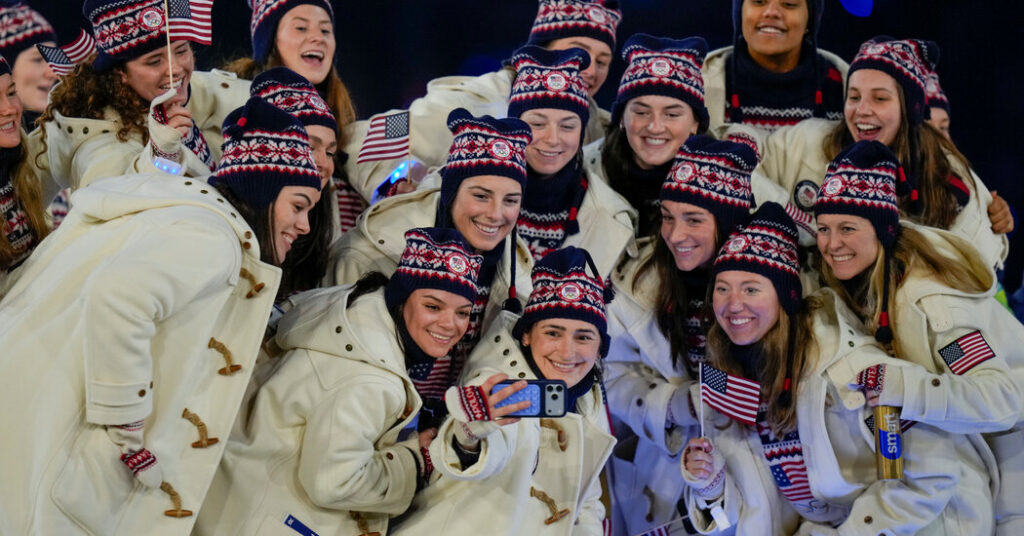
Some of that opposition came out during the opening ceremony in Milan on Friday night. Jeers and boos rippled through San Siro stadium when Vice President JD Vance briefly was shown on huge screens as the U.S. team paraded in waving American flags.
At first, Phillip DiGuglielmo, who coaches the U.S. figure skater Alysa Liu and was seated in the stands, thought the boos were for the athletes.
“It was supposed to be the pinnacle of my life to see my athlete walk into the stadium, but it turned into a really sad moment for me,” said Mr. DiGuglielmo, whose grandparents immigrated to the United States from Italy. “I felt like, hey, the athletes don’t deserve this.”
Later, he learned that the boos were for Mr. Vance. But he said he still worried that some athletes had heard the jeers instead of the applause.
Zach Werenski, a defenseman on the U.S. hockey team, was in the stadium but said he saw news of the boos only later on social media. Earlier that day, he had met Mr. Vance. “He’s a proud American and he wants all the athletes here to show well for our country and that’s our goal,” Mr. Werenski said.
Mr. Werenski said he wouldn’t let politics distract him in the rink. “I just try and block all that out,” he said.
The International Olympic Committee casts the Games as a neutral ground where athletes can compete “without being held back by the politics or divisions of their governments,” Kirsty Coventry, the I.O.C. president, said at the opening ceremony.
But the athletes, wearing the colors and emblems of their countries, can’t help but appear as symbols of their nations’ values. That leaves Americans in Italy to contend with the emotions elicited by Trump administration policies.
Last week, news that investigative agents from U.S. Immigration and Customs Enforcement would join a State Department security team at the Olympics prompted anger from Italians outraged over the actions of federal agents in Minneapolis. At a protest of several hundred people on Friday, some demonstrators carried a large anti-ICE banner that read, “Milan despises you.”
The furor drove the American figure skating, hockey and speedskating federations to hastily rename a hospitality venue for athletes in Milan from “Ice House” to “Winter House.”
Inside the rechristened venue on Saturday, Annie White, the chief marketing officer for U.S. Figure Skating, said she never “thought the surface we skate on would potentially become a polarizing word.”
Mr. Vance, who traveled to Italy with his wife and children, met with Prime Minister Giorgia Meloni on Friday but avoided publicly discussing politics on his visit. He and his family attended a figure skating team event in Milan, where Evan Lysacek, a 2010 Olympic champion skater who was traveling with the vice president, said Mr. Vance’s daughter enjoyed the fashion and his two sons “mostly wanted to make sure that America is going to win.”
By Sunday morning, no member of the U.S. team in Italy had spoken publicly in support of the Trump administration. U.S. Olympic committee guidelines stipulate that athletes can advocate for social and racial justice, but should avoid partisan politics.
Still, many American Olympians have faced questions about what it feels like to represent the United States.
“I just stay focused on the fact that there are a lot of really good people at home who I am proud to represent,” Summer Britcher, a luger from New York who is competing in her fourth Olympics, said in an interview last week inside the Olympic Village in Cortina d’Ampezzo.
Asked a similar question by a Norwegian journalist at a news conference in Cortina on Saturday, the skier Mikaela Shiffrin, a three-time Olympic medalist, was quiet for a few seconds.
Ms. Shiffrin said it was “an honor and privilege” to compete for her country but then read from prepared remarks quoting Nelson Mandela, and said she wanted to represent “values of inclusivity, values of diversity and kindness.”
Some competitors are using their platform to champion their politics. “I know that a lot of people say you’re just an athlete, like, stick to your job, shut up about politics, but politics affect us all,” Amber Glenn, the three-time U.S. national figure skating champion, told reporters on Wednesday.
Asked about the Trump administration’s policies toward L.G.B.T.Q. Americans, Ms. Glenn, who is pansexual, said, “It is something that I will not just be quiet about.”
The skier Lindsey Vonn, a three-time Olympic medalist, was asked by a Canadian journalist on Tuesday about “everything going on in Minnesota.” She responded that the state is “where I grew up, and my heart is incredibly heavy for everyone at home.” She added: “We are more than what’s happening right now.”
Prominent Trump supporters have taken note of the comments. Richard Grenell, the Trump-appointed president of the John F. Kennedy Center for the Performing Arts, shared on X a video of the American skier Hunter Hess telling reporters that he had “mixed emotions” about representing the United States. “Move to Canada if you aren’t proud to wear USA,” Mr. Grenell wrote.
The Games’ Italian hosts, no strangers to turbulent politics at home, appear willing to give the athletes the benefit of the doubt. “We look at the United States with real, great concern,” said Barbara Barile, 57, who attended the opening ceremony in Milan. “We must distinguish between those who govern and those who are governed.”
Skepticism of the United States is not new in Italy. Despite tight connections to the United States, a strain of “anti-Americanism has been here for a long time,” said Gregory Alegi, a historian at Luiss Guido Carli University in Rome.
The Italian political right “has never forgiven the U.S. for defeating Mussolini,” he said, and on the left, “they’ve never forgiven the U.S. for winning the Cold War.”
Ms. Meloni’s supporters appreciate her efforts to maintain a close relationship with Mr. Trump. But the recent conduct by ICE agents in Minneapolis has unified Italians against that aspect of the U.S. administration’s policies.
At a team figure skating event on Saturday night, plenty of American flags waved from the stands. But some American spectators, anticipating a backlash, came to Italy intent on concealing their national identity.
Helen Wehner and her brother Andrew decided not to bring any American flag gear to the Games. Soon after they arrived, Ms. Wehner began to reconsider.
“Once you’re here you see that it’s really about the athletes,” she said. “I want the athletes to see they have some support.”
At a curling event on Friday in Cortina, the Wehners allowed an American volunteer to paint the stars and stripes on their cheeks.
Reporting was contributed by Josephine de La Bruyère in Milan; Jason Horowitz in Cortina d’Ampezzo, Italy; and Kim Severson in Livigno, Italy.
Motoko Rich is the Times bureau chief in Rome, where she covers Italy, the Vatican and Greece.
The post Americans at the Olympics Can’t Escape the Politics at Home appeared first on New York Times.