I first noticed it in late autumn in front of the Queens Public Library in Flushing, where Chinese immigrants gather to socialize, peddle homemade snacks and cheap sneakers, and protest the political system in China.
When I stood on the library steps, I could still hear the horns of passing cars, the coos of pigeons and a chorus of Chinese dialects. But if you know the place as I do, and listen carefully, you can also hear the quietness.
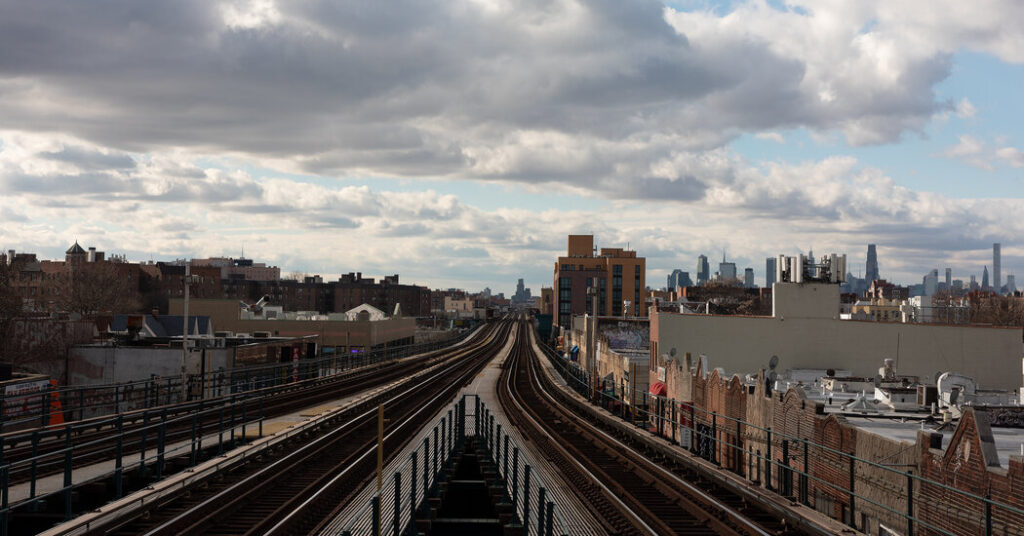
I also saw this in the restaurants, playgrounds and parks along the No. 7 subway line, nicknamed the International Express. Beneath the elevated tracks of the 7 train, Roosevelt Avenue passes through some of New York City’s most ethnically diverse neighborhoods. Hundreds of languages are spoken along this stretch, their cadences mingling with the rhythmic roar of passing trains and the din of bustling shops, eateries and street vendors.
To outsiders, these neighborhoods may still sound raucous. But locals will tell you it’s different now. In November and December, armed federal agents conducted raids in Queens. Arrests and detentions have continued into 2026, leaving many families in a state of watchful quiet. Residents have told me that people are less likely to report crimes. Even simple daily routines — like walking outside — can feel risky.
On a chilly afternoon, I walked along Roosevelt Avenue in Jackson Heights with Hildalyn Colón Hernández, a local resident who works for New Immigrant Community Empowerment, an organization that supports immigrants. She told me that the neighborhood has changed notably in the past few months. A street corner that used to be teeming with day laborers waiting for jobs was now deserted. A nearby plaza that would typically be packed is drawing far fewer people.
Our shadows, stretched long by the slanting sun through the train tracks above, painted the empty sidewalk. When the train pulled into the station, its screeches sounded ominous without the usual backdrop of noise on the street.
The frigid temperatures may have kept some people from venturing out. But business owners and residents told me that they believe the chill brought into some of these neighborhoods by the Trump administration’s immigration crackdown had played a bigger role.
I talked to a resident in Corona who has stopped going to the deli where he used to hang out with neighbors because he is afraid of encountering ICE agents. Karla Veroy, a Honduran immigrant who has worked at a thrift shop in Woodside for 20 years, said that business had slowed and she worried about the store’s survival. “Half of my customers are Latinos,” she said.
Some losses are harder to detect.
Many diasporas have converged in Queens, and sometimes residents rally around causes connected to their homelands — but many are now hesitant to do so. In November, a rally in Little Manila, Woodside, to protest corruption in the Philippines drew about 100 people. The organizers told me that the previous time they had a protest like this, about 300 people showed up. This time, many undocumented Filipino immigrants who cared about the issue opted to stay home.
In Flushing, where protests related to China and its government are common, Chinese activists told me the number of demonstrations dropped last year for the same reason: fear of drawing attention to one’s immigration status.
Maybe if President Trump achieves his goal of mass deportations, the voids left by some people will be filled by others. But will New York be the same?
The 7 train carries thousands of people across the city each day. In some neighborhoods, life presses outward, loud and defiant; in others, it pulls inward, careful and contained. The train bears witness to both.
Rong Xiaoqing is a New York-based journalist, a former Alicia Patterson fellow and the recipient of a Pulitzer Center grant. Andrés Altamirano is a visual artist.
The Times is committed to publishing a diversity of letters to the editor. We’d like to hear what you think about this or any of our articles. Here are some tips. And here’s our email: [email protected].
Follow the New York Times Opinion section on Facebook, Instagram, TikTok, Bluesky, WhatsApp and Threads.
The post When Streets Go Quiet appeared first on New York Times.