Even with President Trump’s “beautiful armada” off its shores, Iran has once again resorted to a familiar strategy: kicking the radioactive can of its nuclear program down the road of extended negotiations.
But given the fundamental disagreements between the two sides, the rapid buildup of American forces in the region and Israeli anxiety over Iran’s ballistic missiles, the road may be shorter than Iran seems to believe.
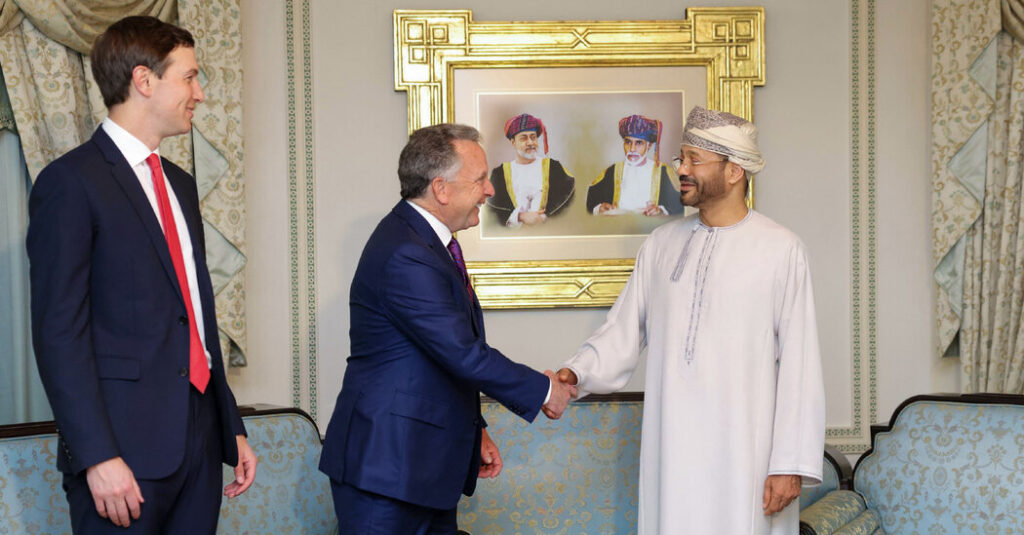
Talks on Iran’s nuclear program between the United States and Iran on Friday in Oman were successful, in the sense that they did not end in either acrimony or airstrikes. Talks are expected to continue soon on what the foreign minister of Iran, Abbas Araghchi, called “a framework” for — “future talks.”
“It was a good start,” he told Iranian media. “We agreed to continue talks, but we’ll consult in capitals how to continue. If this trend persists, we can reach a solid framework for future talks in the next sessions.”
On Saturday in a post on Telegram, Mr. Araghchi repeated Iran’s position — that it insists on the right to enrich and that ballistic missiles are not negotiable.
Though there were no direct U.S.-Iranian talks, there was “an opportunity to shake hands with the American delegation,” the post said, adding that his remarks were made in an interview with Al Jazeera.
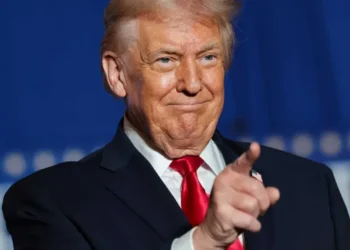
Mr. Trump, too, told reporters on Friday evening that the talks were off to a “good start,” and that he was in “no rush” to make a deal. Iran, he said, would have to agree to “no nuclear weapons.”
But the president’s remarks created confusion. Iran has already said it would never build a nuclear weapon — an assertion that Western governments dismiss. And Mr. Trump’s own negotiators have said that the American bottom line is that Iran agree to no nuclear enrichment at all.
The American demands, as originally formulated, are that Iran hand over all of its enriched uranium, especially the roughly 440 kilograms (about 970 pounds) at near bomb-grade, enough for 10 weapons; limit the range of its ballistic missiles so they cannot reach Israel; and end its support for its regional proxy militias, like Hamas, Hezbollah and the Houthis.
Israel itself has been concerned about Iran’s rapid repair of its ballistic missile production facilities, which would be an early target in any war.
Mr. Trump, who in the past has favored quick, limited military action, seems to prefer an agreement that he can proclaim as a victory without getting bogged down into a long, regional war of the kind that Iran threatens if it is attacked. Such a war could cause the deaths of hundreds of Americans, hit Israel hard, disrupt the world’s energy markets and most likely inflame his Make America Great Again movement, which has been fiercely critical of long American wars in the Middle East and Afghanistan.
Iran and the talented Mr. Araghchi have had long practice at negotiating, frustrating generations of Westerners. Even now, at its weakest point, after the June war with Israel and the United States and the crushing of enormous popular protests, Iran has advantages. The regime, feeling so threatened, is less likely to restrain its counterattacks, one reason America’s allies in the Gulf, like Saudi Arabia, Egypt and Oman, are urging a diplomatic solution.
“What’s really interesting is that Iran continues to insist on a negotiation framework as if nothing has changed or there is no internal threat from the protests or from Trump’s armada and threats,” said Sanam Vakil, the director of the Middle East and North Africa program at Chatham House. “The negotiation terms and conditions are exactly what they were last fall and before the 12-day war in June.”
The question, she said, is whether Mr. Trump has the patience for a negotiated deal. Tehran, she said, is clearly testing that.
As in Venezuela, the military buildup near Iran is designed to increase pressure on the country to make concessions, but American forces also need more time to prepare to deal with a regional war should one start.
That gives time for talking. But how long remains unclear. Mr. Trump’s initial rhetoric in support of the Iranians who protested the regime and died in the thousands has put his own credibility on the line, analysts say, making the chance of military action considerably higher than in the past.
But there are also doubts about what a military intervention would accomplish. Even if the Americans decapitate the Islamic Republic, killing the supreme leader, Ayatollah Ali Khamenei, and many of the top generals of the Islamic Revolutionary Guards Corps, the chances of a democratic government emerging are thin. Analysts suggest that it more likely would be a more hard-line military government under the Islamic flag that could decide to race for a nuclear weapon as the best deterrent against future attacks.
Despite the huge protests, the fierce and bloody reaction from the regime showed that it had no visible splits. And there is “a strong view on the Iranian side that Trump has an excessive and exaggerated view of Iranian weakness,” said Trita Parsi, an Iran scholar with the Quincy Institute for Responsible Statecraft in Washington.
If diplomacy is to work, “these Iranians believe a short, intense war may be necessary to correct Trump’s perception and compel him to adopt more realistic demands,” Mr. Parsi said. Even if Iran takes large losses in such a war, so will the Americans and Israelis, and “Trump has less tolerance for losses or a protracted war,” he said.
Mr. Trump’s original bottom line, which may still be the real one — zero enrichment, limits on ballistic missiles and no support for proxies — would be “tantamount to complete capitulation, even though Iran has not been defeated militarily,” Mr. Parsi said. Those demands will lead, sooner or later, to a collapse in the talks, analysts agree.
But a quick deal on nuclear enrichment alone could also be politically problematic for Mr. Trump, given his dismissal of the 2015 nuclear agreement with Iran as “the worst deal in history.” In these talks, Iran is refusing to stop enrichment entirely, but is reportedly willing to limit its nuclear enrichment to 3 percent — far short of the near weapons-grade 60 percent it has been doing since Mr. Trump pulled out of the 2015 deal in 2018.
But that deal limited Iran’s enrichment to 3.67 percent, so to return to a 2015-like arrangement would hardly be considered a victory. The 2015 deal did have “sunset clauses” and time limits that Mr. Trump also criticized. A new deal that was indefinite could, arguably, be labeled a better one, even if it lifts many economic sanctions and leaves the Islamic Republic largely in place.
Steven Erlanger is the chief diplomatic correspondent in Europe and is based in Berlin. He has reported from over 120 countries, including Thailand, France, Israel, Germany and the former Soviet Union.
The post Trump Reverts to Diplomacy With Iran, but the Road Is Narrow appeared first on New York Times.