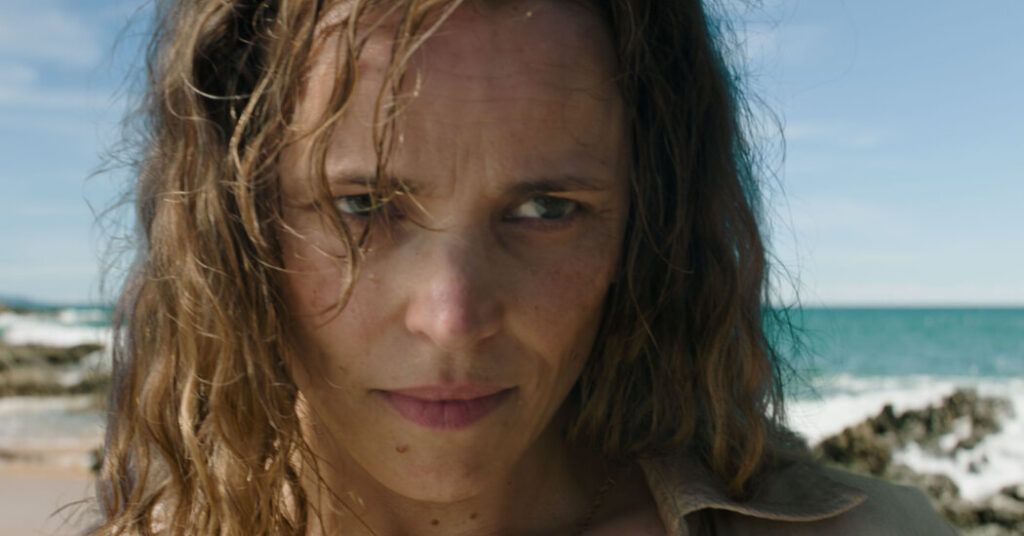
After washing ashore on what is by all appearances a deserted island, Linda Liddle does exactly what you expect.
Standing cautiously, the surf frothing at her feet, she considers the horizon, uncertain if she’s in a paradise or a prison.
It’s at this moment that Linda Liddle, the undersung executive played by Rachel McAdams in “Send Help,” joins the deep roster of cinematic castaways, each taking in their new surroundings in the same stunned fashion.
This premise has been used over and over ever since “Robinson Crusoe,” Daniel Defoe’s 1719 colonialist fable, became a literary sensation. There are variations of it in everything from beloved sitcoms (“Gilligan’s Island”) and romantic crowd-pleasers (“Six Days, Seven Nights”) to art house provocations (“Triangle of Sadness”), war movies (“Heaven Knows, Mr. Allison”) and sci-fi blockbusters (“The Martian”). Because “Send Help” is a Sam Raimi film, revolting flourishes qualify it as horror.
Almost all the films turn into survivalist obstacle courses with escalating challenges: find potable water, make a shelter, build a fire, hunt for food. Even after accomplishing these and hardening into sunburned icons of perseverance, movie castaways all contend with another variable: whether they are by themselves. What if you’re stuck with a political rival? A potential lover? A monkey or robot? Your family?
These films pose different answers to the same question: Is it better to be stranded alone?
1964
‘Robinson Crusoe on Mars’
Rent it on most major platforms.
Substituting the Caribbean tropics with the desert-like environs of the red planet, “Robinson Crusoe on Mars” is despite its otherworldly setting a charmingly ham-handed adaptation of Defoe’s novel. Instead of Crusoe’s talking parrot, a milestone in the Englishman’s pursuit of civilization, there’s a monkey dressed in a miniature spacesuit, complete with a hole for its tail. The movie is endearing in a way that is characteristic of midcentury sci-fi, even if it blunts some of the novel’s more pointed social aspects.
1964
‘Woman in the Dunes’
Rent it on most major platforms.
There is no island in Hiroshi Teshigahara’s cryptic “Woman in the Dunes.” There’s barely any water at all. Just sand, which accumulates everywhere and on everything. The Japanese-language film is set in a cavernous sand pit, which obscures the horizon in all directions. Evidently to avoid becoming engulfed by the landscape, the woman of the title awakens every night to shovel sand out. She’s joined by a stranded tourist who’s soon put to work. Is this about marriage? The working class? Both? Whatever the answer, it’s clear that both characters become resigned to their isolation, certain that the world around them is vanishing.
1969
‘Hell in the Pacific’
“Restraint” is not what first comes to mind with a John Boorman movie. His work ranges from the brutal backwoods action tale “Deliverance” to “Zardoz,” which immortalized Sean Connery in a tomato-colored, suspenders-and-briefs ensemble.
So the director is a curious choice for something as rigorous and understated as a film set on a deserted island with only two actors. Both are played by genre stalwarts: Lee Marvin and Toshiro Mifune in his second English-language role. Naturally, they symbolize opposing forces in the middle of World War II. For the first hour they barely speak to each other. By the end, they’ve grown beards (this movie has remarkable beard continuity) in an indirect acknowledgment of solidarity.
1975
‘Swept Away’
Rent it on most major platforms.
Lina Wertmüller is among cinema’s thorniest provocateurs, especially when armed with the actor Giancarlo Giannini. Descriptions of their films sound paradoxical: “Seven Beauties,” a comedy set in a concentration camp; “Love and Anarchy,” a romance and an assassination plot; or this film, about a communist and a capitalist stuck on a sun-kissed Mediterranean island.
In “Swept Away,” Giannini has been hired as a crewman on a yacht leased by rich vacationers, the most outspoken of which is a woman (Mariangela Melato, another Wertmüller regular) who constantly berates him. The arrangement becomes combustible after the pair become stranded on the island. The man thrives, abandoning his employer to fend for herself. The woman, deprived of food and water, crawls to him on her hands and knees, subservient to each of his increasingly hostile demands.
2000
‘Cast Away’
With its overt sentiment and top-shelf effects work, “Cast Away” is indisputably a Robert Zemeckis film, at least at the beginning and end. It’s the middle — one of the sparest, most brazenly austere segments in any big-budget Hollywood movie — that doesn’t fit this description.
For more than an hour there is nothing much more than Tom Hanks, the lone survivor of a plane crash that can be described as “impressive,” and the small island he’s been stuck on for years. When he builds a fire, it feels arduous. And after he finally succeeds, ecstatic. Zemeckis doesn’t overdramatize these scenes, as evidenced in the relationship between Hanks and his ever stoic, handmade companion, a volleyball named Wilson, both a comedic foil and reliable empath. Zemeckis shows his hand again toward the end: when the music swells as Wilson drifts helplessly into the Pacific, you may sob like Hanks does.
2019
‘Portrait of a Lady on Fire’
Céline Sciamma’s period romance isn’t a castaway movie per se. The island is only mostly deserted. But when a young portrait artist arrives there she’s abruptly deposited on one of its craggy beaches as though she’s been abandoned. Alone, she treks inland with her materials, toward anything that resembles civilization.
Sciamma’s film has the contours of a castaway story, starting with isolation, culminating in perseverance. These elements foster the burgeoning infatuations of the artist and the noblewoman whose portrait she’s been commissioned to paint. When they first meet, they are guarded, probing each other with stolen glances during walks along those craggy beaches. The landscape soon summons a profound longing within them, and before long it feels less secluded, more like the center of the universe.
Rumsey Taylor is an assistant editor. He works across multiple desks as a visual editor, designer and engineer.
The post Sullen and Sunburned: The Tradition of Castaways at the Movies appeared first on New York Times.