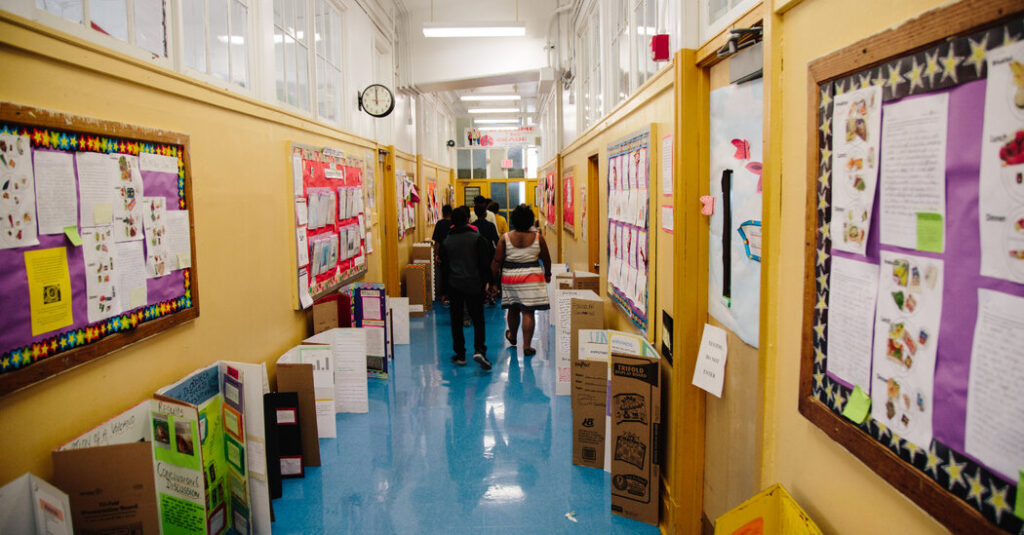
Chris Phillips’s son was struggling to stand out in his crowded New York City classroom.
But this fall, his diverse campus, Public School 9 in Prospect Heights, Brooklyn, hired almost a dozen new elementary teachers. Classroom rosters fell from 32 students to 20.
Quickly, the fifth grader began to have more face time with his teacher and richer conversations with his classmates. He even seems more excited about school.
“When I saw it in action, I was thrilled,” his father said. “I’m worried about the city and state’s ability to keep it going.”
There’s good reason for his concern. While Mayor Zohran Mamdani wants to replicate the experience at P.S. 9 in schools across New York City, making that happen in all corners of the nation’s largest education system will be a formidable task.
To pull it off, his administration will need to hire more than 10,000 new educators — it has 75,000 already — even as the state’s new teacher pipeline dries up. And the price tag is steep: Mr. Mamdani needs up to $700 million in additional funding, according to the city’s Independent Budget Office.
Other big ticket items that anchor the mayor’s ambitious agenda are well-known: free bus service and universal child care, for example. But the quest to reduce class size, and the state law that mandates it, has largely played out beyond the spotlight.
A state law requires New York City to decrease the size of public school classes to 25 students or fewer, depending on the grade. The deadline to comply is only two years away.
The mayor’s predecessor, Eric Adams, often complained that fulfilling the class size mandate would require New York to take on huge costs including more than $15 billion in construction.
But Mr. Mamdani has forged ahead, even as some education leaders call on him to push for changes to the law. He made it a top priority of his education agenda, promising that children would no longer be “fighting for the attention of a teacher” in his administration.
The issue of class size has helped fuel teacher strikes in cities including Los Angeles and Minneapolis. More than 20 states mandate caps on class sizes. But the law in New York City goes further than most.
The implementation of the class size law has highlighted long-running tensions in the school system. Some elite schools are overcrowded because middle-class families have clamored for seats while other schools have empty classrooms.
Will Mr. Mamdani cap enrollment at the most in-demand schools, a move that would make it even tougher to gain admission?
Even before he took office, Mr. Mamdani received a crash course in the complicated politics of running a school system with an enrollment that exceeds the populations of four states. On the campaign trail, he issued frequent calls to end mayoral control of schools. But the day before he was inaugurated, he backed down on that pledge, which had been the biggest pillar of his blueprint for schools.
A shift in his stance on class size could threaten his alliances with labor unions, teachers and public school families, with whom the mandate is broadly popular.
But his other priorities, such as making the city the first in the United States to offer free universal child care for all children younger than 5, will also come at a significant cost. And Mr. Mamdani needs to close a $12 billion municipal budget gap.
“The class size law runs right into that,” said Andrew Rein, the president of the Citizens Budget Commission, a budget watchdog group.
“He’s got to make some hard choices,” Mr. Rein said of the mayor.
The class size law generated discord from the outset. Research shows that smaller classes can help students, though the extent — and whether there are more cost-effective ways to improve education — remains hotly debated. Children from poorer families stand to benefit most.
But to make the city’s classes smaller, New York will run into a tough hiring landscape. Enrollment in university education programs in the state, the incubator of new teachers, has declined more than 50 percent during the last 15 years.
And then there are concerns over retention. Could a hiring spree at well-off schools draw top talent away from struggling sections of the system — and reduce the benefits of small classes at less-advantaged schools?
“We have to look at the equity issue,” Betty A. Rosa, the New York State education commissioner, said at a state budget hearing last month.
Chris Caruso, the managing director for school-age children at Robin Hood, an antipoverty organization, said that the pursuit of smaller classes was laudable. But as Mr. Mamdani confronts tight budgets and “competing, expensive priorities,” he said that the state should rethink the law.
“A rigid mandate can look progressive on paper, but really operate regressively in practice — by pulling money and experienced teachers toward schools with fewer needs,” said Mr. Caruso, a former high-level official in the city’s Education Department.
For its part, the Mamdani administration insists that it remains committed to shrinking class sizes. The schools chancellor, Kamar Samuels, said that class size would be an “incredibly important” issue even without a mandate: “For me, it’s not about a law.”
The mayor wants to provide $12,000 a year in tuition benefits for 1,000 college students who commit to teaching in the city’s public schools for three years.
But the clock is ticking.
By September, 80 percent of classrooms across New York City must comply with the law. The target remains distant: This fall, just under 65 percent met the class size requirement. But to do that, the city had to grant a significant number of exemptions.
(Under the law, unions and the chancellor can approve temporary exemptions for schools, but the process is opaque.)
The influence of the educators’ union, the United Federation of Teachers, in the State Legislature was key to securing the law’s passage. Michael Mulgrew, the union’s president, maintained that much of the hiring is “really not as big of a challenge as people think,” though he acknowledged new construction would take time.
For educators, small classes remain a leading priority. Many say that a dozen extra students can make it impossible to give students personalized attention.
In Brooklyn, Sean Caffrey-Agoglia, a special education teacher at John Dewey High School, said that he saw more fruitful discussions and participation when his class roster was whittled from 34 students to 25. “It’s easier to make sure that nobody falls through the cracks,” he said.
In Manhattan, a worried mother asked Bethany Trench — who now teaches 18 children at P.S. 199 after leading as many as 28 — about her child’s reading struggles less than two weeks into the fall semester. Ms. Trench offered specific examples of his strengths and weaknesses.
“I would have never in 15 years of teaching been able to answer that question in that much depth on the tenth day of school,” Ms. Trench said.
For hundreds of other schools, including many of the city’s most sought-after selective options, the changes at schools like John Dewey and P.S. 199 would be impossible today: They simply lack space.
Take Townsend Harris High School in central Queens. The school is considered a jewel of the public education system in parent circles, counting at least three Nobel laureates and a smattering of Pulitzer Prize winners among its alumni. For every freshman seat, it receives more than 15 applicants.
Many of its social studies and science classes hold more than 30 students. “We are already using spaces that are traditionally used for office spaces as classrooms,” Brian Condon, the principal at Townsend Harris, told the student newspaper, The Classic.
“Where else am I going to put classes? In the hallways?” Mr. Condon asked, questioning whether a school like his, where reading scores and graduation rates are already high, should be asked to shrink its classes.
There is another option: Popular schools could accept fewer students.
That’s the advice of some parents and advocates, who hope that capping enrollment at some overcrowded schools leads to the migration of students to small schools nearby. Mr. Mulgrew said that he wasn’t in favor of the idea. And many families warn that limiting access to popular programs could drive them away from the public school system.
How Mr. Mamdani navigates these questions, and the broader rollout of smaller classes, could be among the most consequential factors shaping his relationship with public school parents.
Many will be watching closely.
New York City’s admissions season just wrapped up, and Mr. Phillips, the father in the Prospect Heights neighborhood of Brooklyn, spent months touring middle schools and diving into data on their academics and culture.
Among the biggest factors for his family when ranking schools? Small class sizes.
“To me, this is essential,” Mr. Phillips said.
Troy Closson is a Times education reporter focusing on K-12 schools.
The post Smaller N.Y.C. Classes Will Cost Millions. Can Mamdani Pull It Off? appeared first on New York Times.