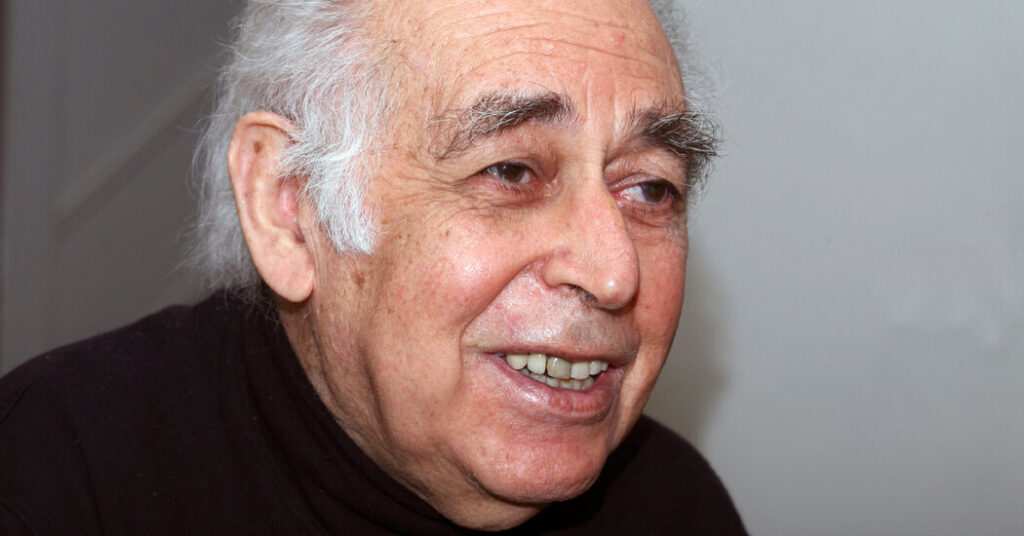
Roland Huntford, a journalist and historian who wrote about the world’s polar extremities and the men who explored them, including a book that challenged the previously undisputed heroic status of Robert Falcon Scott for his doomed expedition to the South Pole in 1912, died on Jan. 23 in Cambridge, England. He was 98.
His death was announced by the Fram Museum in Oslo, which focuses on polar exploration. It did not give a specific location or cause.
Mr. Huntford brought a frosty passion to his work: South African by birth, he later spent 15 years as the Scandinavian correspondent for The Observer, a British newspaper, a job that allowed him to indulge his love for Nordic skiing and winter hiking.
His familiarity with Nordic culture — he spoke fluent Norwegian — first turned him on to the story of the epic race to the South Pole between Mr. Scott, who was English, and the Norwegian explorer Roald Amundsen.
Undeniably one of the last great adventurers from the golden age of the British Empire, Mr. Scott set out in 1910 with a four-man crew to be the first to reach the South Pole but, at a resupply stop in Australia, he learned of Mr. Amundsen’s competing expedition.
Upon reaching the pole in January 1912, Mr. Scott and his crew found a Norwegian flag already planted there; Mr. Amundsen had placed it only a month before. Crestfallen, they set out to return home but died of exposure just 11 miles before reaching a cache of supplies.
Mr. Scott nevertheless received a posthumous hero’s welcome in Britain, where stories of his resolve and selflessness in the face of death fit with the British archetype of the gentleman adventurer. Though Mr. Amundsen was lauded in his home country, it was the rare case where the runner-up got the glory while the winner was largely ignored, at least in the English-speaking world.
Published in 1979, Mr. Huntford’s book “Scott and Amundsen” (later retitled “The Last Place on Earth”) sent shock waves through Britain by poking holes in Mr. Scott’s previously incontestable heroic narrative.
He argued that Mr. Scott had failed to prepare adequately for the grueling trip and made critical errors, including his decision to use horses instead of dogs to pull their sleds. Mr. Huntford also claimed that Mr. Scott had persuaded his surviving teammates to die with him in the cold instead of return home in shame.
Critics praised the book as gripping and thorough — Robert R. Harris in The New York Times called it “one of the great debunking biographies” — but Mr. Scott’s partisans were livid. His son, Peter, sued Mr. Huntford for libel, based on a sentence in the book’s acknowledgments thanking him for access to his father’s papers. Mr. Scott said the sentence implied that he approved of the book as a whole.
The two sides reached a settlement with a disclaimer, appearing in subsequent editions, that made clear Peter Scott disapproved of the book.
Separately, Mr. Huntford said, the Scott Polar Research Institute, a part of the geography department at the University of Cambridge, barred him from accessing its archives after the book appeared, which made it hard for him to proceed with further projects.
Mr. Huntford denied that there was anything biased about his approach. “In as much as I had an agenda, it wasn’t to run down Scott,” he told The Guardian in 2008. “Rather, it was to rehabilitate Amundsen, who I felt had never been given the credit he deserved outside Norway.”
Mr. Huntford’s life itself followed an adventurous trajectory. He was born Roland Horowitz on Sept. 4, 1927, in Cape Town, and said he was the son of a British Army officer and a Russian mother who had fled the Communist Revolution of 1917.
However, Ranulph Fiennes, another polar historian who wrote his own, decidedly pro-Scott book, claimed that in researching Mr. Huntford’s background, he found the author’s parents were Lithuanian immigrants and that he had changed his surname to to Huntford in his 30s.
Mr. Huntford studied engineering at Imperial College London but was asked to leave after two years; he told Mr. Fiennes, who had interviewed Mr. Huntford, that he was happy to go, as he found British-style scientific training too narrow-minded and that he was “a bit fed up with London at that time.”
He traveled around Europe, trying to write a novel. During a return visit to London, he met a Dane who turned him on to the Norwegian playwright Henrik Ibsen, insisting he read his work in the original.
Mr. Huntford learned Norwegian and was soon traveling to Scandinavia frequently, especially after finding a job in Switzerland with the U.N. High Commissioner for Refugees.
In the early 1960s, he convinced the sports editor at The Observer to let him write about skiing, an assignment that turned into a full-time post as the paper’s Scandinavia correspondent.
His 1971 book, “The New Totalitarians,” was a scathing critique of the social-welfare system in Sweden under the political party that had dominated for decades, comparing the policies with the dystopia portrayed in Aldous Huxley’s novel “Brave New World.” The English author Paul Britten Austin, writing in the Times Book Review, called Mr. Huntford’s book “the first detailed critique and expose of the Social Democratic regime” and “a major study by an unsympathetic observer of Swedish social democracy in all its aspects.”
Mr. Huntford’s first marriage ended in divorce. He married his second wife, Anita, a Swedish woman, in 1966. She died in December. Survivors include their two sons, Anthony and Nicholas.
In 1974, Mr. Huntford profiled the only Norwegian man on Mr. Scott’s polar team, Tryggve Gran, who had stayed behind at base camp and whose story about Mr. Scott conflicted with the accepted British narrative. Intrigued, Mr. Huntford moved to Cambridge and began work on “Scott and Amundsen.” A British TV mini-series based on the book aired on PBS’s “Masterpiece Theater” in 1985, starring Martin Shaw as Mr. Scott and Sverre Anker Ousdal as Mr. Amundsen.
Mr. Huntford wrote two more books in what he called his Antarctic cycle — a 1985 biography of another British polar explorer, Ernest Shackleton, and a 1997 biography of Fridtjof Nansen, a Norwegian polar explorer and peace activist.
Mr. Huntford also wrote “Two Planks and a Passion: The Dramatic History of Skiing” (2008) and an unpublished novel that speculates about what would have happened had Mr. Scott lived to tell his side of the story.
Clay Risen is a Times reporter on the Obituaries desk.
The post Roland Huntford, Lore-Debunking Historian of Polar Exploration, Dies at 98 appeared first on New York Times.